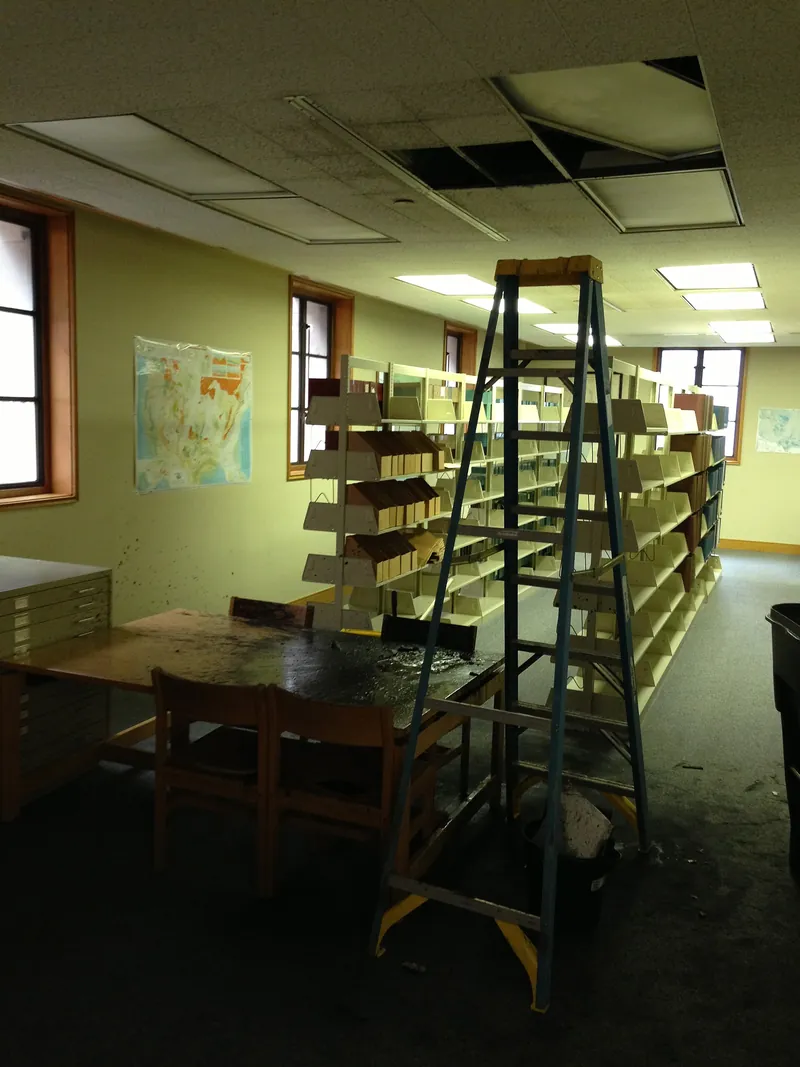
The short version
Ceiling water damage in California starts with cutting power to the room and placing a bucket beneath the lowest point of the sag, then opening it from the side so water drains slowly. After that, the timing of the drips separates a rain leak from an AC line or an upstairs bathroom. Soft drywall is replaced.
On this page (12)
- What do I do first if my ceiling is dripping or bulging?
- What are the warning signs of a ceiling that may fall?
- How can I tell whether a ceiling stain is active?
- How do I trace where a ceiling leak starts?
- Why did my ceiling start leaking with the season's first big rain?
- Could the bathroom above be the source of my ceiling stain?
- Might attic equipment such as an AC or water heater be leaking?
- When can a damaged ceiling stay, and when does the drywall go?
- How can I prevent mold on a ceiling that got wet?
- Will a California homeowners policy cover a damaged ceiling?
- How much does it cost to repair a water-damaged ceiling?
- Which trade should I phone first for a ceiling leak?
What do I do first if my ceiling is dripping or bulging?
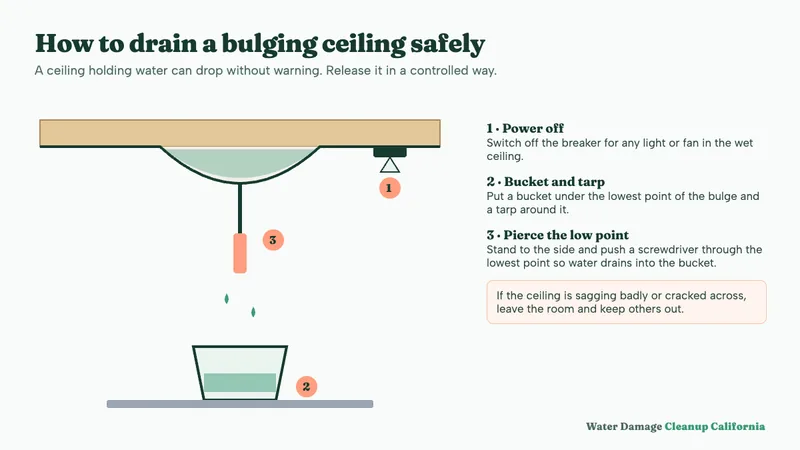
Cut the electricity to that section of the house, then release the trapped water in a controlled way. Soaked drywall is heavy and can fall with no warning, so follow the order below and never stand beneath a bulge. Hunt for the source only after the room is safe.
- Turn off the breaker for each light, fan and outlet beneath or beside the wet spot.
- Clear the floor. Take out rugs, electronics and small furniture, and drape a tarp over whatever stays.
- Set a bucket beneath the bulge's lowest point.
- Punch one small hole at that low point with a screwdriver, standing off to the side so the water drops into the bucket.
- Shut off the supply. When a pipe or fixture overhead is feeding the leak, close its valve or the main shutoff.
- Record photos and video before any cleanup, then phone your insurance company.
Unsure where the water shuts off? The prevention guide lists the usual valves, and the water damage repair page describes what follows once the flow ends.
What are the warning signs of a ceiling that may fall?
Ceilings tend to warn before they fail. Watch for a bulge that keeps enlarging, cracks creeping along seams, joint tape peeling away, screw heads poking through the paint, or a patch that feels soft. If you see any of these, everyone should leave the room and stay out.
- A bulge in which the water seems to shift when the ceiling is tapped from the side.
- Fresh cracks tracing a seam or ringing a light or fan.
- Drips starting at several points together.
- Paint or texture that has blistered and hangs down in a sheet.
A small bulge can be released using the low-point method above. A whole panel that droops or splits is another matter: close the door, leave the power off in that room and get help. Never reach up and poke a big sag.
How can I tell whether a ceiling stain is active?
A new stain is cool and damp to the touch, darkest at the center and expanding over a few days. An old one is dry, edged in firm brown or yellow and stays put. Nested rings point to a leak that has come back more than once.
- Press lightly around the stain. Drywall that yields like a sponge is still wet.
- Outline the edge in pencil, then check again after the next storm, shower or AC cycle. If the stain passes the line, the leak is live.
- Measure moisture with your own meter, or ask a restoration team for readings.
After a repaired leak leaves a dry mark, stain-blocking primer and paint will cover it. A damp stain means water is still entering, so locate the source before any cosmetic work. Stains elsewhere in the house are covered in the signs of water damage guide.
How do I trace where a ceiling leak starts?
Note exactly when the water appears. Timing narrows the source before anyone cuts into drywall, and the table below pairs each pattern with the trade that normally repairs it. Water also runs along joists, wires and pipes, so a stain can sit far from the actual leak.
| What you notice | Likely cause | Who handles it |
|---|---|---|
| Stain shows up during or after rain | Roof surface, flashing, a vent boot, a skylight or a window overhead | Roofer |
| Water appears while the AC runs | Clogged condensate line or a pan overflowing beneath an attic air handler | HVAC technician |
| Drips after a shower upstairs | Shower pan, tub overflow, tile grout or drain seal | Plumber |
| Drips after the upstairs toilet is flushed | Wax ring or supply line | Plumber |
| Water near an attic water heater | Tank, fittings, relief valve line or a drain pan that has filled | Plumber |
| Constant, day and night, in dry weather | Pressurized supply line or fitting | Plumber, once the main shutoff is closed |
Even a single-story house has an attic or roof space over each ceiling, so equipment up there and the roof explain many stains. Restoration teams differ in what they take on, so confirm before booking.
Why did my ceiling start leaking with the season's first big rain?
Following a long dry spell, tiny roof openings go unnoticed until heavy rain tests them. Cracked sealant, a raised shingle or loose flashing can each admit water. Insulation absorbs it first, so the stain may not appear until hours or days after the storm.
California's rainy season frequently comes in a handful of large storms. NOAA reports that roughly 30 to 50 percent of annual precipitation in the West Coast states falls during just a few atmospheric river events, so a roof can go from dry to tested over one weekend. The atmospheric river guide describes these storms.
The roof leak and storm damage page lays out the sequence of events; keep a tarp or bucket ready ahead of the next system. A roofer fixes the opening. Drying the ceiling first only helps if no further water is getting in.
Could the bathroom above be the source of my ceiling stain?
It could. In a two-story house, the floor beneath a shower, tub or toilet sits right over a ceiling. A cracked shower pan, a tired drain seal or a weeping supply line can drip for weeks inside the floor cavity before any stain shows on the level below.
- Run only the shower for a few minutes, then inspect the ceiling, to separate it from the toilet and sink.
- Check for soft flooring, loose tile, or caulk pulling away along the tub edge.
- A leaking supply line keeps the stain growing even when nothing is being used.
Avoid using that bathroom until a plumber finds the source. What the floor above may need is covered on the bathroom and kitchen water damage page. These leaks stay out of sight, so the ceiling below often hides damage older than it appears.
Might attic equipment such as an AC or water heater be leaking?
It might, if either unit lives in your attic. An air handler pulls moisture from the air and drains it through a condensate line. When the line clogs, the pan fills and then overflows onto the ceiling. An attic water heater can drip from its tank, a fitting or the relief valve line.
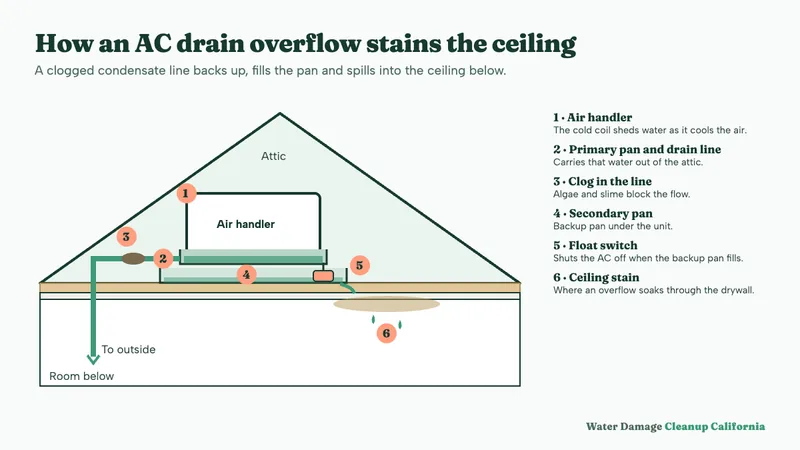
AC leaks track the cooling cycle, worsening while the system runs and easing when it stops. If water drips from the unit, switch it off and call an HVAC technician. For a heater leak, close the cold water valve atop the tank and turn the gas control or breaker off.
The water heater leak page lists the shutoff steps in order, and it also applies if your unit sits in a garage.
When can a damaged ceiling stay, and when does the drywall go?
A minor leak of clean water can often be dried out and repainted. Drywall that has gone soft, drooped or started crumbling has lost its strength and is cut out. Two factors decide the call: how long the material stayed wet and how clean the water was.
The IICRC S500 standard sorts water into three categories, and that rating counts as much as the visible damage. A supply line or roof leak is normally cleaner than water from a drain or a flood.
| Ceiling condition | Usual approach | Reason |
|---|---|---|
| Dry ring left by an old, repaired leak | Prime and paint | The material is intact and the source is gone |
| Damp yet still firm after a clean leak | Dry where it is, then verify with a meter | Drywall that held its shape can often dry |
| Soft, drooping or cracked | Cut out and swap | Soaked gypsum loses its strength |
| Soaked insulation overhead | Pull the insulation, open the ceiling, dry the framing | Trapped water keeps the cavity damp |
| Drain water, sewage or flood water | Take out the affected material | IICRC S500 calls it Category 3, grossly contaminated |
Prior to closing up or painting, a restoration team should test the drywall and framing with a moisture meter. Paint on damp drywall seals the moisture in, and the stain tends to come back.
How can I prevent mold on a ceiling that got wet?
Speed is the answer. To prevent mold growth, the EPA advises drying water-damaged areas and items in the first 24 to 48 hours. The California Department of Insurance says to locate and stop leaks at their source, then dry and dehumidify the wet areas.
- After the leak stops, run fans and a dehumidifier and hold indoor humidity under 60 percent, ideally 30 to 50 percent, as the EPA recommends.
- Take out soaked insulation and soft drywall rather than waiting for it to dry.
- Never paint or caulk over a moldy spot; the EPA warns against it.
According to the EPA, a moldy area under about 10 square feet can in most cases be handled by the homeowner. Bigger patches, or mold that arrived with sewage or flood water, need a professional. The rest is in the mold after water damage guide.
Will a California homeowners policy cover a damaged ceiling?
Frequently, if a covered cause produced the water. According to the NAIC, damage from a home's plumbing or a roof leak is typically covered, but damage from ground water or rain runoff is not. The California Department of Insurance cites a roof opened by wind as a covered example.
Triple-I adds that policies exclude damage from lack of maintenance, and mold is often excluded too. Your policy wording has the last word, so ask your agent which cause fits your leak.
- Report the damage promptly, as the California Department of Insurance advises.
- Photograph or film the ceiling, and per Triple-I keep damaged items until the adjuster has seen them.
- Insurers must acknowledge a claim within 15 calendar days and accept or deny it within 40 calendar days after proof of claim (10 CCR 2695.5 and 2695.7).
The insurance claim guide walks through the full process. Triple-I reports that water damage and freezing claims averaged $15,400 across 2019 to 2023.
How much does it cost to repair a water-damaged ceiling?
Bob Vila's cost guide gives $350 to $1,250 for ceiling repair. It is a national figure built on Angi and HomeAdvisor data and leaves out the cost of fixing the source. California prices and your scope will vary, so treat it only as a sanity check on a quote.
- Extent of damage: a single stained patch or a whole room of drywall.
- Insulation: soaked insulation adds removal and replacement.
- Finish: matching texture, priming and painting add steps.
- The source: a roofer, plumber or HVAC technician bills apart from the ceiling work.
Fixr puts drywall restoration at $1.50 to $3 per square foot, also a national figure. Have a restoration team spell out the scope in writing. What moves the price is explained in the restoration cost guide.
Which trade should I phone first for a ceiling leak?
Begin with whoever can stop the water, then bring in a restoration team for the wet materials. That first call is often a roofer, plumber or HVAC technician. Restoration teams concentrate on drying and removal, and each chooses its own jobs, so ask before anyone drives out.
- Stop the source, or get the right trade to do it.
- Take pictures of the ceiling, the room and any wet contents.
- Ask whether the restoration team records moisture readings before and after drying.
- Ask what it would tear out and what it would try to dry in place.
- Have the scope in writing before work starts.
For water from a burst pipe in the attic or an upper wall, see the burst pipe guide. Whenever you are ready, reach out to us and a local water damage restoration team that serves your area will answer.
Sources: IICRC S500; EPA, A Brief Guide to Mold, Moisture and Your Home; EPA, Mold Cleanup in Your Home; NAIC, Homeowners Insurance; California Department of Insurance, Residential Property Claims Guide; 10 CCR 2695.5; 10 CCR 2695.7; Triple-I, Which disasters are covered by homeowners insurance; Triple-I, Settling insurance claims after a disaster; Triple-I, Homeowners Insurance Facts; NOAA Research, Atmospheric Rivers; Bob Vila, Water Damage Restoration Cost; Fixr, Water Damage Restoration Cost.
Water Damage Cleanup California is the local water damage restoration line and information resource for California. When you call or send a request, it reaches a local water damage restoration team that serves your area. That team confirms whether it can reach you and gives its own scope, price and timing. Confirm them directly before you agree to anything.