For Stockton and Modesto homeowners
For water damage restoration in San Joaquin and Stanislaus counties, shut off the main valve, photograph everything and start drying in the first 24 to 48 hours. River and street flood water is Category 3 and standard policies exclude it. We take requests from San Joaquin and Stanislaus counties.
On this page (8)
- Which San Joaquin and Stanislaus cities and ZIP codes do you take requests from?
- Why is Stockton's flood risk tied to the Delta?
- Could river flooding reach Stockton neighborhoods?
- Does Modesto flood when it rains hard?
- How do Stockton and Modesto compare for water damage?
- How are commuter-town homes in Tracy, Manteca and Turlock different?
- Will insurance pay for river or storm water in Stockton?
- What should I do in the first 24 to 48 hours?
Which San Joaquin and Stanislaus cities and ZIP codes do you take requests from?
Requests for water damage restoration in San Joaquin and Stanislaus counties come from San Joaquin County and Stanislaus County. In San Joaquin that means Stockton, Lodi, Manteca, Tracy, Lathrop, Ripon and Escalon. In Stanislaus it means Modesto, Turlock, Ceres, Oakdale and Riverbank. A restoration team confirms whether they can reach you when they call. City pages cover Stockton and Modesto.
The two cities are 24 miles apart, according to Wikipedia, but they sit on different rivers. Stockton is on the San Joaquin at the edge of the Delta. Modesto lies between the Stanislaus and Tuolumne rivers. For the cities north and east, see Sacramento County, and for the ones south, Fresno County.
Why is Stockton's flood risk tied to the Delta?
Stockton sits at the southeastern corner of a large inland river delta, according to Wikipedia. Much of that land was drained and diked for farming, and it now depends on levees. When a levee fails, the water has little room to go anywhere else.
Here is what Wikipedia's Delta article records:
- The Delta has about 57 reclaimed islands and tracts, ringed by 1,100 miles of levees.
- Peat soil has sunk by up to 25 feet since the late 1800s, and much of the western and central Delta is at least 15 feet below sea level.
- There have been over 160 levee failures since 1900, including a breach in June 2004.
Your street is not on a Delta island, but the pattern explains why local agencies talk so much about levees. The IICRC S500 standard puts rising river water in Category 3. Read flood damage restoration for what that means for cleanup.
Could river flooding reach Stockton neighborhoods?
A federal study says it could. Wikipedia reports that a 2018 federal study predicts San Joaquin River flooding could put much of Stockton under 10 to 12 feet of water if the levees are not upgraded. That is a warning about a worst case, not a forecast for a given street.
The county article adds that San Joaquin County has a very flat drainage basin and an exceptionally high water table, with a tendency to flood in spring with Sierra snowmelt runoff. The first people here knew it. The Yatchicumne built villages on low mounds to keep homes above regular floods.
Find out whether your address sits in a mapped flood zone before you buy or insure. Our guide to buying a water-damaged house explains what to ask a seller, and the atmospheric river page covers the storms that feed the rivers.

Does Modesto flood when it rains hard?
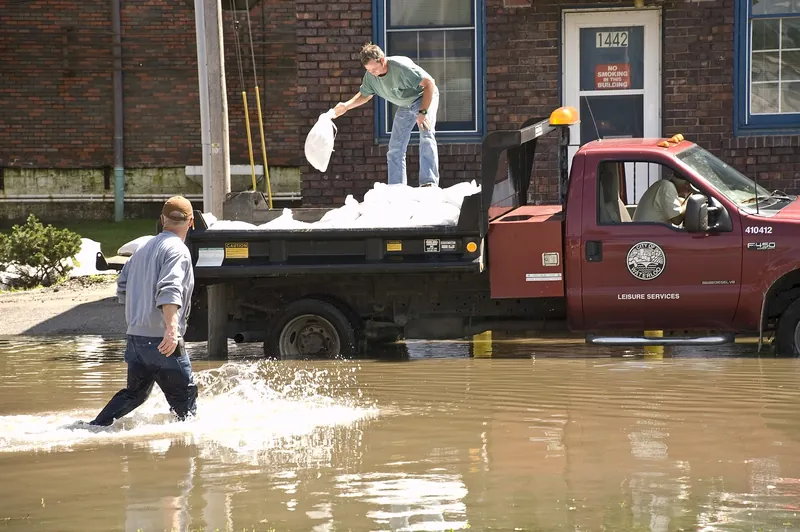
Streets can. Wikipedia says Modesto does not have a full storm sewer system, and many streets flood during winter rain storms. Its rain usually arrives from atmospheric rivers or bomb cyclones, and annual rainfall averages 13.11 inches, mostly in winter.
The city lies between the Tuolumne and Stanislaus rivers, and Dry Creek empties into the Tuolumne. A flooded street can push water toward garages, thresholds and low doors. Wikipedia does not say which neighborhoods flood, so do not assume yours does or does not.
After a storm, look at the lowest door, the garage and any crawl space. See the after-storm checklist and roof leaks after storms. Surface water that enters from outside is not a plumbing leak.
How do Stockton and Modesto compare for water damage?
They share a valley but not the same worries. Stockton's story is levees and river water, while Modesto's is rain on streets and a hot, dry summer. The table lays out the numbers each Wikipedia article gives, side by side, so you can see where your own worries should start.
| Topic | Stockton | Modesto |
|---|---|---|
| 2020 census | 320,804 | 218,464 |
| Average yearly rain | 13.45 inches, nearly 95 percent from October to April | 13.11 inches, mostly in winter |
| Afternoons at 90 degrees or above | 88 | 79 |
| Water worry | Levees and the San Joaquin River | No full storm sewer system |
Both articles mention winter tule fog, which slows drying outdoors. Read indoor humidity after a leak for what to do inside.
How are commuter-town homes in Tracy, Manteca and Turlock different?
Many were built fast. Wikipedia says San Joaquin County has grown through long-distance commuters priced out of the Bay Area, and that about 10 percent of its residents commute 90 minutes or more each way. Newer homes and older farmhouses can sit on one road, so check the build date of your own.
The same article names Tracy, Manteca, Lodi and Lathrop as county cities. Stanislaus County's article lists Turlock, Ceres, Oakdale and Riverbank. An owner who commutes may not notice a slow leak for days, which is why a water monitor or a trusted neighbor can help.
If you are away often, read leak monitoring for homes you leave. Renters and condo owners can start with tenant and condo water damage.
Will insurance pay for river or storm water in Stockton?
Not for flood. The Insurance Information Institute says standard homeowners and renters policies exclude it, and FEMA says most homeowners insurance does not pay flood losses. You would need the NFIP or a private flood policy. Ask your agent which policy you hold and what it names.
The NAIC separates plumbing and roof leaks, which are typically covered, from ground water and rain runoff, which are not. The Triple-I adds that a typical homeowners policy does not cover sewer backup, and flood cover does not either. Ask your agent about an endorsement.
Ring your insurer before you sign and photograph the damage first. The claim guide covers what to photograph, and restoration cost shows the published ranges.
What should I do in the first 24 to 48 hours?
Dry first, argue later. The EPA advises drying water-damaged areas and belongings in the first 24 to 48 hours so mold does not start, and keeping indoor humidity below 60 percent. Between 30 and 50 percent is the ideal range for a home.
- Close the main valve. Switch off power to wet areas only when you can do so safely.
- Photograph and film every wet surface before cleanup begins.
- Notify your insurer and ask what it needs before repairs.
- Call a restoration team and ask what they will measure and record.
- Stay away from moving water. Ready.gov warns that six inches can take a person off their feet.
The emergency page adds more. For growth that has already begun, see mold after water damage.
Sources: Stockton, California, San Joaquin County, Modesto, California, Stanislaus County and Sacramento-San Joaquin River Delta (Wikipedia); IICRC S500; Triple-I, disasters covered by homeowners insurance; FEMA, flood insurance; NAIC, homeowners insurance; EPA, mold and moisture; Ready.gov, floods.
Coverage
Cities and communities in Stockton and Modesto
Requests come from 34 cities and communities here, covering 70 ZIP codes. The cities with their own guide come first.
Water Damage Cleanup California is the local water damage restoration line and information resource for California. When you call or send a request, it reaches a local water damage restoration team that serves your area. That team confirms whether it can reach you and gives its own scope, price and timing. Confirm them directly before you agree to anything.