For San Francisco residents
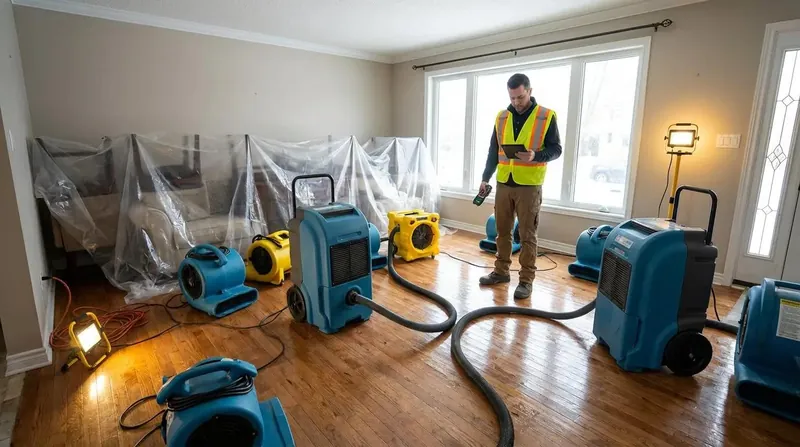
For water damage restoration in San Francisco, CA, begin drying in the first 24 to 48 hours. Shut off the water, photograph each room and report the loss. Homeowners policies exclude flood and earthquake damage. Requests are accepted from every San Francisco ZIP code.
On this page (12)
- Which ZIP codes in San Francisco can send a request?
- How do San Francisco's hills and fog affect water damage?
- Which San Francisco neighborhoods sit on landfill or buried creeks?
- How did the December 2022 storm hit San Francisco?
- Why do San Francisco's Victorian and post-1906 buildings leak?
- Can a quake break pipes and tip water heaters in San Francisco?
- What should each part of San Francisco check first?
- What can a request from San Francisco turn into?
- Do you take requests from towns near San Francisco?
- What should I do in the first hours after a San Francisco leak?
- How does California insurance treat a San Francisco water claim?
- Am I required to hire the restoration team I reach?
Which ZIP codes in San Francisco can send a request?
Requests for water damage restoration in San Francisco, CA are accepted from anywhere in the combined city and county, whether you live in the Richmond, the Sunset, the Mission, Bayview or the Marina. When a restoration team takes your location, the callback itself shows whether your block sits inside their route.
Street-address ZIP codes: 94102, 94103, 94104, 94105, 94107, 94108, 94109, 94110, 94111, 94112, 94114, 94115, 94116, 94117, 94118, 94121, 94122, 94123, 94124, 94127, 94128, 94129, 94130, 94131, 94132, 94133, 94134, 94158 and 94188.
Post office box and unique-user ZIP codes we also accept: 94119, 94120, 94125, 94126, 94137, 94139, 94140, 94141, 94142, 94143, 94144, 94145, 94146, 94147, 94151, 94159, 94160, 94161, 94163, 94164, 94172 and 94177.
For the surrounding region, read water damage restoration in San Francisco and the Peninsula. To test one code, use the San Francisco ZIP finder.
How do San Francisco's hills and fog affect water damage?
Hills decide where water goes. Wikipedia counts more than 50 hills inside city limits, and rain that lands on a steep street runs downhill into whatever sits lowest. Garages, ground-floor flats and basement-level rooms at the bottom of a slope take the runoff first.
Wikipedia puts the average at 73 rainy days and 23.65 inches of rain a year, with the rainy period running November to April.
Fog is a different kind of moisture. Wikipedia says the cool winds and fog come in through the Golden Gate and are less pronounced in the eastern neighborhoods. Damp air can slow drying, and the indoor humidity guide explains what readings mean after a leak.
Which San Francisco neighborhoods sit on landfill or buried creeks?
Several of the most familiar neighborhoods do. Wikipedia says the Marina, Mission Bay and Hunters Point, along with large sections of the Embarcadero, sit on landfill, and that most natural watercourses, including Islais Creek and Mission Creek, have been partly or fully culverted and built over.
That matters for two reasons. Wikipedia notes that filled land tends to be unstable in earthquakes, and that the Marina suffered soil liquefaction in the 1989 Loma Prieta quake. Water that once drained to a creek now moves through pipes and tunnels, so a blocked or overloaded drain pushes water up into the street and lower floors.
Wikipedia also says that, as of 2021, sea levels were projected to rise by as much as 5 feet, bringing periodic flooding and rising groundwater. That is a coastal projection, not a map of your block, so check FEMA's flood map service for an address.
If water comes up through a floor drain or a toilet, treat it as sewage. The sewage backup page explains why that is a job for a professional, and the basement and garage page covers below-grade rooms.
How did the December 2022 storm hit San Francisco?
San Francisco had its second wettest day. Wikipedia's account of the 2022 to 2023 floods says 5.46 inches of rain fell on December 31, 2022, and that US 101 flooded in South San Francisco on the same date, just beyond the city's southern border.
One reason the flooding grew, per that article, is that successive storms outran the soil's ability to soak up water. Wikipedia's atmospheric river entry adds a long-run figure: the Bay Area averages one Category 4 atmospheric river every three years.
When rain gets in, work from the outside in. Look at the roof, skylights, window frames, the garage door and any wall below street level. The roof leak page and the after-storm checklist walk through it, and atmospheric river water damage covers the bigger pattern.
Why do San Francisco's Victorian and post-1906 buildings leak?
Age and repeated patching are the usual causes. Wikipedia says the city's sea of Victorian houses began to take shape after the first cable cars of 1873, and that Pacific Heights features homes built after the 1906 earthquake. Roofs, drain lines and supply pipes there were often repaired rather than replaced.
Before you trust a house, ask the owner, seller or inspector which parts have been renewed. Nothing visible from the sidewalk rules out a pinhole leak inside plaster or beneath a floor.
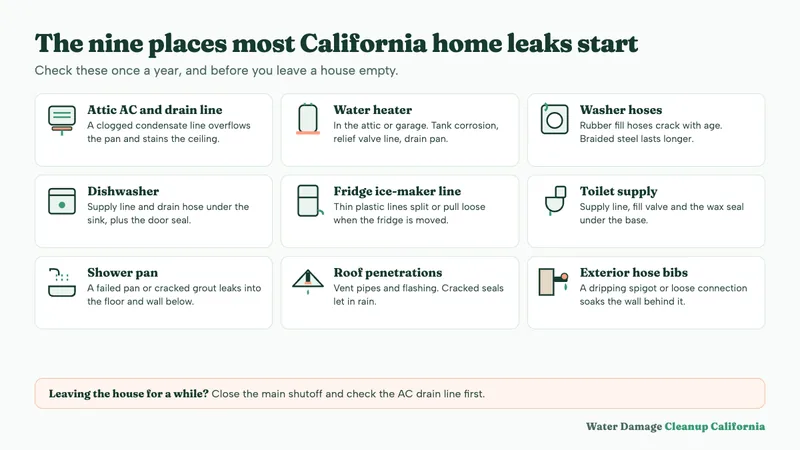
In stacked buildings, a wet ceiling often belongs to the unit above. Start with the apartment building guide and the upstairs neighbor page to see who does what. Condo owners can read about HOA responsibility, and tenants can read renters, landlords and condos.
Can a quake break pipes and tip water heaters in San Francisco?
Yes, and failed plumbing is the usual route to water damage. Wikipedia says the San Andreas and Hayward Faults drive much of the region's quake activity, though neither crosses the city, and that thousands of smaller buildings remain vulnerable to quake damage.
Under Health and Safety Code section 19211(a), California requires water heaters to be braced, anchored or strapped so they cannot fall or slide in a quake. Inspect yours: the straps, the flexible connectors and the floor around the base.
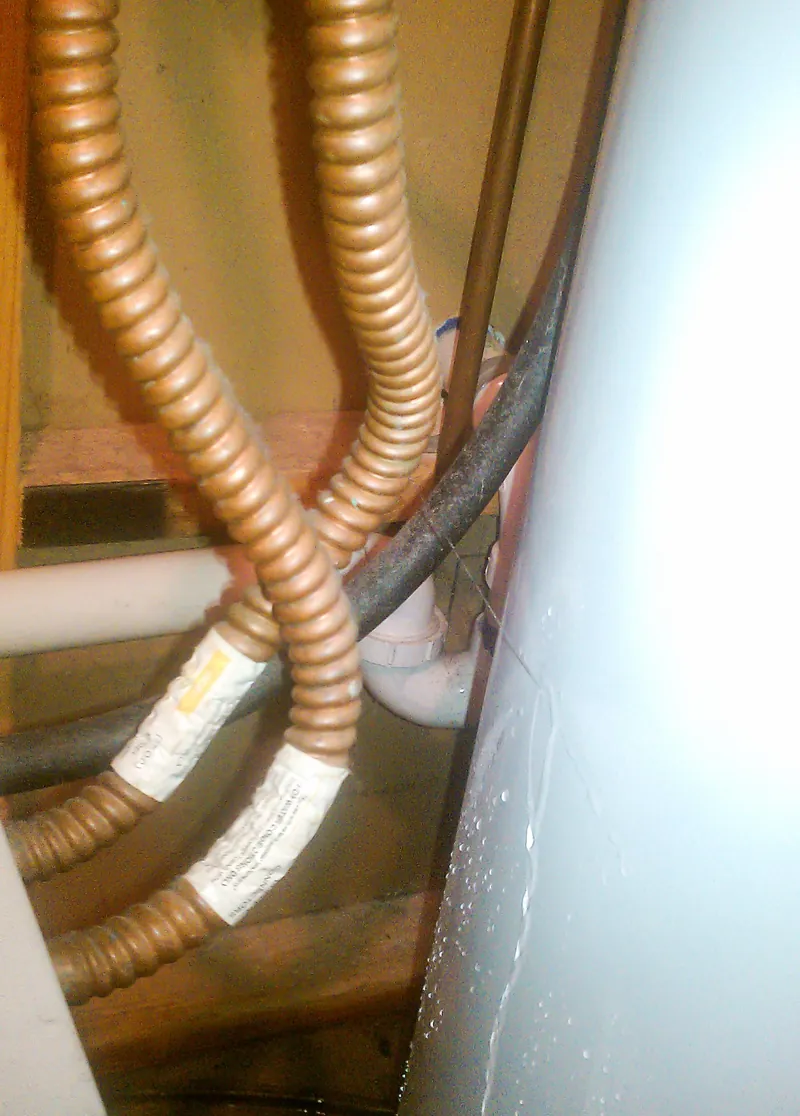

The California Department of Insurance states that homeowners, renters and condo policies exclude earthquake damage, apart from fire that follows one. Water from a cracked pipe is its own question, so read your policy and ask your insurer. The water heater leak page describes what a failing tank looks like.
What should each part of San Francisco check first?
Treat this table as a prompt for your own walk-through, not as a hazard map. The terrain and housing notes come from the sources cited below, and the city, your insurer and your restoration team can confirm what applies to your address.
| Neighborhood type | Source note | Look at first |
|---|---|---|
| Marina, Mission Bay, Hunters Point | Built on landfill | Foundation cracks, floor drains and supply lines after a quake |
| Streets over buried creeks | Islais and Mission Creeks are culverted | Street drains, garage doors and low windows in heavy rain |
| Steep hill streets | More than 50 hills | Gutters, downspouts and retaining walls |
| Victorian and 1906-era blocks | Housing dating to the 1870s and after 1906 | Old supply lines, drain stacks and roof edges |
| Western neighborhoods | Former dunes, later built up | Fog-slowed drying, window flashing and low rooms |
Wikipedia says the west side, once sand dunes it calls the Outside Lands, stayed largely undeveloped until the early 20th century.
What can a request from San Francisco turn into?
Which services you can book depends on the restoration team who accepts your location. Equipment, hours and the jobs a restoration team takes all differ, so settle scope and price with them directly before any work begins.
- For an active leak or storm intrusion: emergency water damage help.
- For standing water: water removal and extraction.
- For soaked walls, subfloors and framing: structural drying.
- For belongings that must leave the unit: contents cleaning and pack-out.
- For shops, offices and rental buildings: commercial water damage.
Tight blocks raise practical questions. Ask how a restoration team deals with street parking, stairs and shared hallways, and how they prove materials are dry before closing walls. Rebuilding afterward is covered on the water damage repair page.
Do you take requests from towns near San Francisco?
Yes. Daly City, Brisbane and South San Francisco lie to the south and are handled through the Peninsula hub page. North across the Golden Gate, Sausalito and Belvedere Tiburon fall under the North Bay page.
East of the bay, Oakland has a page of its own, and the Alameda County hub handles the rest of that shore. Range depends on the restoration team, and the ZIP code you enter is what routes your request.
What should I do in the first hours after a San Francisco leak?
Stop the water, keep people safe, then begin drying. The EPA recommends drying wet areas and belongings in the first 24 to 48 hours to prevent mold, and says contaminated water such as sewage needs a professional. Work through this order.
- Shut the main water valve, or the one at the leaking fixture.
- Cut power to wet rooms only if you can reach the switch without standing in water.
- Photograph every wet room before anything is moved.
- If the source looks like a neighbor's unit, tell the building manager or landlord in writing.
- Call your insurer, then ask a restoration team how they will measure drying.
More detail lives in the what-to-do guide, and the mitigation page explains why speed counts.
How does California insurance treat a San Francisco water claim?
According to the California Department of Insurance, homeowners policies exclude flood damage but cover other water damage, such as rain entering through a roof opening caused by a covered event. Where the water came from decides which side of that line your loss lands on.
The state also puts the insurer on a clock. 10 CCR 2695.5 requires acknowledgment of a claim within 15 calendar days, and 10 CCR 2695.7 requires an accept-or-deny decision within 40 calendar days of proof of claim, with any denial in writing.
The NAIC says damage from ground water and rain runoff is typically not covered. The steps, in order, are in the insurance claim guide.
Am I required to hire the restoration team I reach?
Asking for a call does not oblige you to hire anyone. Each restoration team states its own availability, scope and price, and you can compare before you decide. Check the contractor license on the Contractors State License Board site before you sign.
Availability, scope and price get confirmed on the call with a restoration team who accepts your location. No response time, insurance handling or outcome is promised here. See how a call works and the guide to choosing a restoration company first.
Sources: San Francisco, 2022 to 2023 California floods and Atmospheric river (Wikipedia); Health and Safety Code 19211; California Department of Insurance, Residential Property Claims Guide and earthquake insurance page; NAIC, homeowners insurance; 10 CCR 2695.5 and 10 CCR 2695.7; EPA, mold and moisture; EPA, mold cleanup.
Water Damage Cleanup California is the local water damage restoration line and information resource for California. When you call or send a request, it reaches a local water damage restoration team that serves your area. That team confirms whether it can reach you and gives its own scope, price and timing. Confirm them directly before you agree to anything.