The short version
When an appliance floods part of a California home, begin at the valve: the shutoff on the unit itself, or the house valve if that one sticks. Kill the breaker when outlets are wet, take photos, and book a technician for the machine and a restoration team for the water. Drying should start in the first 24 to 48 hours.
On this page (12)
- What is the right first move when a household appliance starts leaking?
- Which appliances leak where, and what category of water do they release?
- How urgent is a water heater that has started leaking?
- Why do washing machines leak or overflow?
- Why does a leaking dishwasher ruin the cabinet base first?
- Why are refrigerator and ice maker leaks so easy to miss?
- Is it possible for an air conditioner leak to soak a ceiling?
- How can I spot damage from an appliance leak I cannot see?
- Are leak sensors and automatic shutoff valves worth installing?
- Will my homeowners policy pay for water from an appliance?
- How long does a California insurer have to respond to an appliance claim?
- What simple habits head off the next appliance leak?
What is the right first move when a household appliance starts leaking?
Cut off the water at the machine, make the room safe, then record the scene. Appliance water seeps beneath flooring and into cabinet bases without a sound, so the opening minutes count for more than the mop-up. Afterward you will need two different trades, one for the machine and one for the water.
- Shut the appliance's own valve. Washers, dishwashers, toilets and ice makers each have a small stop on their supply line. When it will not turn, shut the house valve instead.
- Flip the breaker off if water has touched outlets or cords, and only when the panel can be reached without standing in water.
- Take photos or video of the appliance, the path the water followed and every soaked surface before anything is moved.
- Pick up rugs and boxes from wet flooring and soak up pooled water with towels.
- Phone a plumber or appliance technician for the unit, plus a restoration team for the water.
Extracting water and drying the structure is restoration work, described on the water removal page. Restoration teams vary, so ask each one directly what it will do.
Which appliances leak where, and what category of water do they release?
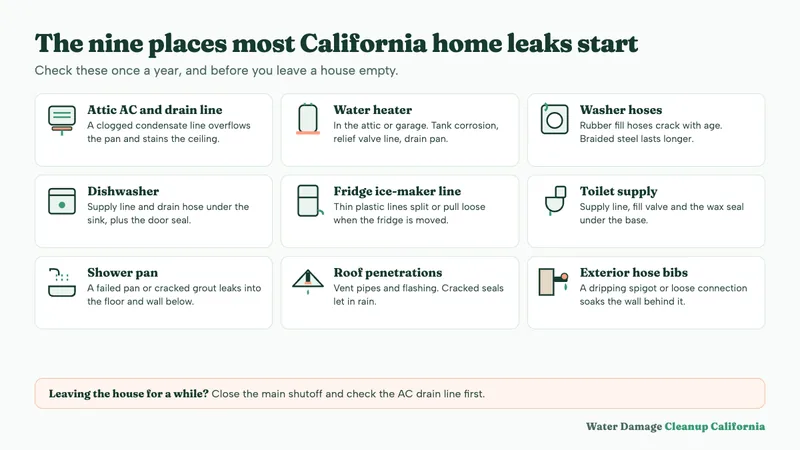
Failure points, shutoffs and water type differ from one appliance to the next, and the water type shapes how soaked materials are treated. Under the IICRC S500 standard, water from a supply line is Category 1 (clean), while washer or dishwasher discharge is Category 2 (grey).
| Appliance | Where it tends to leak | How to stop it | Category (IICRC S500) |
|---|---|---|---|
| Water heater | Tank shell, drain valve, pipe fittings, relief valve pipe | Cold inlet valve on top, plus its own breaker or gas control | Category 1 if it is supply water |
| Washing machine | Inlet hoses, the drain hose, the pump, or a standpipe that overflows | Hot and cold valves in the wall box at the back | Category 1 if a supply hose fails, Category 2 for discharged water |
| Dishwasher | Door seal, plus the supply and drain hoses under the sink | Small valve inside the sink cabinet | Category 1 for supply water, Category 2 for discharged water |
| Refrigerator and ice maker | The slim plastic feed tube and fittings behind the unit | A small valve on the tube, or one at a nearby sink | Category 1 from a supply line |
| Toilet | Supply line, fill valve, tank, the seal at the base | Oval-handled valve in the wall behind the bowl | Category 1 from supply, Category 2 from an overflow without waste |
| Air handler | Blocked condensate line, a pan that overflows | Thermostat first, then the unit's switch | Have the restoration team assess it on site |
As water collects waste, its category climbs. Sewage backup cleanup deals with Category 3.
How urgent is a water heater that has started leaking?
Treat a stream from the tank shell as an emergency. A dripping fitting is urgent but less dire, and moisture at the relief valve pipe needs a plumber to work out why. Many California tanks stand in a garage or closet, so water can reach a shared wall before anyone notices.
- Leak through the shell: the tank has failed. Shut the cold inlet on top, then remove the fuel by turning a gas control off or switching an electric unit off at its breaker.
- Leaking fitting or drain valve: shut the inlet and phone a plumber. Often the fitting is fixable and the tank stays.
- Water coming from the relief valve pipe: do not cap it, since it is a safety device.
Leaving the heater powered while the water is off is a mistake. The water heater leak page discusses garage tanks, state bracing rules and drain pans.
Why do washing machines leak or overflow?
Common culprits include a split fill hose, a loose drain hose and a worn-out pump. A clogged standpipe can also back up and spill over the top. The most severe floods begin when a pressurized fill hose fails and keeps running until the wall valves are closed.
Shutting both valves each time the house will be empty rules out that worst case, and takes only seconds.
Washer discharge is generally handled as Category 2. It spreads beneath the machine and along baseboards, and in a two-story home it can drop through the ceiling below. Lift the machine's feet clear of wet flooring, but never drag a full washer across it.
Why does a leaking dishwasher ruin the cabinet base first?
Gravity sends the water down instead of across the room. It gathers under the dishwasher and saturates the cabinet base and subfloor, often well before a puddle crosses the kitchen floor. A slow dishwasher leak can continue for weeks with nothing to see.
Suspect the door gasket, the feed line, or the drain hose beneath the sink. Take off the toe-kick panel and check for staining, mushy wood or a cabinet floor that has swollen.
Nothing dries a floor hidden under cabinets from above. A restoration team can take moisture readings in the cabinet bases and subfloor and say which parts can dry in place. Repair the dishwasher before drying, or the leak simply restarts.
Whether wet cabinets get repaired or replaced is covered on the cabinet water damage page.
Why are refrigerator and ice maker leaks so easy to miss?
They spread quietly where nobody looks. One slim tube behind the refrigerator serves the ice maker and the water dispenser, and a pinhole or a loose fitting on it can drip for weeks into the wall, an adjacent cabinet or the floor.
The usual discovery comes when a plank lifts or a baseboard goes soft. By that point the wet zone is bigger than the stain suggests.
- Shut the small valve on the line and turn the ice maker off.
- Slide the fridge out and examine the floor, the base of the wall and the tube.
- Look along both sides of the unit as well as the front.
Supply water begins as Category 1, but standing water can pick up contamination from the materials it soaks. Drying early is wiser than waiting to learn how bad things get.
Is it possible for an air conditioner leak to soak a ceiling?
Yes. Once the condensate drain clogs, the pan overflows and water falls on whatever sits beneath. With an air handler in an attic or closet, a ceiling or wall can get soaked before a stain shows, which makes the damage easy to overlook.
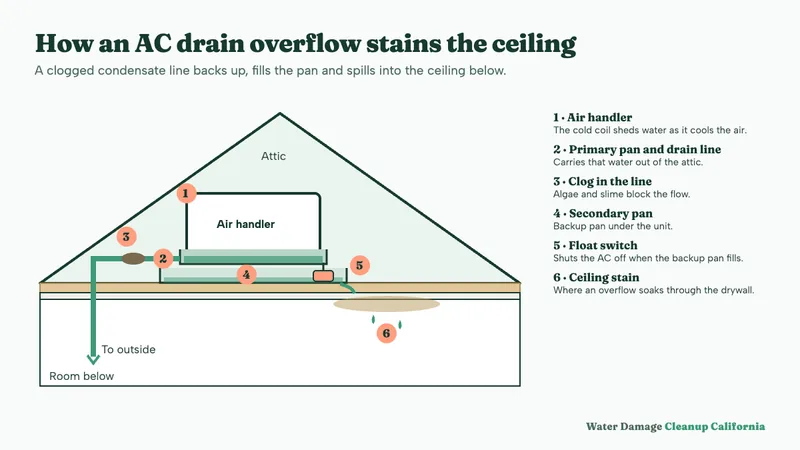
Turn the cooling off at the thermostat so no more condensate forms. After that an HVAC technician can unclog the line and look over the pan. For a sagging ceiling, the ceiling water damage page explains safe relief.
How can I spot damage from an appliance leak I cannot see?
The warning signs are swollen cabinet bottoms, floors that cup or lift, a musty smell, and stains or soft patches around an appliance. A slow leak behind a fridge or below a dishwasher harms the nearby materials long before liquid water appears.
- Soft or puffy cabinet bases next to a dishwasher or under a sink.
- Boards that cup, buckle or rise around the kitchen or laundry.
- A musty odor that comes back after cleaning.
- Paint that bubbles or baseboards pulling away from the wall.
- A water bill that climbs although your habits have not changed.
A moisture meter is the only way to confirm what eyes miss. To keep mold from growing, the EPA recommends drying water-damaged areas and items in the first 24 to 48 hours. More clues appear in signs of water damage.
Are leak sensors and automatic shutoff valves worth installing?
They can reduce harm by warning you or closing the water, but only where they sit and only while they are maintained. A sensor on the floor next to the washer, dishwasher or fridge can flag a leak while it is still small.
- Leak sensors go where water would land. Some sound an alarm and others push a phone alert.
- Automatic shutoff valves close the supply the moment a sensor trips. Which type fits your plumbing is a question for a plumber.
- Batteries and Wi-Fi need periodic checks, since a dead sensor guards nothing.
Hardware does not replace inspecting hoses and fittings for bulges, rust and drips. For a home left empty for long periods, the remote leak monitoring guide goes deeper.
Will my homeowners policy pay for water from an appliance?
Often, if the release is sudden. Standard forms cover a peril that Triple-I describes as accidental discharge or overflow of water from plumbing, heating, air conditioning or a household appliance. The policy wording decides, so read it or ask your agent before counting on a payment.
That same source says policies leave out damage caused by lack of maintenance, so a hose that cracked slowly over months is likelier to be disputed. The NAIC notes that plumbing-related water damage is typically covered, while ground water and rain runoff are not.
The California Department of Insurance says homeowners policies do not cover flood but do cover other kinds of water damage, and that any water damage claim should be reported to your agent right away.
The Insurance Information Institute reports that roughly one in 60 insured homes has a water damage or freezing claim every year, with an average claim of $15,400 for 2019 to 2023.
How long does a California insurer have to respond to an appliance claim?
State claim regulations give an insurer no more than 15 calendar days to acknowledge notice of a claim and no more than 40 calendar days after proof of claim to decide it. Any denial must come in writing with its reasons.
Those limits appear in section 2695.5 and section 2695.7 of Title 10 of the California Code of Regulations. When the insurer wants more time, it must say so in writing within the 40 days.
Triple-I recommends keeping receipts, photographing the damage and holding onto damaged items until the adjuster visits. If no claim gets opened, the Department of Insurance lists its Consumer Hotline at 1-800-927-4357. The insurance claim guide covers the remainder.
Earthquakes change the picture. A California Earthquake Authority sample policy does not exclude water released from a water heater, refrigerator or supply pipe inside the home as a direct result of a quake, though your own policy governs.
What simple habits head off the next appliance leak?
Keep every shutoff within easy reach, place a sensor where water would land, and check hoses and lines on a schedule. The effort is small next to the cleanup, and the prevention guide offers a longer list. Repeated small habits catch most failures early.
- Operate each shutoff once a year and move anything stacked in front of it.
- Examine hoses and supply lines for bulges, rusty fittings, cracks and drips. Ask a plumber about braided steel lines.
- Set a drain pan beneath a water heater that stands above finished space.
- Shut the washer valves and the house valve when nobody is home.
- Learn where the main shutoff is. The cost guide shows why a quick shutoff matters.
If a leak has already soaked flooring or walls, water mitigation explains how drying is planned and verified.
Sources: IICRC, S500 standard; Triple-I, Which disasters are covered by homeowners insurance; Triple-I, Settling insurance claims after a disaster; Insurance Information Institute, Facts and statistics on homeowners and renters insurance; NAIC, Homeowners Insurance; California Department of Insurance, Residential Property Claims Guide; 10 CCR 2695.5; 10 CCR 2695.7; California Earthquake Authority, sample policy; EPA mold and moisture guide; CDC, About Mold and Your Health.
Water Damage Cleanup California is the local water damage restoration line and information resource for California. When you call or send a request, it reaches a local water damage restoration team that serves your area. That team confirms whether it can reach you and gives its own scope, price and timing. Confirm them directly before you agree to anything.