For Sacramento County homeowners
For water damage restoration in Sacramento County, shut off the water, photograph everything and begin drying in the first 24 to 48 hours. River and creek water is flood, which homeowners policies do not cover. Requests come from every city in the county.
On this page (8)
- Which Sacramento County cities and ZIP codes do you take requests from?
- Why does Sacramento County have so many levees?
- How did the 2023 storms hit Sacramento County?
- How do older and newer Sacramento County neighborhoods differ after a leak?
- When do roofs and air conditioners leak in Sacramento County?
- Does insurance pay for flood water in Sacramento County?
- What should I do in the first 24 to 48 hours?
- Is this a restoration company, and do I have to hire anyone?
Which Sacramento County cities and ZIP codes do you take requests from?
Requests for water damage restoration in Sacramento County come from the capital and the suburbs around it. Start with the Sacramento city page for downtown and the neighborhoods nearby. The Sacramento County ZIP finder lists every code, and the restoration team who calls back confirms your street.
The county article on Wikipedia counted 1,585,055 residents in the 2020 census and lists seven cities: Citrus Heights, Elk Grove, Folsom, Galt, Isleton, Rancho Cordova and Sacramento. The county covers about 1,026 square miles.
Homes north of the American River and in the foothills of Folsom are covered by the Placer and foothills page, which also takes Roseville, Davis and the mountain counties. South of the county line, see Stockton and Modesto and the North Bay.
Why does Sacramento County have so many levees?
Because the land is flat, low and crossed by large rivers. Most of the county sits close to sea level and some of it below, Wikipedia says, and its watercourses include the American, Sacramento and Cosumnes rivers plus Dry Creek. A levee is often the only thing between a river and a street.
The city's own story shows why. A flood on January 10, 1850 devastated Sacramento, according to its Wikipedia article. The first levee, finished in early 1852, was breached a month later, and flooding in 1861 and 1980 followed.
Wikipedia's Delta article says much of the Delta now sits below sea level behind about 1,100 miles of levees that border 700 miles of waterways.
| Part of the county | Wikipedia note | Ask your city or county |
|---|---|---|
| River confluence | City at the American and Sacramento rivers, 25 feet above sea level | Is my block behind a levee? |
| South county | Low Delta land between two rivers | Who maintains the nearest levee? |
| Cosumnes corridor | A levee broke in January 2023 | What is the creek-side drainage plan? |
| Folsom foothills | High point of the county, 828 feet | Where does hillside runoff go? |
How did the 2023 storms hit Sacramento County?
Harder than any other county in California, according to Wikipedia's 2023 California floods article. Atmospheric rivers ran from December 31, 2022 to March 25, 2023, and five people died in Sacramento County during the December and January storms, the most of any county.
The article says a Cosumnes River levee broke in January, flooding State Route 99, forcing evacuations in Wilton and stranding drivers. Gusts over 60 miles per hour also cut power to more than 500,000 SMUD and PG&E customers.
Fallen limbs can open a roof. The atmospheric river guide explains how these storms work, and the after-storm checklist gives a room-by-room walk-through once the rain stops.
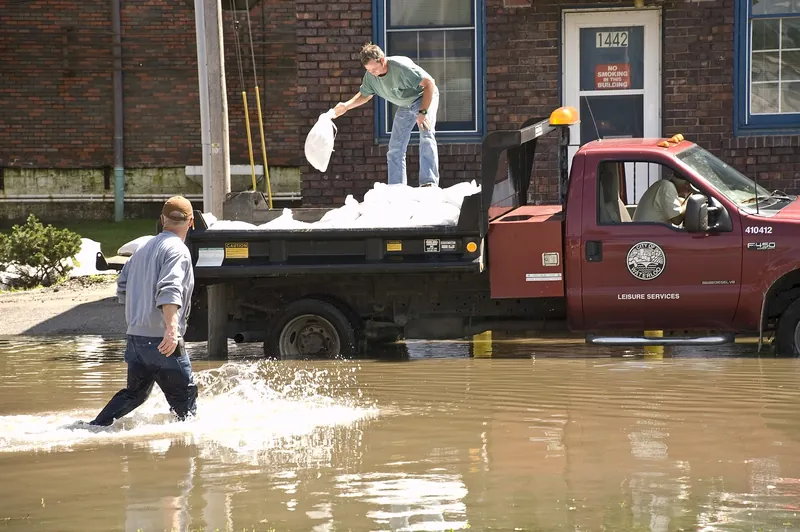

How do older and newer Sacramento County neighborhoods differ after a leak?
Age sets the likely weak points. The oldest buildings stand near the river, and the newest tracts were built where farmland used to be, so a pinhole in old copper and a failed hose in a young house need different checks. Ask the restoration team what it sees in your wall, not what it saw next door.
Wikipedia says Old Sacramento keeps buildings from the 1850s and 1860s. The city also raised its downtown streets from 1862 to the mid-1870s, which turned some first floors into basements. If you own in a historic block, mention any room below street level, because low spaces collect water first.
The city absorbed North Sacramento in 1964, and Wikipedia says large annexations of the Natomas area drove growth through the 1970s, 1980s and 1990s. Houses from those decades may have aging plumbing and roofs.
If your house sits on a slab, a leak can start under the floor, so read about slab leak damage. With a crawl space, see crawl space water damage.
When do roofs and air conditioners leak in Sacramento County?
Roofs leak in the first big storm of winter, and air conditioners leak in summer. Wikipedia says Sacramento averages 18.14 inches of rain a year on 58 days, with nearly all of it falling between November and April. A roof that sat dry for months may show every weak flashing at once.
The swing between years is wide. Rainfall ranged from 5.81 inches in 2013 to 33.44 inches in 1983, according to the same article. A stain that shows up days later usually means water has already traveled through the ceiling.
Summers are long and hot, Wikipedia adds, so cooling systems run hard. A clogged drain line can overflow an attic pan and stain a ceiling in July. Read roof leak damage for storm leaks, AC condensate leaks for the summer kind, and ceiling water damage for what a stain means.
Does insurance pay for flood water in Sacramento County?
Usually not. The California Department of Insurance says homeowners policies do not cover flood damage but do cover other kinds of water damage, such as rain coming through a roof hole made by a covered event. Flood insurance is a separate policy, and sewer backup often needs its own endorsement.
Water that comes up out of a river or creek is flood, even if it only reaches the garage. Tell your insurer exactly where the water came from.
California sets claim clocks in 10 CCR section 2695.5 and section 2695.7. An insurer must acknowledge a claim within 15 calendar days, accept or deny within 40 days of proof of claim, and pay within 30 days of accepting it.
The Department of Insurance complaint page explains how to ask for help. Our insurance claim guide covers photos and paperwork, and California flood insurance covers the separate policy.
What should I do in the first 24 to 48 hours?
Stop the source, document the damage and start drying. The EPA says to dry water-damaged areas and belongings in 24 to 48 hours to prevent mold, and to keep indoor humidity below 60 percent, ideally between 30 and 50 percent.
- Turn off the water at the house shutoff, or at the meter box if you cannot find it.
- Photograph and video each room before anything is moved.
- Call your insurer or agent and ask what it needs before repairs.
- Ask each restoration team what moisture readings it takes and how it will show the structure is dry.
- If street water is rising, leave. Ready.gov says one foot of moving water can sweep a vehicle away.
The emergency page has a longer checklist. If a musty smell or dark spots appear, mold after water damage explains what to do next.
Is this a restoration company, and do I have to hire anyone?
No. This site is the local water damage restoration line and information resource. A request reaches a local water damage restoration team that serves your address, and sending one creates no obligation to hire anyone. The team that calls you sets its own availability, scope and price.
Before you agree to work, check the contractor's license with the Contractors State License Board. The guide to choosing a restoration company lists questions to ask, and the how a call works page explains how requests move.
Sources: Wikipedia articles on Sacramento County, Sacramento, the Sacramento-San Joaquin River Delta and the 2023 California floods; California Department of Insurance, residential property claims guide; 10 CCR 2695.5 and 2695.7; EPA, mold and moisture; Ready.gov, floods.
Coverage
Cities and communities in Sacramento County
Requests come from 22 cities and communities here, covering 129 ZIP codes. The cities with their own guide come first.
Water Damage Cleanup California is the local water damage restoration line and information resource for California. When you call or send a request, it reaches a local water damage restoration team that serves your area. That team confirms whether it can reach you and gives its own scope, price and timing. Confirm them directly before you agree to anything.