The short version
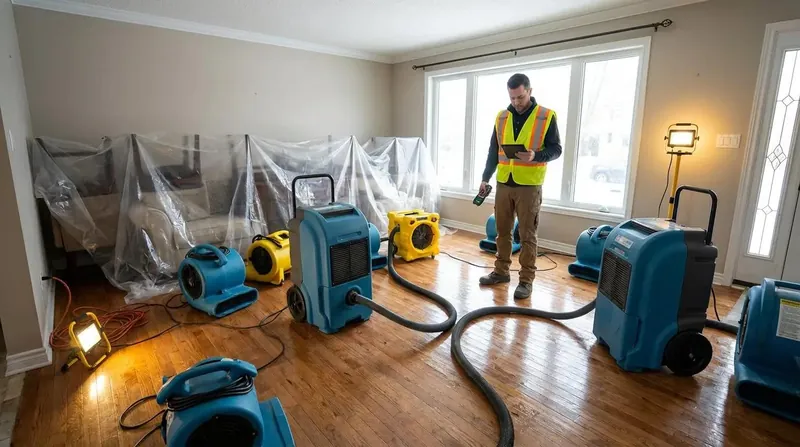
In California, water mitigation is the set of tasks that stops a loss from getting worse. A provider inspects, pumps out standing water, removes wet materials beyond saving, sets air movers and dehumidifiers and logs moisture readings. The EPA recommends drying within 24 to 48 hours. Rebuilding counts as restoration, a later phase.
On this page (11)
- What does water mitigation mean for a California home?
- How do mitigation and water damage restoration differ?
- What takes place when a provider arrives to start mitigation?
- Why does moisture mapping decide which materials come out?
- What is the usual duration of a mitigation job?
- What does a dry log contain, and why does it matter?
- Is it realistic to dry out a California house on your own?
- What do mitigation services cost?
- Will your insurer cover the cost of mitigation?
- Which questions belong on a work authorization before you sign?
- What comes next once the structure is dry?
What does water mitigation mean for a California home?
It is the opening phase of a water loss: close off the source, clear out standing water, remove materials beyond saving and dry the structure. The point is to keep the damage from growing. Here the trigger could be a burst pipe, a storm-soaked roof or a water heater that tipped over.
You may also hear water remediation or emergency water mitigation. Those labels get used loosely, so read what a quote covers rather than trusting the name.
Speed is the reason this phase comes first, since the EPA recommends drying wet areas within 24 to 48 hours to prevent mold growth. Every restoration team sets its own scope and terms.
How do mitigation and water damage restoration differ?
Mitigation limits the damage and dries the building, and restoration repairs and rebuilds once that is finished. A single provider might do both, yet each phase has its own purpose, paperwork and often its own invoice, and an insurer may review the two separately.
| Mitigation | Restoration | |
|---|---|---|
| Goal | Contain the loss, then dry it | Repair and rebuild what was damaged |
| Begins | Once the leak is stopped and the area is safe | Once readings show the materials are dry |
| Typical work | Water extraction, tear-out, drying machines, moisture readings | New drywall, insulation, flooring, trim and paint |
| Insurance angle | Reasonable steps against further damage | Usually waits on the adjuster's assessment |
Triple-I claim advice is the basis for the insurance row, while the other rows reflect how the phases usually run. Some providers divide the work differently, so ask. For the rebuild side, see water damage repair in California.
What takes place when a provider arrives to start mitigation?
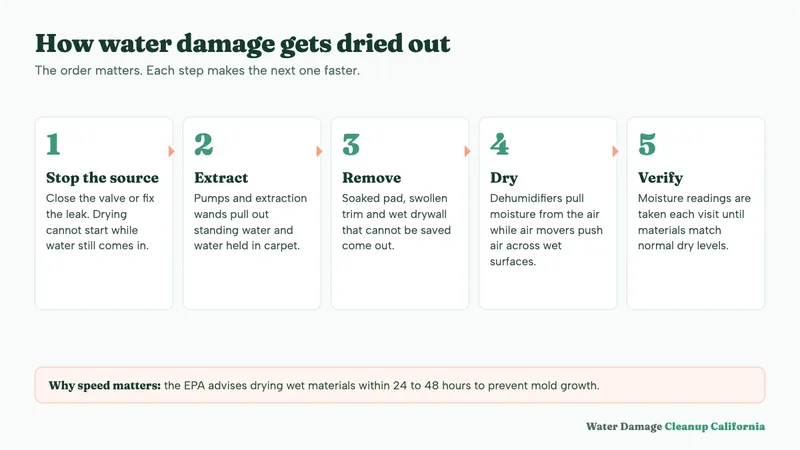
An inspection comes first, followed by extraction, tear-out of whatever cannot dry and equipment setup. A careful provider writes down the starting conditions so the job can be measured afterward. The order shifts with the damage, but this is the usual sequence.
- Make it safe. You or a plumber shuts the water off first, after which the provider checks for shock and slip risks.
- Classify the water. IICRC S500 labels clean supply-line water Category 1, washer, dishwasher or waste-free toilet overflow Category 2, and sewage or rising flood water Category 3.
- Map the moisture. A moisture meter, often with a thermal camera, shows how deep the water went in walls, floors and ceilings.
- Extract. Pumps and wands take up the standing water; see water removal and extraction.
- Remove what cannot dry. Soaked pad, swollen trim and saturated drywall frequently come out.
- Set equipment. Air movers blow air across wet surfaces while dehumidifiers draw moisture from the air.
- Log readings. Numbers are added at each visit until the materials are dry.
Category 3 water alters the plan, because porous materials generally have to be removed instead of dried where they sit. Outside water is covered under flood damage restoration. For sewage, read sewage backup cleanup and keep away from it.
Why does moisture mapping decide which materials come out?
Mapping separates materials that can dry in place from those that must go. Water climbs drywall and travels along framing, so the wet area is often larger than the stain you can see. Readings at marked points reveal the real boundary and can be repeated on every visit.
In a slab house, water tends to hide under the floor covering, because concrete does not absorb the way carpet pad does. Where there is a crawl space, ask if the provider will check underneath, since wet insulation and subfloor down there can go unnoticed.
Cutting out wet material seems harsh, but it speeds up drying and cuts the chance of hidden mold. Request photos before removal along with the readings behind each decision. The signs of water damage guide shows how wet materials look.
What is the usual duration of a mitigation job?
Drying should get underway in the first 24 to 48 hours, the window the EPA gives for preventing mold growth. Total time varies with the water category, the materials involved and the distance the water traveled. No verified California figure is available here, so ask the provider for target readings and a review date.
Readings, not a fixed number of days, mark the end of drying. A provider should compare the wet areas with an unaffected spot of the same material.
The EPA suggests holding indoor humidity below 60 percent, ideally 30 to 50 percent. If machines are still running and no readings explain it, ask which number they are aiming for. The structural drying page explains drying goals.
What does a dry log contain, and why does it matter?
A dry log records moisture readings, room conditions and equipment day by day. It proves the drying worked, and it is the first paper to produce if an insurer questions a bill. Ask to look at it during every visit.
- Moisture readings at the same marked spots, with dates.
- Indoor humidity and temperature, checked against the EPA range above.
- Equipment in place: how many air movers and dehumidifiers are running and where they sit.
- Equipment changes, each with a stated reason.
- Photos taken before, during and after.
Add it to your claim paperwork.
Is it realistic to dry out a California house on your own?
A small clean spill that you catch fast, often yes. Beyond that, a rented dehumidifier alone usually falls short, since water inside walls, insulation and under flooring is beyond its reach. The table shows which side of the line you probably fall on.
| Situation | Do it yourself | Professional drying |
|---|---|---|
| Small clean spill on tile | Often manageable: mop up, run fans, keep watching | Usually unnecessary |
| Soaked carpet and pad | Risky, since the pad retains water | Extraction, with the pad removed |
| Water in walls or under floors | No way to gauge it without a meter | Meters and focused drying |
| Grey or black water | Unsafe to handle yourself | Called for |
Per the EPA, damage from sewage or other contaminated water should go to a professional with experience in such buildings. Even if you work alone, hit the 24 to 48 hour window and stay alert for a musty smell. The mold guide lists next steps.
What do mitigation services cost?
Whole jobs land in the low thousands across the country. Fixr, updated January 31, 2025, puts water damage restoration at $1,200 to $5,000, with a national average of $3,000. Those are national numbers rather than California quotes, and local prices differ from them.
| Item (national, per Fixr) | Range |
|---|---|
| Extracting clean water, per sq ft | $3.75 to $4.25 |
| Extracting gray water, per sq ft | $4.10 to $6.50 |
| Extracting black water, per sq ft | $7 to $7.50 |
| Class 1 damage, flat | $150 to $400 |
| Class 2 damage, flat | $500 to $1,000 |
| Class 3 damage, flat | $1,000 to $3,000 |
Every figure above is taken from Fixr, Water Damage Restoration Cost. This site cannot predict what a given provider will charge. More detail is in water damage restoration cost in California.
Will your insurer cover the cost of mitigation?
Frequently, if a covered cause produced the water. The California Department of Insurance says homeowners policies cover some water damage but exclude flood. The NAIC adds that plumbing and roof leaks are typically covered, whereas ground water and rain runoff are not.
The department also urges homeowners to find and stop leaks at the source immediately. Drying and dehumidifying wet areas, it says, can reduce the chance of mold afterward, and waiting can let mold grow.
- Call your agent or insurer without delay, as Triple-I advises.
- Take reasonable steps to shield the property from further damage.
- Postpone major permanent repairs until the adjuster has visited.
- Photograph the damage, and keep damaged items until the adjuster comes.
- Save receipts and request written bids itemized line by line.
State claim regulations put insurers on a clock: 10 CCR 2695.5(e) calls for acknowledging a claim within fifteen calendar days, and 2695.7(b) calls for accepting or denying within forty calendar days of proof of claim. See the insurance claim guide for the sequence.
When a quake-damaged heater is the source, a policy may respond differently. The department states that homeowners policies exclude earthquake damage other than fire. A sample California Earthquake Authority policy does cover water released from a water heater or supply pipe inside the dwelling when an earthquake directly causes it, though your own policy and deductible control.
Which questions belong on a work authorization before you sign?
Do not sign a form that is blank or only partly filled in, and read every line first. A work authorization is a contract rather than a formality. It can assign your insurance benefits, permit direct billing of the insurer or set lien terms if a bill goes unpaid.
- Does the scope stop at mitigation, or does it commit me to the rebuild?
- Are charges by item, by day or a single flat total, and what could alter them?
- If the insurer covers only part, who pays the remainder?
- Does the form hand my benefits over to the provider?
- Which reading shows that the equipment can leave?
California adds contractor rules. The Contractors State License Board says a down payment may not exceed $1,000 or 10 percent of the contract price, whichever is less, and that you should pay only as work is completed. Its guide also notes that a contract for emergency repairs you request on short notice is an exception to the usual cancellation right, which ends once you sign and work starts.
Answers differ between providers, so confirm each point directly. A provider's terms belong to that provider, and this site is not a party to the contract. See choosing a restoration company for more questions.
What comes next once the structure is dry?
Once readings confirm the structure is dry, the equipment comes out and rebuilding can start, covering insulation, drywall, flooring, trim and paint. An adjuster generally inspects before permanent repairs begin, so hold off on rebuilding on your own and keep each drying record and photo.
Store the dry log, photos and invoices together. If a musty smell shows up weeks later, the log makes it easier to trace what was dried and how.
Winter is a common trigger in California, because NOAA Research reports that about 30 to 50 percent of annual precipitation in the west coast states falls in a few atmospheric river events. For storm losses, read roof leak and storm damage, and locate your area on the service areas page.
Sources: EPA, A Brief Guide to Mold, Moisture and Your Home; EPA, Mold Cleanup in Your Home; IICRC, S500 standard; Fixr, Water Damage Restoration Cost; CDI, Residential Property Claims Guide; CDI, Earthquake Insurance; CEA, Homeowners Choice sample policy; 10 CCR 2695.5; 10 CCR 2695.7; CSLB, Home Improvement Contracts guide; NAIC, Homeowners Insurance; Triple-I, Settling claims; NOAA Research, Atmospheric Rivers.
Water Damage Cleanup California is the local water damage restoration line and information resource for California. When you call or send a request, it reaches a local water damage restoration team that serves your area. That team confirms whether it can reach you and gives its own scope, price and timing. Confirm them directly before you agree to anything.