The short version
Contents pack out in California is the inventory, boxing and cleaning of soaked belongings so a room can dry. Clean-water items are often rescued, but absorbent ones hit by flood, mud or sewage are mostly lost. Take photos before moving anything, and leave wet electronics unplugged. Each provider works differently, so ask who covers contents.
On this page (11)
- What does contents pack-out mean after a California water loss?
- Will any restoration provider in California take my belongings?
- What are the stages of a pack-out from start to finish?
- Which items survive flood, mud or leak water?
- What is the best way to rescue wet documents and photos?
- Is it safe to power up electronics or appliances that got wet?
- What survives a mudslide or storm flood in California?
- How should you record belongings for an insurance claim in California?
- Who foots the bill for cleaning and pack-out?
- What should you do with your belongings before help arrives?
- Where is my property kept while the room dries?
What does contents pack-out mean after a California water loss?
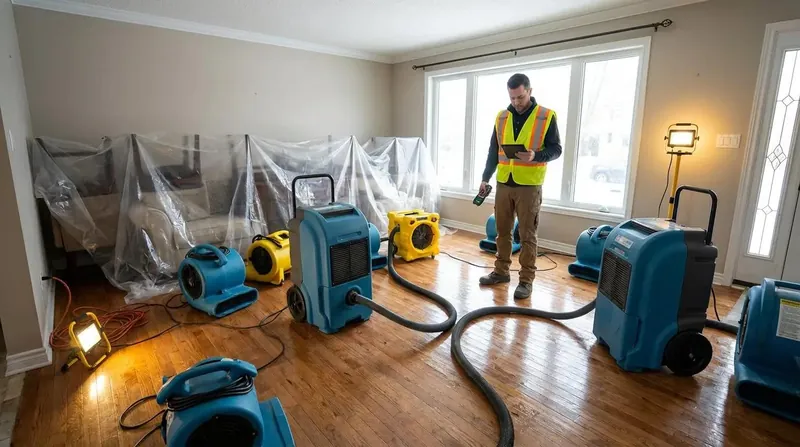
Pack-out is the branch of water restoration that handles what you own rather than the structure. Belongings are photographed, itemized, boxed and carried out of the wet rooms so crews can dry the building. Cleaning then treats the items worth saving, at a facility or back at your home.
Here you will find notes on furniture, rugs, clothing, papers, photos, electronics and food soaked in a California house. Walls and floors have their own pages: the structural drying guide and the water mitigation guide.
Whether a restoration team takes contents jobs at all varies from one to the next.
Will any restoration provider in California take my belongings?
Not necessarily. A few providers clean belongings at their own facility, others subcontract that work, and some limit themselves to drying the building. The team that extracts the water may never handle your furniture or clothing, so raise contents before a single box is carried out.
- Does your own staff do contents work, or a separate company? If separate, which one?
- Where do my things sit while they are away, and who answers for them?
- Will I receive a photo inventory, created before anything moves?
- Is contents work priced separately from drying, and will the estimate arrive in writing?
- Who judges an item beyond saving, and do I sign off before it is discarded?
More first-call questions appear in the guide to choosing a restoration company. Nothing on this page claims that a particular provider offers contents services, so verify that directly.
What are the stages of a pack-out from start to finish?
A pack-out opens with a written record and closes when your things return to a dry, repaired room. Each provider sequences the work slightly differently, yet the stages repeat, and every one protects either your belongings or your insurance claim. The ordinary run of events looks like this.
- Record the scene. Film or photograph the rooms and every ruined item while all of it is still in place.
- Sort by condition. Three piles form: probably salvageable, uncertain, and a loss. The water category steers the sorting.
- Label everything. Every box or item gets a number that matches the written list.
- Move it out. Belongings travel to storage or a cleaning facility, which opens up the room for drying equipment.
- Clean by material. Hard goods, fabrics and paper each call for a different method.
- Return it. Things come back once the structure shows dry readings and the repairs are finished.
An empty room also dries faster. Furniture shoved against the walls blocks airflow, and soaked items left behind keep humidity high. The water damage repair guide explains why belongings tend to come back last.

Which items survive flood, mud or leak water?
Two factors settle the question: how contaminated the water was, and how absorbent the item is. Under the IICRC S500 standard, clean supply-line water is Category 1, water from a washer or dishwasher is Category 2, and sewage, rising flood water and outside surface water are Category 3. Category 3 condemns far more belongings.
Treat the table as a rough guide only. A provider or your adjuster rules on each item.
| Type of item | After clean water (Category 1) | After flood, mud or sewage (Category 3) |
|---|---|---|
| Glass, metal, ceramic, hard plastic | Washed, then dried | Frequently scrubbed and sanitized |
| Solid wood furniture | Frequently kept after it dries | Judged piece by piece, so ask the provider |
| Upholstery and mattresses | Occasionally cleaned and dried | Mostly thrown out |
| Clothes and linens | Machine wash | Ask which pieces are safe to wash |
| Papers, books, photos | Dry them fast, details below | Save only what has no replacement |
| Electronics and appliances | Disconnect, dry, get them inspected | Mostly replaced |
| Food and medicine | Judge each item one at a time | Discard |
For how those jobs differ in practice, see the sewage backup cleanup guide and the flood damage restoration guide. The EPA suggests hiring someone who has worked on buildings hit by contaminated water.
What is the best way to rescue wet documents and photos?
Move quickly, since damp paper molds fast. The EPA advises drying water-damaged items within 24 to 48 hours to prevent mold growth. Books, prints and legal papers each respond to different handling, so do not stack them together or treat them all alike.
A few habits apply to any kind of paper.
- Touch wet prints and sheets as little as you can, holding them by the edges.
- Keep pages separated so they cannot fuse together while drying.
- Never scrub, and do not attempt mold removal on irreplaceable items.
- Pull out deeds, wills, heirloom photos and other one-of-a-kind items, then tell the provider at once.
For those pieces, ask if the provider works with a document recovery specialist. Many do not, so bring it up early. Once cleanup ends, keep important papers in a sealed waterproof box and store a digital copy somewhere else.
Is it safe to power up electronics or appliances that got wet?
No. Wet electronics can shock you, or break down later even when they look fine, so leave them unplugged and off until a qualified person inspects them. Should water have touched outlets, cords or the electrical panel, get an electrician in before any drying equipment is plugged in.
Never handle electrical gear while you stand in water. If the floor is wet and the breaker panel sits in that room, stay out and call for help.
Photograph model and serial numbers before moving a device aside, because an adjuster may request them. The appliance leak guide covers the appliance end of a loss. If a ceiling leak soaked boxes stored below, the ceiling water damage guide shows how the water traveled.
What survives a mudslide or storm flood in California?
Mud and flood water are Category 3, so soft goods they touched are normally thrown out, while hard goods can often be cleaned. Winter storms may bring both. NOAA says roughly 30 to 50 percent of annual precipitation along the west coast falls in a handful of atmospheric river events.
Debris flows can be brutal. The USGS reports the January 9, 2018 Montecito debris flow damaged 408 homes after the Thomas Fire stripped the hillsides above them. Belongings buried in that sort of mud pose a different problem from a plumbing leak, and many cannot be saved.
- Skip washing mud-caked items inside, which carries silt through the home.
- Put on gloves, boots and eye protection before handling contaminated belongings.
- Set keepsakes and papers apart, and speak to the provider before anything goes in the trash.
For the building side of these events, read the mudslide water damage page and the atmospheric river guide.
How should you record belongings for an insurance claim in California?
Photograph and list each item before it is cleaned or discarded. Triple-I advises taking photos or video of the damage, saving receipts, and holding on to damaged items until the adjuster visits. A room-by-room written list makes the contents portion of a claim far easier to support.
- Per entry, note the brand, a rough age and, if you can, the replacement cost.
- Shoot close-ups of labels, model numbers and serial numbers.
- Check first before throwing out large items, and hold a sample if the adjuster asks.
- Save every inventory sheet and receipt that the provider hands you.
The California Department of Insurance says insurers must acknowledge a claim within 15 calendar days and accept or deny it within 40 calendar days after receiving proof of claim. Once accepted, payment is due within 30 calendar days. The Department's consumer hotline is 1-800-927-4357.
The cause drives coverage. The CDI says homeowners policies exclude flood but do cover other types of water damage. Our insurance claim guide explains the process.
Who foots the bill for cleaning and pack-out?
Frequently the insurer, provided your policy covers whatever caused the loss. Contents typically appear as a separate line in an estimate, and policies cap personal property. This site does not quote provider prices, and costs differ from job to job.
Ask each provider to put contents charges and structural charges on separate lines, in writing. Paying yourself? Request an itemized quote ahead of the first box leaving.
Flood is the big carve-out. According to Triple-I, standard homeowners and renters policies leave flood damage out, and FEMA states that most homeowners insurance does not pay for it. For wider context, see the restoration cost guide, plus the tenant and condo guide for renters.
What should you do with your belongings before help arrives?
Begin with safety, then document, and only after that move what can be moved safely. Do not wade through standing water with a load in your arms, and do not carry items through a house with live power. These steps bridge the wait for a provider.
- Cut power to wet areas if that is safe, and keep out of standing water.
- Film or photograph each room and each damaged item before anything shifts.
- Raise dry items, papers and electronics off wet floors and onto counters or furniture.
- Put irreplaceable papers and photos aside, and mention them to the provider.
- Keep ruined items on hand until the adjuster comes by.
- Ring your insurer, then find out from the restoration provider who deals with contents.
For the first hour of building-side response, see the emergency water damage guide.
Where is my property kept while the room dries?
That depends on the provider. One might run a warehouse, another rent storage units, and a third leave sealed boxes in a dry room of your own house. Find out which applies, ask for a written inventory, and learn who is answerable for items in transit and in storage.
Areas this site covers are listed on the service areas page, though contents work varies by provider. If a term on a work order puzzles you, the water damage glossary defines it simply.
Sources: IICRC S500; EPA, Brief Guide to Mold, Moisture and Your Home; EPA, Mold Cleanup in Your Home; FEMA, flood insurance FAQ; Triple-I, Which disasters are covered by homeowners insurance; Triple-I, Settling insurance claims after a disaster; 10 CCR 2695.5; 10 CCR 2695.7; CDI, Residential Property Claims Guide; NOAA Research, Atmospheric Rivers; USGS, Montecito Debris-Flow Event.
Water Damage Cleanup California is the local water damage restoration line and information resource for California. When you call or send a request, it reaches a local water damage restoration team that serves your area. That team confirms whether it can reach you and gives its own scope, price and timing. Confirm them directly before you agree to anything.