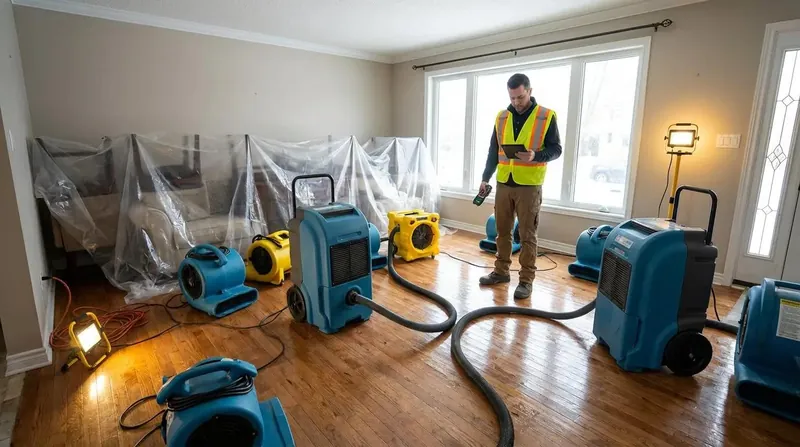
The short version
A slab leak in California means a supply line has failed beneath or within a concrete floor. Watch for a warm patch underfoot, a rushing sound, a bigger bill and a meter that turns with every fixture off. Close the water valve, have a plumber locate the break, then get wet floors and walls dried before mold starts.
On this page (11)
- How can I tell my California house has a slab leak?
- Is there a quick way to check the water meter for a hidden leak?
- What are the first steps once I suspect water is leaking under the floor?
- Which trade handles the pipe, and which handles the wet floor?
- Should the plumber fix one spot or reroute the line?
- How does a leak under the slab harm flooring and walls?
- What does drying a soaked slab involve?
- Will mold form beneath the floor after a leak in the slab?
- Will my California homeowners policy pay for a slab leak?
- What should I expect to pay for slab leak repair and drying in California?
- What habits help spot a hidden leak before the floors get wet?
How can I tell my California house has a slab leak?
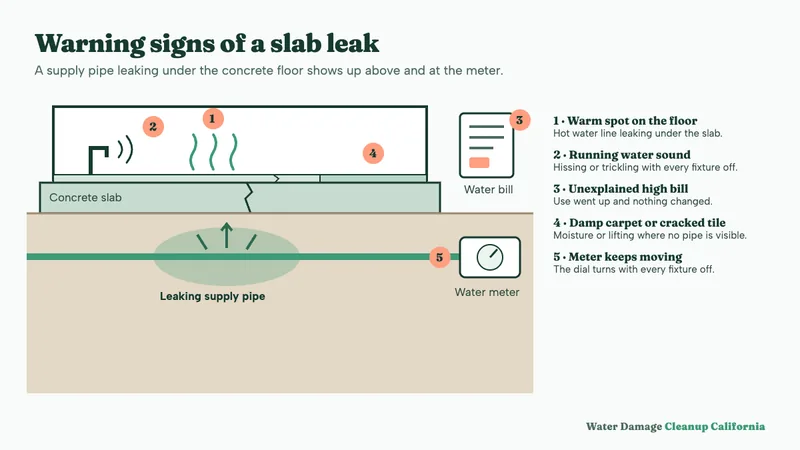
A slab leak is a break in a supply line that passes beneath or inside a concrete floor slab. Nobody sees the pipe itself. Instead the house gives hints: a floor patch that feels warm, a faint rushing noise, a jump in the water bill, or flooring that goes damp.
Plenty of Southern California and Central Valley houses are built on slabs, whereas older homes and much of Northern California tend to stand on a raised foundation above a crawl space. With a crawl space, a failing pipe is normally easier to get at, and the burst pipe page suits you better. Because each clue below has innocent explanations, treat two or three at once as the real alarm.
| Clue | What shows up | Harmless look-alikes |
|---|---|---|
| Warm spot underfoot | A single area of wood or tile stays warm with the heating off | Strong sunlight, a heating vent, a hot line running inside a wall |
| Sound of water | Hissing or trickling while every faucet and appliance sits idle | A toilet refilling by itself, a tired valve |
| Bill creep | Usage rises although nothing changed at home | Sprinkler timer changes, a new routine, a leaky toilet flapper |
| Soggy or rising floors | Wet carpet edges, planks that buckle, loose tile, a musty odor | A leak somewhere else in the house, an appliance, a roof leak |
| Spinning meter | The dial keeps turning while every fixture is off | A leak anywhere on the lot, sprinkler piping included |
Is there a quick way to check the water meter for a hidden leak?
Yes. Turn off everything that uses water, then watch the meter. A dial or small triangle that keeps creeping tells you water is getting out somewhere past the meter. Pick a calm moment, like early morning or late evening, so nobody opens a tap halfway through.
This check only answers whether a plumber is needed. Locating the leak is a separate step.
- Shut down all water use. Make sure the dishwasher, washing machine, ice maker and sprinklers are not running and no one flushes.
- Open the meter box by the street, then write down the reading or snap a photo.
- Give it a short wait and look again. Any movement while everything is off signals a leak.
- Close the shutoff valve at the house and check a third time. A stopped meter puts the leak inside the house plumbing, while a moving one puts it on the pipe between meter and house.
- Eliminate the toilets and the water heater before phoning anyone. A toilet that runs on is the classic false alarm.
That pipe between the meter and the house can also fail beneath a lawn or driveway rather than the floor. Sorting that out belongs to the plumber, and the signs of water damage guide gives you a room-by-room checklist in the meantime.
What are the first steps once I suspect water is leaking under the floor?
Close the house shutoff, phone a plumber who offers leak detection, and keep the floors protected until help arrives. Restoration teams deal with soaked materials and plumbers deal with the pipe, so you will make two separate calls. Do both quickly, since wet flooring deteriorates with each passing day.
- Turn off the main valve. Not sure where it sits? Try the garage, a utility closet or the meter box.
- Clear rugs, cartons and furniture away from damp spots, and lift what you can onto blocks.
- Take photos of the wet areas, the meter reading and the latest bill while everything is untouched.
- Phone a plumber and mention that the meter turns with all fixtures off.
- Tell your insurer early. The California Department of Insurance says homeowners should immediately try to find and stop leaks at the source.
- Request a restoration team if floors or walls have already soaked up water. The water mitigation page describes that work.
Shutting the valve ends the supply, yet whatever already soaked in stays wet. Those materials still need proper drying.
Which trade handles the pipe, and which handles the wet floor?
The plumber owns the pipe. Finding a hidden leak is plumbing work, usually using listening devices or pressure tests to narrow the break down to one spot. Restoration teams do not repair supply lines, and plumbers do not dry out the building.
- Plumber: confirms the leak, pinpoints it, then fixes or replaces the line.
- Restoration team: pulls out standing water and soaked materials, dries the structure and records moisture readings.
- Flooring or drywall contractor: rebuilds after the slab and walls have dried.
- Your insurer: sets what the policy pays once an adjuster has inspected.
The Contractors State License Board's consumer page links to a lookup for checking a contractor's license. Plumbers and restoration teams each work differently and keep different schedules, so ask each one directly what they do. A call reaches a local water damage restoration team.
Should the plumber fix one spot or reroute the line?
The answer hinges on the pipe's condition and its leak history. A spot repair cuts into the floor and slab at a single place and mends that stretch. A reroute retires the failing line and installs a fresh one through the walls or attic. Expect the plumber to advise after testing.
| Choice | How it works | Trade-offs |
|---|---|---|
| Spot fix | Crews open the floor and slab above the break and repair that piece of pipe | Lighter work when only one leak turns up. Weak points elsewhere on the line remain |
| Reroute | A replacement line is run outside the slab and the old one is capped off | Less cutting through concrete. Walls get opened, which means more patching and paint |
Never agree to a figure by phone before a diagnosis. Request a written scope from every plumber, including what happens to the floor finish when the work ends. Costs vary by house and restoration team, so this site names no price.
Age counts too. Older copper or galvanized pipe can fail again at a new location, which is the usual case for rerouting. Have the plumber describe the state of the remaining line.
How does a leak under the slab harm flooring and walls?
Water pushes up through the concrete and through the joints around its edges. Flooring gets wet from beneath first, then the lower part of the walls follows. Because the harm stays out of sight for a while, the real extent can exceed the stain you can see.
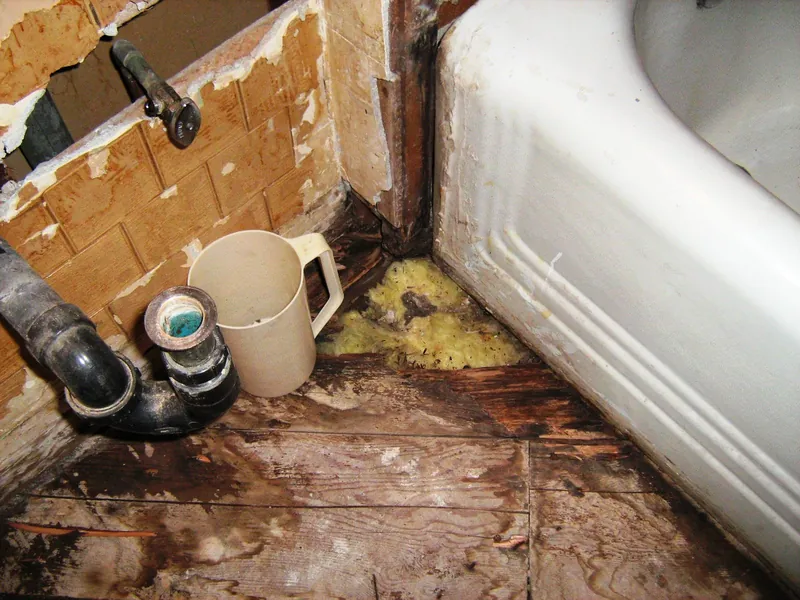

- Carpet and padding draw water upward and keep it pressed against the slab.
- Wood and laminate planks cup, buckle or lift along their seams.
- Tile can come loose once moisture creeps beneath the adhesive.
- Baseboards and drywall absorb water at the bottom edge, then stain or turn soft.
The water-damaged floors page compares flooring types, and the drywall page deals with the walls.
What does drying a soaked slab involve?
The restoration team first takes out wet flooring and padding that cannot be saved. Air movers and dehumidifiers then dry the slab and the base of the walls. Concrete keeps moisture longer than wood or drywall, so readings, not a hand test, show when it is done.
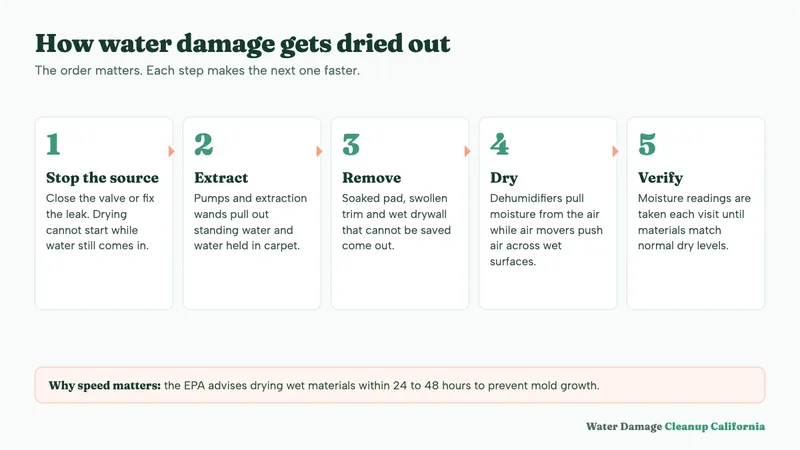
- Any surface with standing water gets extracted first.
- Soaked pad, baseboards and a low strip of drywall may be taken out so the structure can breathe.
- Equipment keeps running, and the restoration team logs readings at every visit.
- Rebuilding starts only when the slab and walls read dry.
More on the steps appears under structural drying and wet carpet drying. For tracking the air once drying ends, see the indoor humidity page.
Will mold form beneath the floor after a leak in the slab?
It can when materials remain wet. Per the EPA, mold growth is best prevented by drying water-damaged areas and items during the first 24 to 48 hours. A hidden slab leak may run far longer, so sniff for mustiness and look for dark patches along the base of walls.
- Indoor humidity should stay below 60 percent according to the EPA, with 30 to 50 percent as the ideal range.
- The EPA says not to paint or caulk moldy surfaces.
- The CDC lists a stuffy nose, sore throat, coughing, wheezing and burning eyes as mold effects, with stronger reactions possible in people who have asthma or a mold allergy.
- The EPA says a moldy patch under about 10 square feet can in most cases be handled by the occupant.
Bigger or concealed growth needs a professional, and the mold after water damage guide covers more.
Will my California homeowners policy pay for a slab leak?
Possibly. Triple-I names accidental discharge or overflow of water from plumbing as a covered peril on standard forms, and the NAIC reports that plumbing-related water damage is typically covered. Policy details settle it, particularly when the leak ran for a long stretch.
Triple-I notes that damage traced to poor upkeep is not covered, and the NAIC says mold is often excluded. The California Department of Insurance says mold caused by a covered peril may be covered. Two questions matter for a slab leak: was it sudden, and does the policy treat the water's damage differently from the pipe itself?
Whether your policy pays to break open the slab for pipe access differs from one policy to the next, and nothing here says what yours does. Put the question to your insurer in writing, covering the pipe repair, the access work and the floor.
Report promptly. Under section 2695.5 of the California regulations, an insurer must acknowledge a claim no more than 15 calendar days after notice.
Under section 2695.7 it must accept or deny within 40 calendar days of proof of claim. The water damage insurance claim guide walks through the process. If the house is on the FAIR Plan, read the FAIR Plan page.
What should I expect to pay for slab leak repair and drying in California?
No verified California price for pipe repair is on file here, so none is given. On the drying side, In its 2025 national guide, Fixr gives a range of $1,200 to $5,000 for water damage restoration and a national average of $3,000. A job in California may land outside that band.
- Fixr lists clean-water extraction at $3.75 to $4.25 per square foot.
- Fixr puts carpeting restoration at $4.75 to $10.50 per square foot and hardwood at $10 to $15.
- Fixr prices Class 1 damage at $150 to $400, Class 2 at $500 to $1,000 and Class 3 at $1,000 to $3,000.
Read these as national reference figures rather than quotes. Collect written bids from every plumber and restoration team, itemizing materials and prices, as Triple-I advises. The restoration cost guide covers what moves a price.
What habits help spot a hidden leak before the floors get wet?
Check the meter on a routine, compare bills, and stay alert to changes underfoot. A dial that moves while everything is off is typically the first warning. Spending a few minutes every few months on the check can expose a leak before flooring soaks through.
- Read the meter with all water off and photograph the dial.
- Set each bill beside the same month from last year.
- Cross the floors in bare feet from time to time and notice warm or damp spots.
- Listen for running water late at night when the house is silent.
- If the house is older, ask a plumber about the age of the pipe and the water pressure.
The water damage prevention guide offers a year-round checklist, and high water pressure deserves a look as well. If you use the home only part of the year, see second home leak monitoring.
Sources: California Department of Insurance, Residential Property Claims Guide; 10 CCR 2695.5; 10 CCR 2695.7; Triple-I, Which disasters are covered by homeowners insurance; Triple-I, Settling insurance claims after a disaster; NAIC, Homeowners Insurance; EPA mold and moisture guide; EPA, Mold cleanup in your home; CDC, About Mold and Your Health; Fixr, Water Damage Restoration Cost; CSLB, Hire a Contractor.
Water Damage Cleanup California is the local water damage restoration line and information resource for California. When you call or send a request, it reaches a local water damage restoration team that serves your area. That team confirms whether it can reach you and gives its own scope, price and timing. Confirm them directly before you agree to anything.