For Peninsula homeowners
For water damage restoration in San Francisco, close the main valve, document the damage and begin drying in the first 24 to 48 hours. Fog keeps indoor air damp, so ask your restoration team to measure moisture. Requests come from San Francisco and San Mateo counties.
On this page (8)
- Which San Francisco and Peninsula cities and ZIP codes do you take requests from?
- Why do fog and damp matter for water damage in San Francisco?
- How does older housing in San Francisco affect leaks?
- Do bay-front and low-lying San Francisco neighborhoods flood?
- How did the 2022 to 2023 storms hit San Francisco and San Mateo County?
- Why does an earthquake bring water damage?
- Will insurance pay for water damage in the Bay Area?
- What are the first steps after water gets into a San Francisco home?
Which San Francisco and Peninsula cities and ZIP codes do you take requests from?
Requests come from San Francisco County and San Mateo County. Main places include San Francisco, Daly City, South San Francisco, San Mateo, Redwood City, Menlo Park, Pacifica and Half Moon Bay. Each restoration team sets its own service area, so ask on the first call whether your block is inside it.
The ZIP finder has one anchor per county: San Francisco and San Mateo. Nearby regions have their own pages: Alameda County, Santa Clara County, the North Bay and the Central Coast.
The 2020 census counted 873,965 people in San Francisco, according to Wikipedia. San Mateo County had 764,442 residents that year.
Why do fog and damp matter for water damage in San Francisco?
Fog keeps the air cool and moist for much of the year, so a wet wall or floor dries slowly. Wikipedia says San Francisco has cool, moist winters and that cool winds and fog come in through the Golden Gate, with less fog in eastern neighborhoods.
The same article puts the average at 73 rainy days a year and 23.65 inches of rain, falling mostly from November to April. That is not a lot of rain, but damp air means a small leak can leave a wall wet long after the source is fixed.
Ask your restoration team how they will check moisture rather than judging by touch, and run a dehumidifier if one is offered. The EPA puts the target for indoor relative humidity under 60 percent, with 30 to 50 percent best. Our humidity after a leak page explains what the numbers mean, and water damage smell covers musty odors.
How does older housing in San Francisco affect leaks?
Many homes are old, and that changes where leaks start. Wikipedia says the city's sea of Victorian houses began to take shape after the first cable cars ran in 1873, and that Pacific Heights has homes built after the 1906 earthquake. Older plumbing and roofs get more attention here.
The west side grew later. According to Wikipedia, it stayed largely undeveloped until the early 20th century, and the Twin Peaks Tunnel of 1918 linked the southwest neighborhoods to downtown by streetcar. Ask your seller or inspector when your own house was built and what has been replaced.
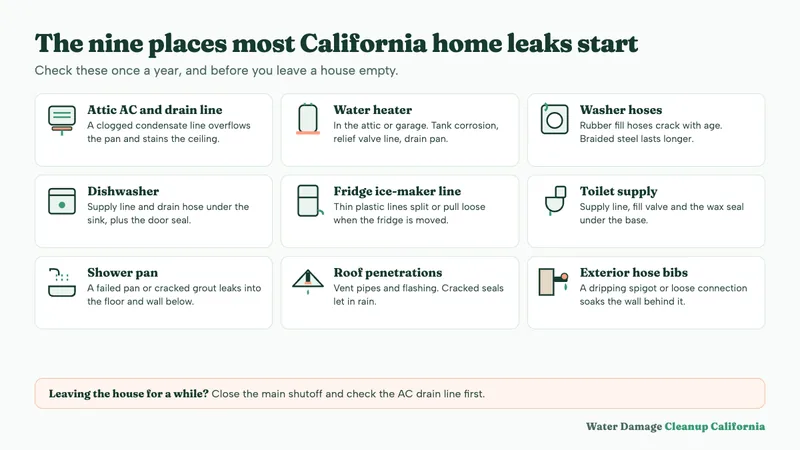
Homes of any age fail at the same weak points, and older pipes make pinhole leaks more likely. See preventing water damage and burst pipe damage for what to check. If you rent or own a unit, read tenant and condo water damage to see who handles a leak from the unit above.
Do bay-front and low-lying San Francisco neighborhoods flood?
Some low areas are built on fill and are vulnerable to water from below as well as above. Wikipedia says the Marina, Mission Bay, Hunters Point and parts of the Embarcadero sit on landfill, and that most natural watercourses, including Islais Creek and Mission Creek, are culverted and built over.
| Setting | What Wikipedia says | What to ask about |
|---|---|---|
| Marina and Mission Bay | Built on landfill | Groundwater, basement garages and flood maps |
| Islais and Mission Creek areas | Creeks culverted and built over | Storm drain capacity on your street |
| Hills such as Twin Peaks | More than 50 hills in the city | Runoff flowing downhill to lower doors |
| Outer west side | Former sand dunes called the Outside Lands | Fog, salt air and damp walls |
Wikipedia also says that as of 2021, sea levels were projected to rise by as much as 5 feet, bringing periodic flooding and rising groundwater to lowland areas. Water that rises from outside counts as Category 3 under the IICRC S500 standard, so see flood damage restoration.
How did the 2022 to 2023 storms hit San Francisco and San Mateo County?
The storms set records. Wikipedia says San Francisco had its second wettest day on December 31, 2022, with 5.46 inches of rain, and that US 101 flooded in South San Francisco. The series of storms ran from December 31, 2022 to March 25, 2023.
Wikipedia also records that State Route 84 near Woodside was closed after a landslide on March 11, 2023, and says repeated storms exceeded the soil's capacity to soak up water. San Mateo County runs along the Santa Cruz Mountains, and its article names bayside watercourses such as San Bruno Creek and Colma Creek.
Its atmospheric river article says the Bay Area averages one Category 4 event every three years. For roofs and gutters under that kind of rain, see roof leak storm damage and the atmospheric river guide.
Why does an earthquake bring water damage?
Quakes break pipes and move heavy fixtures. Wikipedia says the San Andreas Fault caused the 1906 and 1989 San Francisco earthquakes, and that the Marina district, built on landfill, suffered soil liquefaction in 1989. Pipes and fixtures in shaken buildings can fail quietly.
After any strong shake, check around the water heater, under sinks and at washer hoses for wet spots. If you smell gas or see damage to the main line, leave and call your utility first. Shut off the water at the main valve and keep photos of what you find.
The water heater leak page and appliance leak page show typical failure points.
Will insurance pay for water damage in the Bay Area?
Often only for the right cause. Flood is not part of a standard homeowners or renters policy, per the Insurance Information Institute; protection comes from the NFIP or a private carrier instead. FEMA agrees that most homeowners policies exclude flood losses.
The NAIC lists a plumbing failure or roof leak as typically covered, with ground water and rain runoff typically left out. San Mateo County's census data show 43.5 percent of occupied homes are rented, so many people need a renter policy and a landlord who responds. Our insurance claim guide explains the steps.
What are the first steps after water gets into a San Francisco home?
Stop the source and protect people. Then start drying, because the EPA ties mold prevention to drying wet areas and belongings within 24 to 48 hours. Document everything before you move it, and ask a restoration team how they will measure drying.
- Close the main water valve, and turn off power to wet rooms only when you can do so safely.
- Photograph and film each wet area, including serial numbers on damaged appliances.
- Phone your insurer or landlord and note who you spoke to.
- Move small items off wet floors and open interior doors for airflow.
- Avoid outside flood water, since Ready.gov warns that six inches of fast water can topple an adult.
The emergency page has more detail, and mold after water damage covers growth already under way. Timing differs by restoration team, so confirm yours can come to your address.
Sources: San Francisco, San Mateo County, 2022 to 2023 California floods and Atmospheric river (Wikipedia); Ready.gov, floods; IICRC S500; Triple-I, disasters covered by homeowners insurance; FEMA, flood insurance; NAIC, homeowners insurance; EPA, mold and moisture.
Coverage
Cities and communities in SF and the Peninsula
Requests come from 23 cities and communities here, covering 87 ZIP codes. The cities with their own guide come first.
Water Damage Cleanup California is the local water damage restoration line and information resource for California. When you call or send a request, it reaches a local water damage restoration team that serves your area. That team confirms whether it can reach you and gives its own scope, price and timing. Confirm them directly before you agree to anything.