The short version
For emergency water damage in California, work in this order: shut the nearest valve, keep clear of wet wiring and gas appliances, photograph the loss, then call your insurer and a restoration provider. The EPA says wet materials need drying within 24 to 48 hours to prevent mold.
On this page (10)
- When does a leak become a water emergency in California?
- What are the first steps to take right after water starts flowing?
- Where is the water shutoff, and how do you close it?
- Can you stay home when electricity and gas are still connected?
- What should you do if a quake cracked a pipe or tipped the water heater?
- How should you respond when rain or flood water enters the house?
- How do clean water, grey water and sewage differ?
- Who gets the first phone call: plumber, insurer or restoration provider?
- Does a homeowners policy cover sudden water damage?
- What should the first three days of a drying job look like?
When does a leak become a water emergency in California?
Water that keeps arriving, water that has touched outlets or the electrical panel, and water that has soaked into drywall, insulation or flooring all qualify. The EPA advises drying wet areas and belongings within 24 to 48 hours, because mold can start growing after that window.
A spill you mopped up right away is minor. A supply line that split while nobody was home all weekend is a different problem.
- A pipe that split in the attic, inside a wall or under a sink, even a pinhole leak that has dripped for days
- A water heater that gave out in the garage or a closet, or a washer or dishwasher hose that came loose
- A ceiling that is stained or sagging beneath a roof, an attic air handler or an upstairs bathroom
- A toilet that overflowed, or sewage rising from the lowest drain in the house
- Storm runoff or flood water entering through a door, a garage or a low window
- A pipe or water heater that was damaged by an earthquake
What are the first steps to take right after water starts flowing?
Stop the water, make the space safe, take photos, and then phone your insurer and a restoration provider. The sequence holds whether a pipe, an appliance or the roof is to blame. Hold off on tearing out materials until the photos exist.
- Stop the source. Turn off the fixture valve, the water heater inlet or the main house shutoff.
- Kill the power to wet rooms. Work from a dry position, and leave the panel alone if getting there means wading.
- Get people and pets out of any room where the water is deep, dirty or close to outlets.
- Take photos and video of the source, the water and the damaged belongings before anything is moved.
- Notify your insurer. The California Department of Insurance advises homeowners to tell their agent or company promptly about water damage.
- Phone a restoration provider and explain the source, the affected rooms and how long things have been wet.
- Raise small items off soaked floors, and slip foil or plastic beneath furniture legs standing on wet carpet.
Triple-I advises taking reasonable steps to protect the property, saving receipts, and postponing major permanent repairs until an adjuster has assessed the loss. Hold on to ruined items until the adjuster has looked at them.
Where is the water shutoff, and how do you close it?
Begin at the valve nearest the leak: the small stop valve under a sink or behind the toilet, the cold-water inlet at the heater, or the main shutoff at the point the supply line comes into the house. When none of those works, the meter box by the street has a valve, though it can need a special wrench.
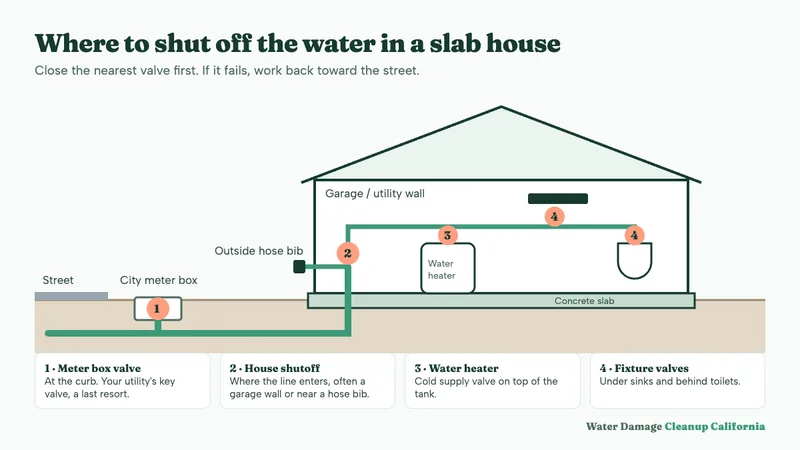
Locate each valve while things are calm. Many Southern California and Central Valley houses sit on a slab, and there the main shutoff often lives on an outside wall, in the garage or next to the meter. A home with a crawl space may bring the line in under the floor, so look there too.
Never muscle a stuck valve with a pipe wrench. Phone a plumber and let the restoration provider know water is still flowing.
If the meter keeps moving while every fixture is off, the leak may be beneath the floor. The slab leak guide describes how to spot it.
Can you stay home when electricity and gas are still connected?
Not if water has reached outlets, the panel or a gas appliance, or if it is deep or contaminated. Keep out of the wet zone, switch the power off from dry footing, and never handle electrical gear while standing in water. When in doubt, step outside and ask for help.
- Keep wet vacs, space heaters and extension cords away from standing water.
- If a gas water heater or furnace was submerged, get it inspected before anyone relights it.
- Smell gas or hear hissing? Exit the building and phone the gas utility from outdoors.
- Ready.gov cautions that six inches of moving water can knock an adult off their feet, and a foot of it can carry a vehicle off.
Wiring hidden inside walls can also get wet. If lights flicker, outlets spark or breakers trip again and again, leave that section off until an electrician has checked it.
What should you do if a quake cracked a pipe or tipped the water heater?
Close the main valve, look for gas and electrical dangers, and photograph what you find. Shaking can crack supply lines and knock heaters over. How insurance treats the loss turns on the cause, so read your policy before you assume anything is covered.
The California Department of Insurance says homeowners, renters and condominium policies exclude earthquake damage, apart from fire. It adds that earthquake policies leave out water damage from outside the home, including sewer or drain back-up and flood.
One California Earthquake Authority sample policy states that its water exclusion does not reach water escaping from water heaters, refrigerators or supply pipes inside the dwelling as a direct result of an earthquake. Your own policy and deductible control, so ask your agent.
Health and Safety Code section 19211 requires existing residential water heaters in California to be braced, anchored or strapped against earthquake motion. For a tank that is already leaking, see the water heater leak guide.
How should you respond when rain or flood water enters the house?
Protect people before property. Head for higher ground, avoid moving water, and stay out of a flooded house until officials declare it safe. Water arriving from outdoors counts as Category 3, so the cleanup is not the same as for a pipe leak.
NOAA reports that roughly 30 to 50 percent of yearly precipitation across the West Coast states comes from a handful of atmospheric river events. A single winter storm can therefore swamp gutters, drains and roofs within hours. The atmospheric river guide explains how these storms work.
Roofs often leak after a long dry spell. The roof leak and storm damage page covers tarping and which photos to take.
Water rising at ground level is covered under flood damage restoration. If a burned slope let go, read the mudslide and debris flow page.
How do clean water, grey water and sewage differ?
Under the IICRC S500 standard, restoration providers place water in one of three categories. The category determines what may be dried where it sits and what must be removed. Sewage and rising flood water land in the worst category, and one storm can bring both.
| Category | Typical source | What it tends to mean |
|---|---|---|
| 1. Clean water | A supply line or a burst pipe | Often dried in place when work starts early. |
| 2. Grey water | Washer or dishwasher discharge, a toilet overflow with no waste | Carpet pad usually comes out and surfaces are cleaned first. |
| 3. Grossly contaminated | Sewage, rising river or stream water, outside surface water | Porous materials the water reached are usually removed. |
Even clean water can be reclassified if it sits long enough, which is why a plain pipe leak still calls for quick action.
Where sewage or other contaminated water caused the damage, the EPA advises hiring a professional with experience in that kind of cleanup. The sewage backup cleanup guide walks through the details.
Who gets the first phone call: plumber, insurer or restoration provider?
Whoever can end the flow. If a valve will not close, that is a plumber. Once the water has stopped but the house is still soaked, contact your insurer and a restoration provider back to back, since the drying clock began the moment water got in.
| Situation | Call first | Then |
|---|---|---|
| Water keeps flowing and the valve is stuck | A plumber | Your insurer and a restoration provider |
| Leak is stopped but the house is wet | Your insurer | A provider for pumping and drying |
| Sewage in the house | A plumber for the line | A provider with contaminated-water experience |
| Storm water or flood water from outside | Emergency services if anyone is unsafe | Your flood insurer, then a provider |
Restoration teams vary in services, coverage areas and availability, so verify each one when you speak. The guide to choosing a restoration company suggests questions to ask.
Does a homeowners policy cover sudden water damage?
Frequently, when the cause is a sudden plumbing, appliance or roof leak, but not for flood water from outside. The California Department of Insurance explains that homeowners policies exclude flood yet cover other water damage, such as rain coming through a storm-damaged roof. The policy wording decides.
Triple-I counts accidental discharge or overflow from plumbing, heating or cooling systems and household appliances as a named peril. Sewer backups, it adds, are left out of a standard policy and need an added endorsement.
The Insurance Information Institute reports a yearly water damage or freezing claim on about one in 60 insured homes, with severity averaging $15,400 across 2019 to 2023.
State rules also set timing for insurers. Under 10 CCR 2695.5(e), the insurer has 15 calendar days to acknowledge notice of a claim and start any investigation it needs. Section 2695.7(b) allows 40 calendar days after proof of claim to accept or deny it.
If opening a claim goes badly, the CDI consumer hotline is 1-800-927-4357. The insurance claim guide covers paperwork and flood versus homeowners coverage, and the cost guide gives price ranges.
What should the first three days of a drying job look like?
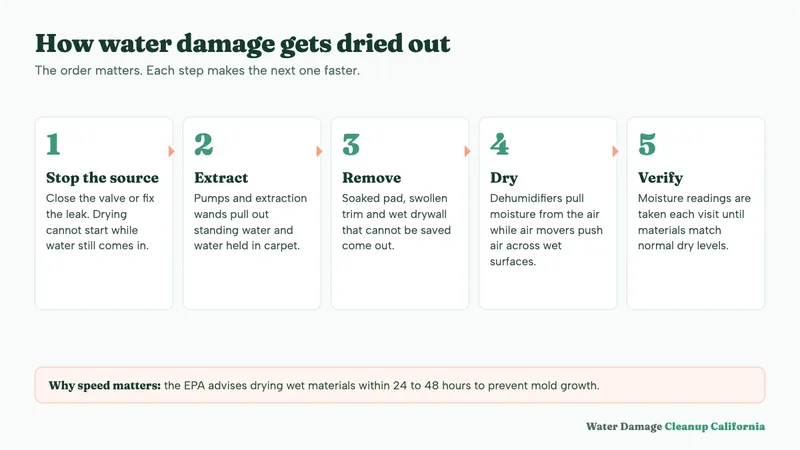
Day one: the source is stopped, standing water is pumped out and the damage is photographed. Day two: soaked materials that cannot be saved are removed and drying equipment is running. Day three: moisture readings drop at every visit. Those are the markers to watch.
To head off mold, the EPA recommends getting wet areas and belongings dry inside 24 to 48 hours. After a flood, the CDC points to the same window and recommends discarding soaked carpets and upholstery that cannot be dried quickly.
Should nothing be drying by the second day, tell the provider. That affects the equipment they need to bring. The water removal page and the water mitigation page show how progress is measured.
Sources: EPA, A Brief Guide to Mold, Moisture and Your Home; EPA, Mold Cleanup in Your Home; IICRC S500; Ready.gov, Floods; CDC, About Mold and Your Health; California Department of Insurance, Residential Property Claims Guide; California Department of Insurance, Earthquake Insurance; California Earthquake Authority, Homeowners Choice sample policy; California Seismic Safety Commission, Health and Safety Code 19211; NOAA Research, Atmospheric Rivers; 10 CCR 2695.5; 10 CCR 2695.7; Triple-I, Which disasters are covered; Triple-I, Settling claims after a disaster; Insurance Information Institute, Homeowners and Renters Insurance.
Water Damage Cleanup California is the local water damage restoration line and information resource for California. When you call or send a request, it reaches a local water damage restoration team that serves your area. That team confirms whether it can reach you and gives its own scope, price and timing. Confirm them directly before you agree to anything.