The short version
Water mitigation vs restoration comes down to timing. Mitigation stops the damage from spreading by removing water and drying the structure, ideally in the first 24 to 48 hours per the EPA. Restoration is the repair and rebuild that follows. Ask any provider to put each task in writing under one phase.
On this page (9)
- What is the difference between water mitigation and restoration?
- What does water mitigation usually involve?
- What does water restoration mean after the drying is done?
- Where does mitigation stop and restoration begin?
- Why does the difference matter for my insurance claim?
- Why do mitigation and restoration often get separate estimates?
- Does the water type change what mitigation involves?
- What happens if mitigation is skipped or delayed?
- How do I know if a quote mixes the two phases?
What is the difference between water mitigation and restoration?
Mitigation is the first phase: it stops damage from spreading by removing water and drying the structure. Restoration is the second: repairing or rebuilding what the water ruined. The two terms get used loosely, so providers and insurers do not always draw the line in the same place.
A simple way to hold it: mitigation keeps the loss from growing, and restoration returns the home to the way it was. Most of the confusion comes from the word restoration, which people use for both phases.
Because the labels are not set by one rulebook, ask any provider to write down which tasks fall under each phase. The water mitigation service page and the water damage repair page describe each side in more detail.
What does water mitigation usually involve?
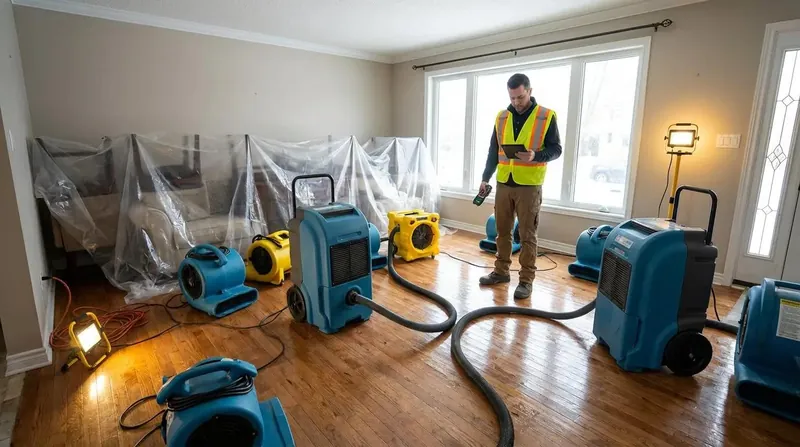
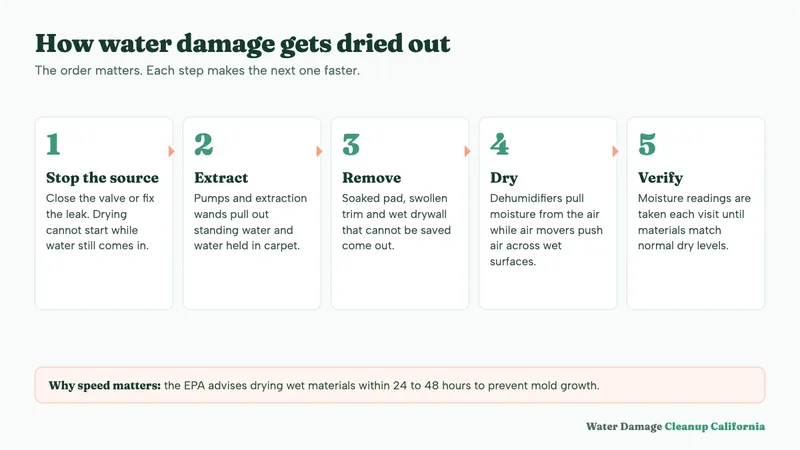
Mitigation covers the urgent work that limits further damage: finding and stopping the source, removing standing water, taking out materials that cannot be saved and drying what can. The goal is to get moisture down fast, since the EPA sets the drying window at 24 to 48 hours for wet areas and belongings.
The California Department of Insurance (CDI) frames the same idea for homeowners. It says one of the most important steps after a property loss is making temporary repairs to prevent further damage, such as covering roof or wall openings with plastic sheeting or plywood.
On a scope of work, mitigation items tend to look like this:
- Source control. Closing a valve, tarping a roof opening or isolating a failed appliance.
- Water removal. Pumping or extracting standing water. See water removal.
- Removal of unsalvageable materials, such as soaked carpet pad or wet insulation.
- Drying and dehumidifying with air movers and dehumidifiers. See structural drying.
- Moisture checks, so someone can say whether materials have reached a dry condition.
- Moving contents out of the wet area. See contents pack-out.
The building changes the list. If your home is on a slab, water can spread under flooring and along wall bases, and a leak beneath the slab needs its own diagnosis. If it has a crawl space, the area under the floor may need a look as well.
What does water restoration mean after the drying is done?
Restoration is the rebuild. Once materials are dry and the source is fixed, damaged drywall, insulation, flooring, trim, paint and cabinets are repaired or replaced. It is ordinary construction work, and it is where most of the cost and the calendar time often land.
The industry standard muddies the vocabulary a little. The IICRC S500 standard, titled for professional water damage restoration, covers procedures and precautions for the work, including drying technology, equipment and the microbiology of water damage. In that usage, restoration includes the drying itself.
The same IICRC page says the standard assumes that finding and correcting the source of the water is the property owner's responsibility, not the restorer's, though the owner may hire the restorer or another specialist to do it. A plumber usually fixes the pipe, and the roofer fixes the roof.
See drywall water damage and water damaged floors for what rebuilding looks like in those materials.
Where does mitigation stop and restoration begin?
The handoff usually comes when the moisture readings show materials are dry and the leftover damage is cosmetic or structural. Until then the work is about drying. After that it is about repair. No state rule fixes the exact moment, so your scope should name it.
| Task | Usually counted as | Why |
|---|---|---|
| Tarping a storm-damaged roof | Mitigation | It keeps more rain out while repairs are arranged |
| Extracting standing water | Mitigation | It limits how far water wicks into materials |
| Running air movers and dehumidifiers | Mitigation, or restoration under the S500 wording | The label differs, the work is the same |
| Replacing cut-out drywall | Restoration | It rebuilds what was removed |
| Installing new flooring and paint | Restoration | It returns the finish to its prior state |
| Fixing the failed pipe or roof | Neither, in most cases | A plumber or roofer handles the cause |
If a quote lists a task you cannot place, ask which phase it belongs to and whether the insurer treats it the same way.
Why does the difference matter for my insurance claim?
Insurers often look at the emergency steps and the permanent repairs separately. CDI says your insurer will reimburse reasonable costs to protect the property if you save your receipts, and that payments for temporary repairs are part of the total loss settlement.
Triple-I, the insurance industry's information group, offers the same guidance: protect the property with reasonable steps, and wait on large permanent repairs until an adjuster has looked at the damage. Photograph the damage and keep receipts before discarding anything.
This split is the reason to start mitigation quickly and slow down on restoration. CDI also warns homeowners to beware of building contractors who encourage spending a lot of money on temporary repairs. If a proposal for emergency work looks large, ask the adjuster about it before you sign.
Coverage depends on the water's source. CDI says homeowners policies do not cover flood damage but do cover other kinds of water damage, and Triple-I notes that neglected maintenance is not covered. The insurance claim guide goes through the process.
Why do mitigation and restoration often get separate estimates?
They are different jobs with different timing. Mitigation is urgent and priced around equipment, labor and materials removed. Restoration is a rebuild priced by the material and finish you choose, and it often cannot be scoped until the drying shows how much is salvageable.
The wording of the contract matters here. The Contractors State License Board (CSLB) says an unlicensed person may complete projects up to $1,000 only if they hire no workers and no building permits are needed, and that the $1,000 includes all labor and materials. Larger or permitted rebuild work needs a licensed contractor.
CSLB also cautions that a down payment should not exceed 10 percent of the contract price. Its consumer guide says the limit is $1,000 or 10 percent, whichever is less, and that payments should follow work completed. See what restoration costs for how pricing is usually built.
Restoration teams differ in what they take on, and some separate the phases while others do not. Confirm directly who does the rebuild and who does the drying.
Does the water type change what mitigation involves?
Yes. The IICRC S500 standard sorts water into three categories: clean water from a supply line or burst pipe, grey water from a washer, dishwasher or toilet overflow without waste, and grossly contaminated water such as sewage and rising flood water. The category shapes how much has to be removed.
For sewage or other contaminated water, the EPA says to hire a professional who has worked on buildings damaged by contaminated water. Ask the provider which materials it plans to remove, since more tear-out means more work in the rebuild phase.
Speed matters most with clean water, since a drying job can often stay a drying job. The categories and classes page explains the types, and sewage backup cleanup covers the contaminated case.

What happens if mitigation is skipped or delayed?
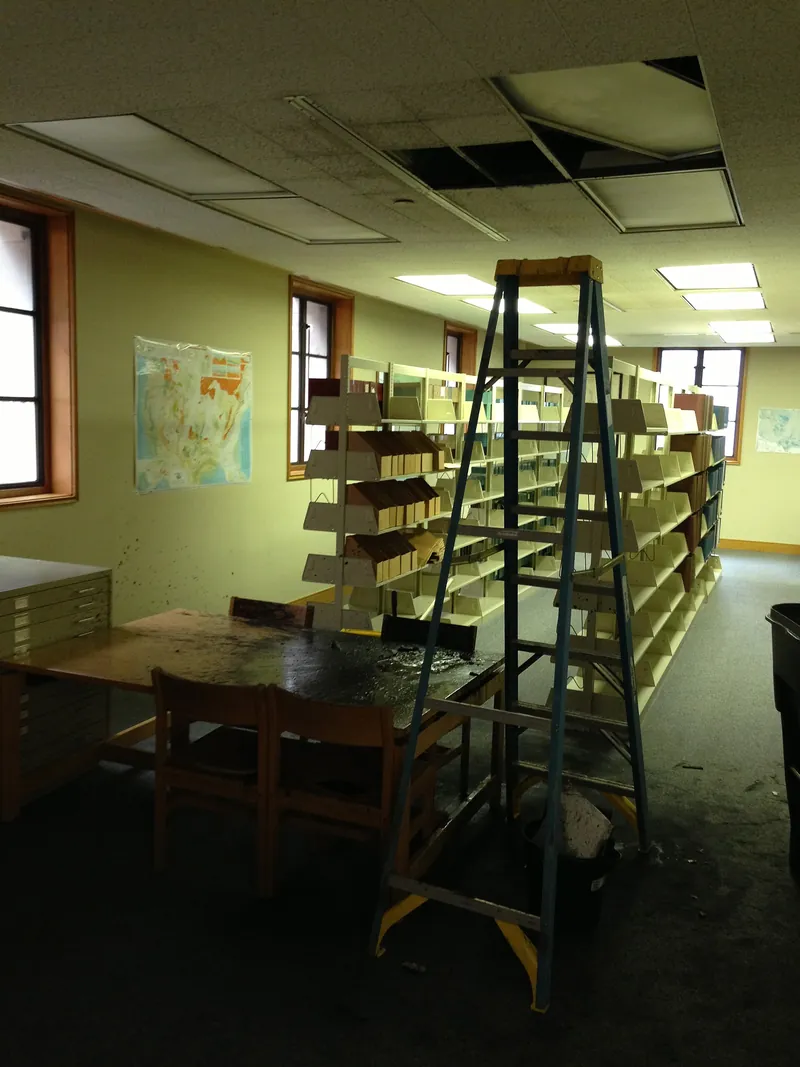
Water keeps moving into materials and mold gets a chance to start. CDI says delay in cleanup can result in mold growth, and the EPA gives 24 to 48 hours as the window for drying wet areas and items. Waiting turns a drying job into a tear-out job.
Mold also changes who can do the work. California sets no state license for mold assessors or remediators, according to the California Department of Public Health, so the contractor license rules apply only to the building portion. Read mold after water damage before you hire anyone.
Homeowners also carry risk on the coverage side. Triple-I notes that standard policies leave out maintenance failures and mold, so a loss that grew while nobody dried it may be harder to claim. NAIC likewise says policies often exclude the cost of mold damage.
How do I know if a quote mixes the two phases?
Read the line items against the table above. A quote that mixes them will list extraction and drying equipment next to new drywall and paint, with one total. Ask for the phases separated so you can show the adjuster what was emergency work and what was repair.
- Ask for a written scope that names each task and the phase it belongs to.
- Ask how drying will be verified, such as moisture readings recorded at the start and the end.
- Ask who handles the rebuild, and whether it is the same business or a separate contractor.
- Check the contractor license on the CSLB site before you sign anything for repair work.
- Send the proposal to your adjuster before agreeing to large permanent repairs.
This site cannot say what any one restoration team offers. Use how to choose a restoration company and the emergency restoration page to prepare your questions.
Sources: IICRC S500; CDI, Residential Property Claims Guide; Triple-I, Settling claims after a disaster; Triple-I, Which disasters are covered; NAIC, Homeowners Insurance; EPA, Brief Guide to Mold, Moisture and Your Home; EPA, Mold Cleanup in Your Home; CSLB, handyperson exemption; CSLB, Terms of Agreement consumer guide; CDPH, Frequently Asked Questions about Mold
Water Damage Cleanup California is the local water damage restoration line and information resource for California. When you call or send a request, it reaches a local water damage restoration team that serves your area. That team confirms whether it can reach you and gives its own scope, price and timing. Confirm them directly before you agree to anything.