The short version
With sewage cleanup in California, stop all water use, keep kids and pets out, and wear gloves and boots for any contact. Category 3 water means soaked carpet and drywall are removed while hard surfaces are disinfected. Paying for it usually takes a sewer backup endorsement on your policy.
On this page (13)
- What do I do in the first minutes after sewage comes up a drain?
- Why does the sewage show up at the lowest drain?
- Does sewage count as Category 3 water?
- Does an overflowing toilet always mean black water?
- Can heavy rain push sewage into a California home?
- Whose job is it to fix the blockage: mine, the city's or a sewer district's?
- Who needs to keep away from sewage?
- Which belongings are lost after a sewage backup?
- What are the stages of sewage cleanup, and how long do they last?
- What drives the price of a sewage cleanup?
- Will my California homeowners policy pay for a sewer backup?
- Can I prevent another sewer backup?
- Which pro comes first for sewage: plumber, utility or restoration team?
What do I do in the first minutes after sewage comes up a drain?
Shut off every source of water headed down the drains and get people out of the room. Each flush, shower or load of laundry pushes more behind the blockage, and the lowest opening in the house takes the overflow. After that, phone a plumber and a restoration team.
- Stop using water at every toilet, sink, tub, shower, dishwasher and washer.
- Get kids and pets out of the area and shut the door to the room that flooded.
- Cut the breaker for that room only when the panel stands on dry ground. If it does not, stay clear and phone an electrician.
- Keep your hands off the water and anything it touched unless you wear waterproof gloves and boots, then wash up thoroughly.
- Take photos of the spill and the drain it came from before you move a thing, because insurers ask for them.
- Phone a plumber to locate the clog and open the line.
When the line runs clear, a restoration team can take over the cleanup. The water removal page describes extraction. Not every restoration team accepts this kind of job, so ask before anyone drives out.
Why does the sewage show up at the lowest drain?
Backed-up sewage follows gravity and exits wherever the opening sits lowest. That is typically a shower, tub or floor drain on the bottom level, and often the fixture closest to the spot where your house line meets the street.
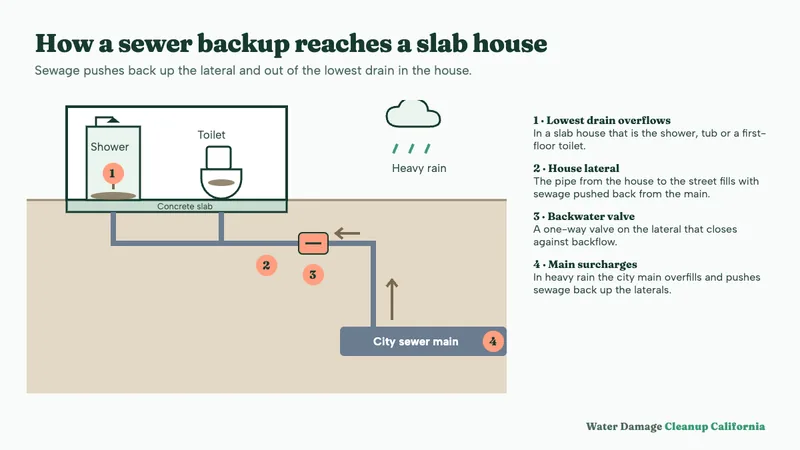
Most backups trace to one of three causes:
- A blockage in your private line between the house and the street, caused by grease, wipes, roots or a broken pipe.
- A public main that is carrying too much, which can follow a storm that floods the system with runoff.
- A clog inside the house, which tends to trouble a single fixture instead of the lowest drain.
In a slab home there is no lower floor to fill, so sewage fans out across the room. If the house has a crawl space, sewage can pool underneath the floor as well, so never go down there to look.
Does sewage count as Category 3 water?
Yes. The IICRC S500 standard lists sewage under Category 3, grossly contaminated water, next to rising water from rivers and streams. It holds bacteria and other pathogens, so any porous material it soaks cannot be made reliably clean and is normally taken out.
For a sewage loss, the EPA advises hiring a professional with experience in buildings damaged by contaminated water. A mop, a household cleaner and a wet vac fall short.
- Carpet, pad, soaked drywall, insulation and upholstered pieces are discarded.
- Concrete, tile and sealed surfaces are cleaned and disinfected.
- Drying equipment comes after the cleaning, never before it.
Water from outdoors is Category 3 too. If it arrived from a street or creek instead of a drain, see the flood damage restoration page.
Does an overflowing toilet always mean black water?
No. In the IICRC S500 scheme, a toilet that overflows without waste in the water is Category 2, grey water. Anything with waste in it, or water that welled up out of a drain, is Category 3. The category settles which items get dried and which get discarded.
| The situation | IICRC S500 category | Typical next steps |
|---|---|---|
| Toilet overflow with no waste | Category 2, grey water | Clean, disinfect and dry. Ask which items can be kept |
| Washer or dishwasher overflow | Category 2, grey water | Check what the water touched, then clean and dry |
| Toilet overflow carrying waste | Category 3 | Porous materials come out, hard surfaces are disinfected |
| Sewage from a tub, shower or floor drain | Category 3 | Soaked porous materials go, hard surfaces are disinfected |
If the source is unclear, play it safe: call it Category 3 and wear gloves and boots. The categories and classes guide walks through all three.
Can heavy rain push sewage into a California home?
It can. When a downpour sends more water into the sewer system than the main can handle, sewage may be forced back toward the lowest homes on the line. A blocked private line can cause the same thing in dry weather, so the forecast alone does not tell you the cause.
The wet season here often comes as a handful of big storms. NOAA reports that about 30 to 50 percent of annual precipitation in the West Coast states falls during just a few atmospheric river events, which is a great deal of water to move at once.
If sewage and flood water arrive together, treat the whole mix as Category 3 and stay out until it is cleaned. The after-storm checklist covers the rest of the house.
Whose job is it to fix the blockage: mine, the city's or a sewer district's?
The answer depends on where the clog sits. Generally, the pipe running from your house to the public main belongs to the property owner, while the main itself belongs to the city or sewer district. Utilities set their own rules, so check yours.
- If the house has a cleanout, photograph it before you phone anyone.
- When neighbors report the same trouble, mention that to the utility.
- Get a written note from the plumber saying where the clog was found. Your insurer and the utility may each want it.
Look on your city or sewer district's website, or call, to learn where its pipes end and yours begin. A plumber with a camera can show which side the clog is on.
Who needs to keep away from sewage?
Anyone without a reason to be near it. Sewage carries bacteria and other pathogens. Keep people with weak immune systems or lung disease, older adults, pregnant people, young children, pets and anyone with open cuts out until the area is cleaned and dry.
- Leave the door closed so odor and spray stay put.
- If you have to enter, use eye protection, waterproof gloves and boots, and wash afterward with soap and clean water.
- Skip eating, drinking and smoking near the spill.
- Call a doctor if anyone feels sick after contact or a cut touched the water.
On hard surfaces, the CDC lists three options: household cleaner, soap and water, or at most 1 cup of household bleach mixed into 1 gallon of water. Do not mix bleach with ammonia or other cleaners, and ventilate as you work.
Which belongings are lost after a sewage backup?
Anything porous that the sewage soaked. On a slab, that usually covers the flooring and the bottom of the walls in the room where the drain overflowed. Photograph each item before it goes in the trash and keep a list for your claim.
- Carpet and its pad.
- Wall board and insulation the water got into, removed from a point above the wet line.
- Cabinets and furniture made of particleboard.
- Upholstered furniture, rugs, mattresses and stuffed toys.
- Cardboard, books, paper, and any food or medicine the water touched.
Concrete, tile, metal, glass and hard plastic usually survive after disinfection. Before tossing solid wood or washable clothing, ask the restoration team what is salvageable. The contents cleaning page covers what can be saved.
What are the stages of sewage cleanup, and how long do they last?
Cleanup runs in a fixed sequence: stop the source, take out the sewage and tainted materials, clean and disinfect, then dry. Duration tracks how far the sewage traveled. A small spill on tile is a brief job, while a carpeted room with wet drywall takes longer.
- Open the line. A plumber clears the clog so the backup ends.
- Pump and remove. The restoration team extracts the sewage and pulls out porous materials.
- Clean and disinfect the hard surfaces that stay, a slab included.
- Dry with air movers and dehumidifiers until readings are back to normal. To head off mold, the EPA says to dry wet areas within the first 24 to 48 hours.
- Rebuild the flooring, drywall and trim after everything tests dry.
The structural drying page explains how readings are checked, and the mold guide applies if anything stayed wet longer.
What drives the price of a sewage cleanup?
Four things set the bill: the size of the affected area, the amount of porous material taken out, the time the sewage sat, and the rebuilding that follows. Fixr's national figures show black water extraction at $7 to $7.50 per square foot, versus $3.75 to $4.25 for clean water. Only a restoration team who inspects the damage can quote it.
- Area: a single bathroom floor or a whole wing.
- Finishes: the carpet, drywall, cabinets and trim that have to be torn out.
- Time: the longer sewage sits, the deeper it soaks into walls and floors.
- Plumbing: opening or repairing the line is billed separately by the plumber.
Those Fixr figures are national averages and not California quotes. The restoration cost guide shows what moves a price.
Will my California homeowners policy pay for a sewer backup?
Generally only if you bought the extra coverage. Triple-I says a standard homeowners policy leaves out sewer backups, and flood insurance does as well. The coverage is sold on its own or as an endorsement, often for a nominal cost, so read your policy before trouble starts.
The California Department of Insurance adds that earthquake insurance does not pay for water damage from outside your home, such as sewer or drain back-up.
- If you have the coverage, report the backup at once. Triple-I advises calling your agent immediately, taking photos and saving receipts.
- Hold on to damaged items until the adjuster has looked at them.
- An insurer must accept or deny a claim within 40 calendar days of proof of claim, and a denial must be in writing (10 CCR 2695.7).
If you dispute a decision, the department takes complaints at 1-800-927-4357. The insurance claim guide covers the whole process.
Can I prevent another sewer backup?
You can lower the odds. Keep grease and wipes out of your pipes, have the line inspected after a repeat backup, and ask a plumber about a backwater valve, a fitting on the sewer line that passes flow outward and shuts if sewage heads back toward the house.
- Scrape grease into the trash, not the sink, and wipe pans with a paper towel first.
- Keep wipes out of the toilet, even those labeled flushable.
- Request a camera inspection of the private line if large trees grow nearby or drains run slowly throughout the house.
- Ask a plumber if a backwater valve fits your line and whether it needs a permit.
- Ask your agent about a sewer backup endorsement.
Have the line cleared and inspected before any rebuilding starts. A repeat backup would ruin the new flooring and drywall.
Which pro comes first for sewage: plumber, utility or restoration team?
Usually all three, in order. A plumber opens a blockage in your private line, the utility looks after the public main, and a restoration team cleans and dries whatever the sewage touched. Restoration teams differ on Category 3 work, so ask at the start.
The guide to choosing a restoration company suggests questions to ask. Request the scope in writing, and find out what will be removed before work begins.
To get started, reach out through the contact page and a local water damage restoration team that serves your area will answer.
Sources: IICRC S500; EPA, Mold Cleanup in Your Home; EPA, A Brief Guide to Mold, Moisture and Your Home; CDC, About Mold and Your Health; Triple-I, Which disasters are covered by homeowners insurance; Triple-I, Settling insurance claims after a disaster; California Department of Insurance, Earthquake Insurance; California Department of Insurance, Help; 10 CCR 2695.7; NOAA Research, Atmospheric Rivers; Fixr, Water Damage Restoration Cost.
Water Damage Cleanup California is the local water damage restoration line and information resource for California. When you call or send a request, it reaches a local water damage restoration team that serves your area. That team confirms whether it can reach you and gives its own scope, price and timing. Confirm them directly before you agree to anything.