The short version
With bathroom water damage in California, shut the fixture valve, mop up pooled water, clear out wet cabinets and photograph the damage. Repairing the source belongs to the plumber, and drying cabinets, floors and walls falls to a restoration team. The EPA says wet materials should be dry within 24 to 48 hours.
On this page (12)
- How do I stop a bathroom or kitchen leak before it spreads?
- What is leaking in my bathroom or kitchen, and who repairs it?
- What signs point to a shower leak behind the wall or under the floor?
- Are soaked cabinets a total loss?
- How does water affect the floor beneath a tub, vanity or sink?
- Can a tiled surface conceal a leak?
- What do I do when a toilet overflows?
- Why did a stain appear on the ceiling under my bathroom?
- Which water category applies to a fixture leak?
- Will my California policy pay for a bathroom or kitchen leak?
- Is mold likely under a sink or behind a shower wall?
- What should I expect to pay for bathroom or kitchen repairs?
How do I stop a bathroom or kitchen leak before it spreads?
Close the water off at the fixture, then begin drying. Bathroom water damage in California often creeps into cabinet bases, wall cavities and flooring before anyone notices, so the first two days count for more than the first few minutes. These steps keep the leak from growing.
- Turn the stop valve clockwise. Sinks and toilets each have a small valve of their own. If it will not budge, close the main house valve, and see the burst pipe page for its usual location.
- Cut the power to the wet room at the panel, but only if you can get there without standing in water.
- Empty the vanity or cabinet. Pull out everything damp so air can reach the bottom panel.
- Take photos of the source and the damage before wiping anything.
- Mop up pooled water with towels or a wet vacuum and point a fan at the area.
- Phone two kinds of help: a plumber for the repair and a restoration team for the drying.
Some restoration teams dry cabinets and open floors while others pass the rebuild to a contractor, so ask which applies. The water damage repair page shows how drying and rebuilding fit together.
What is leaking in my bathroom or kitchen, and who repairs it?
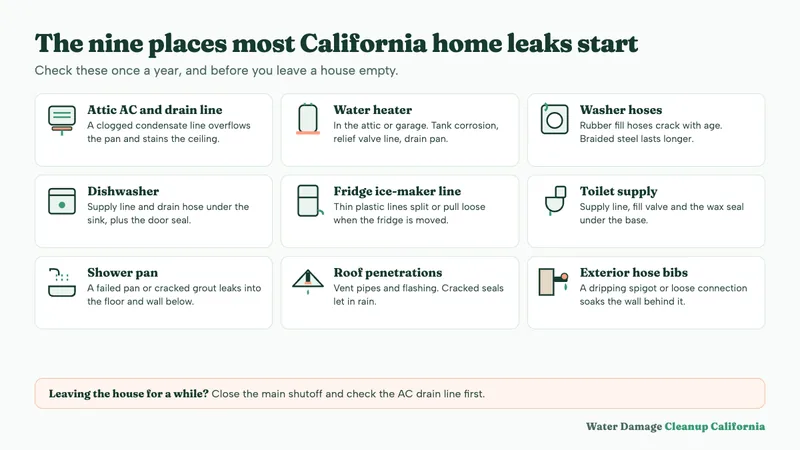
Each fixture fails in its own way, and stopping the leak is usually a plumber's task. The table lists each common source with its warning signs. A restoration team comes in afterward to dry whatever the water reached, which is a separate job.
| Source | Warning signs | Quick stop | Who repairs it |
|---|---|---|---|
| Shower pan or wall | Soft floor beside the stall, loose tile, a stain in the room below | Stop using the shower | Plumber or tile contractor |
| Tub overflow or drain | Water at the floor while the tub fills or empties | Shut the tap, lower the water | Plumber |
| Toilet wax ring or supply | A damp base, a bowl that shifts when you sit | Valve behind the bowl | Plumber |
| Sink supply line | Beads of water at the valve, a damp cabinet floor | Stop valve under the sink | Plumber |
| Drain or P-trap | Drips only while water runs out | Stay off the sink | Plumber |
| Faucet body | Pooling around the handle or base | Stop valves below | Plumber |
| Disposal or dishwasher drain | A smell under the sink, drips from the housing | Switch it off | Plumber or installer |
For dishwashers, refrigerators and washers, see the appliance leak page. Tank failures have a page too, water heater leaks.
What signs point to a shower leak behind the wall or under the floor?
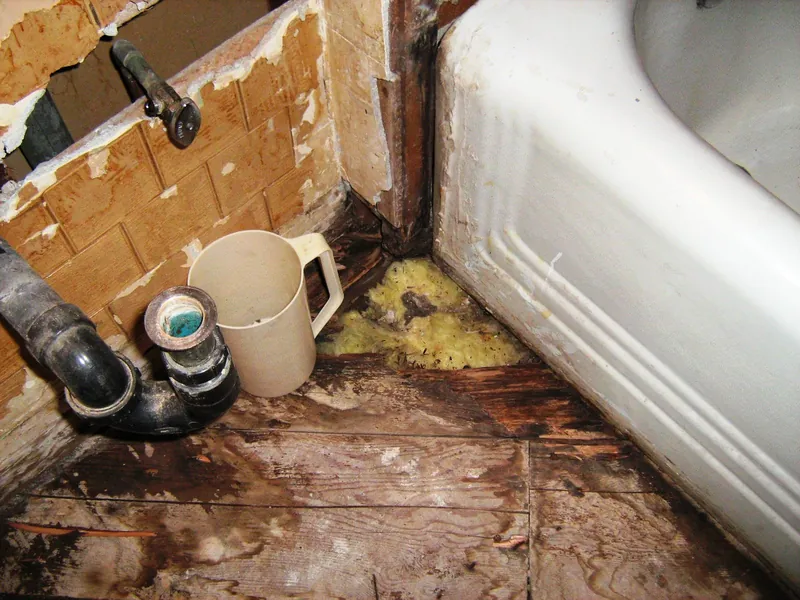
Check the area around the shower, not the stall itself. Failing pans and wall seals seldom show inside. Take seriously a spongy floor outside the glass, tile that sounds hollow when tapped, grout that cracks again after being fixed, or a stain on the ceiling of the room below.
To test the pan, a plumber can plug the drain and see whether the water level falls. A moisture meter held against the adjoining wall reveals how far water has traveled. Wet walls next to a tub bring up the same keep-or-cut decision described in drywall water damage repair.
If a patch beside the shower will not dry, or smells musty for no obvious reason, ask for a meter reading ahead of any re-grouting or recaulking. Sealing over a wet wall conceals the trouble for a time while it keeps growing.
Are soaked cabinets a total loss?
Often not. Solid wood can usually be dried and kept, while particleboard rarely recovers. Inspect the lower edge of the doors, the cabinet floor and the toe kick. Swelling, bubbled veneer, a soft base and a musty smell show how much the material took in.
Particleboard and MDF absorb water, swell and weaken, and drying does not shrink them back. A swollen door edge is cosmetic. A swollen floor under a sink is structural, since it carries the weight of the box and whatever is stored inside.
To get air behind and beneath the cabinet, a restoration team may remove the toe kick and drill a few small access holes. Ask which parts can remain before approving a tear-out, and take photos first because an adjuster will want to see them. Our cabinet water damage page goes further. Countertops are generally fine, although a laminate top over a particleboard core may swell at the seams.
How does water affect the floor beneath a tub, vanity or sink?
Floor structure keeps water longer than the finished surface does. Wood beneath a tub, vanity or kitchen sink can stay wet for a long stretch while nothing shows above it, and the right response depends on how your house is built.
With a slab, what sits under the cabinet is concrete with a tile, vinyl or wood covering. Concrete will not rot, yet it can retain water and keep the covering above it wet. With a raised foundation and crawl space, the floor is wood framing over open air, and water can drip through to the space below.
On an upper floor, water can pass down to the ceiling beneath. Framing that stays wet can soften. Look for a floor that dips, flooring lifting along its edges, a stain that comes back and a damp odor. A restoration team checks with a moisture meter and may open the cabinet or floor. For finished-floor options, see water-damaged floor repair.
Can a tiled surface conceal a leak?
Yes. Water passes through cracked grout and open joints and collects beneath while the surface looks perfect. Tile itself does not absorb, but the backer board, mortar bed and wood under it do, and they dry slowly.
- Crumbling or missing grout gives water a path between tiles.
- Loose or hollow-sounding tile suggests the bond underneath has let go.
- Dark grout lines that return after scrubbing may signal moisture from below.
- A soft spot next to the tub points to a wet floor structure.
Fresh grout fixes only the surface. Should water be reaching the space behind the tile, the wall or floor must be opened and dried before anyone seals it again.
What do I do when a toilet overflows?
Shut the valve behind the bowl, and hold the tank flapper closed by hand if the tank keeps refilling. Next, size up the water. IICRC S500 places a toilet overflow with no waste in Category 2 (grey water), and one that carries waste is more serious.
Handle grey water carefully. Put on gloves, keep kids and pets out, and do not try to dry soaked materials yourself. If the water rose through a floor drain or the lowest fixture and not the bowl, you may have a sewer backup, covered under sewage backup cleanup.
Watch upstairs bathrooms closely. Overflow can slip past the toilet flange or tub drain and appear later as a stain on the ceiling below.
Why did a stain appear on the ceiling under my bathroom?
Water traveled down. In a two-story house, a leaking shower, tub or toilet upstairs can drip through the floor and surface in a ceiling far from its origin. Do not poke a bulging ceiling unless you have a plan for the water that will come out.
To let a bulge drain without a mess, follow the ceiling water damage guide. Tell the restoration team which upstairs fixture is involved, because where it started matters as much as the stain. Attic equipment can leave the same mark, so if the bathroom above seems dry, check an air handler drain line or a water heater before blaming the shower.
Which water category applies to a fixture leak?
The origin of the water sets it. Under IICRC S500, a supply line or burst pipe produces Category 1, clean water. A washer, dishwasher or waste-free toilet overflow produces Category 2, grey water. Sewage and rising flood water fall into Category 3, grossly contaminated.
A cracked supply line begins as Category 1, but a drain leak never does. Even if it began clean, water that has lingered in a cabinet or floor gets handled more carefully than a fresh spill.
Storm water entering from outdoors counts as Category 3, and FEMA notes that most homeowners insurance excludes flooding. A fixture leak and a storm call for different drying plans and different claims. The categories and classes page has the details.
Will my California policy pay for a bathroom or kitchen leak?
Sudden plumbing leaks are often covered, and slow ones often are not. The California Department of Insurance says homeowners policies exclude flood but cover other kinds of water damage. NAIC says plumbing-related damage is typically covered, but ground water and rain runoff are not.
Gradual damage is where trouble starts. Triple-I says policies do not pay for damage from lack of maintenance, mold or pests. A supply line that bursts and drenches a vanity is a very different claim from a drip nobody noticed for months.
The department advises tracking down and stopping leaks at the source and reporting the claim right away. Under state claim rules, an insurer must acknowledge a claim within 15 calendar days of notice, and must accept or deny within 40 calendar days after receiving proof of claim.
Triple-I advises keeping receipts and putting off major permanent repairs until the adjuster has visited. Many policies treat the plumbing fix and the resulting damage as separate items, so read yours. The insurance claim guide takes you through it.
Is mold likely under a sink or behind a shower wall?
Yes, it is. The cramped spaces below sinks and inside shower walls stay humid with almost no airflow. The EPA says water-damaged areas and items should be dried within 24 to 48 hours to prevent mold growth, a deadline that is easy to miss when the leak is hidden.
Watch for a musty smell, dark spots on a cabinet floor and paint peeling close to the shower. For humidity, the EPA recommends staying below 60 percent, with 30 to 50 percent the best range.
The EPA says a moldy patch under about 10 square feet can usually be handled by the homeowner, and that painting or caulking over mold is a mistake. Contaminated water or a bigger area calls for a professional.
The CDC lists a stuffy nose, coughing and burning eyes as symptoms, with stronger reactions in people with asthma. Read more in mold after water damage.
What should I expect to pay for bathroom or kitchen repairs?
Cost depends on the fixture, the materials and the reach of the water. Fixr and Bob Vila both cite $1.50 to $3 per square foot nationally for drywall repair, and Bob Vila gives $350 to $1,250 for ceiling repair. None of that includes cabinets, tile or plumbing.
These are national averages, so a California quote may differ. Pricing a room takes measuring and testing, and every restoration team sets its own rates, so ask them directly. Our restoration cost page offers the larger view.
Before hiring for the repair, verify the contractor's license. The Contractors State License Board says an unlicensed person may take a project up to $1,000, labor and materials included, only if no workers are hired and no permit is needed. See choosing a restoration company for questions to ask.
Sources: IICRC S500; California Department of Insurance, Residential Property Claims Guide; 10 CCR 2695.5; 10 CCR 2695.7; NAIC, Homeowners Insurance; Triple-I, Which disasters are covered by homeowners insurance?; Triple-I, Settling insurance claims after a disaster; FEMA, Don't have flood insurance; EPA, A Brief Guide to Mold, Moisture and Your Home; EPA, Mold Cleanup in Your Home; CDC, About Mold and Your Health; Bob Vila, How Much Does Water Damage Restoration Cost?; Fixr, Water Damage Restoration Cost; CSLB, Handyperson Exemption to Increase to $1,000 in 2025
Water Damage Cleanup California is the local water damage restoration line and information resource for California. When you call or send a request, it reaches a local water damage restoration team that serves your area. That team confirms whether it can reach you and gives its own scope, price and timing. Confirm them directly before you agree to anything.