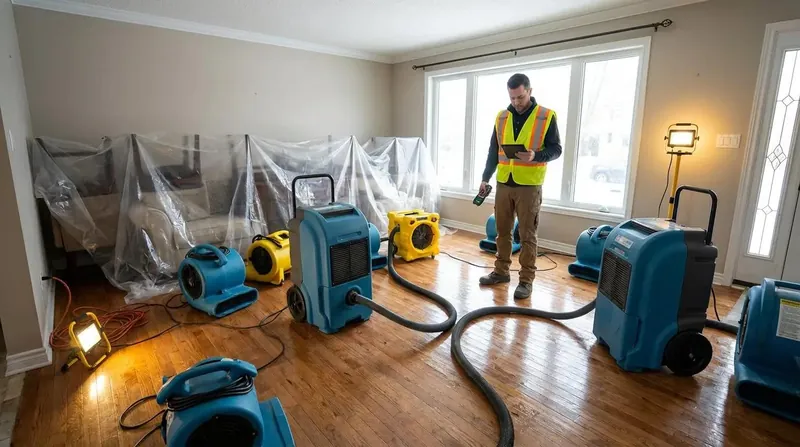
For Riverside County homeowners
For water damage restoration in Riverside County, CA, stop the water, photograph everything and start drying in the first 24 to 48 hours. Water entering from outside is flood water, which standard homeowners policies exclude. Imperial County requests are taken too.
On this page (7)
- Which Riverside County cities and ZIP codes do you take requests from?
- Why does one Riverside County address differ so much from another?
- How do the Santa Ana River and Temescal Creek affect western homes?
- Did a burn scar ever send mud into Corona homes?
- What goes wrong in Idyllwild, Palm Springs and the desert?
- Will homeowners insurance cover water damage in Riverside County?
- What should I do in the first hour after water gets in?
Which Riverside County cities and ZIP codes do you take requests from?
Requests for water damage restoration in Riverside County come from the western cities, the mountain towns and the Coachella Valley. Imperial County requests are taken too. A restoration team confirms by phone whether they can reach your street, because the county is very large and restoration teams differ on how far they travel.
Three cities have their own pages: Riverside, Corona and Temecula. To check a ZIP code, use the finder for Riverside County or Imperial County.
Wikipedia reports that the 2020 census counted 2,418,185 residents here, the fourth-most populous county in California. Bordering hubs are San Bernardino County, Orange County and San Diego County.
Why does one Riverside County address differ so much from another?
The county is long and varied. Wikipedia says it is about 180 miles wide east to west, and that county documents describe the Colorado River town of Blythe as a three-hour drive from the city of Riverside. Western areas have a chaparral, Mediterranean climate, while the central and eastern parts are mostly desert or mountains.
The table groups the county into three settings. Each has a different habit of failing, so tell the restoration team which one you live in.
| Setting | Places Wikipedia names | Water problem to watch for |
|---|---|---|
| Western valleys | Riverside, Corona, Temecula | Slab and pipe leaks, roof leaks in winter storms, runoff near creeks |
| Mountains | Idyllwild, the San Jacinto and Santa Rosa mountains | Cold snaps, cabins left empty, pipes in crawl spaces |
| Coachella Valley and desert | Palm Springs, Indio, Palm Desert, La Quinta, Desert Hot Springs | Air conditioner drains, water heaters, slow leaks in vacation homes |
If you are unsure which row fits, give the restoration team your street and nearest city.
How do the Santa Ana River and Temescal Creek affect western homes?
They carry storm water through the west side of the county. Wikipedia says the city of Riverside took its name from its spot near the Santa Ana River, which runs nearly 100 miles from Mount San Gorgonio to the Pacific. The county then took the name of its seat.
In Corona, Wikipedia places the old village of Paxauxa on the banks of Temescal Creek, and says the Santa Ana Mountains and Cleveland National Forest wrap the city's western side. Homes near a creek bed or at the foot of a slope deserve a look after a hard storm.
Water that enters from outside is flood water. The IICRC S500 standard lists rising river water and outside surface water as Category 3, grossly contaminated. Read about storm and flood damage and flood damage restoration before you touch anything wet.

Did a burn scar ever send mud into Corona homes?
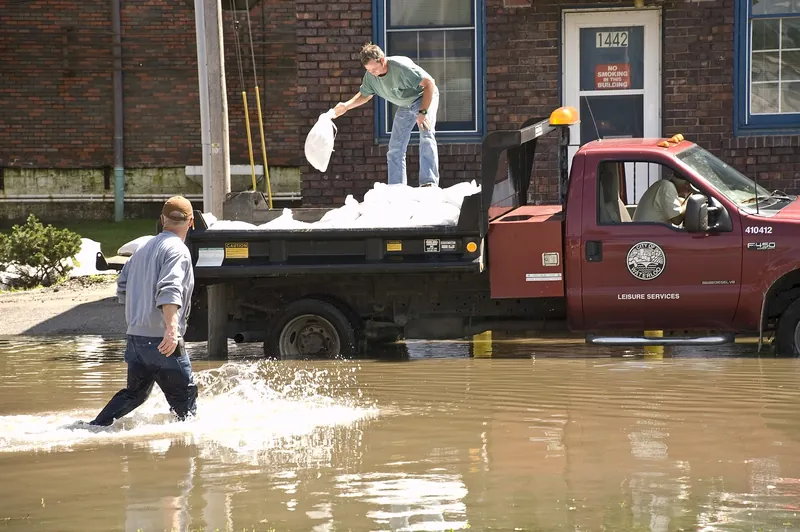
Yes, on a small scale. Wikipedia's article on the January 2018 Southern California mudflows says heavy rain in Corona, where the Canyon Fire had burned, covered streets with mud and flooded into several homes. The article records no major damage there, though the larger event hit Santa Barbara County hardest.
The lesson reaches foothill neighborhoods. When a fire burns the slope above a street, rain can bring mud before plants grow back. Ask your city or the county about debris-flow risk, and read our page on post-wildfire flood and mudflow damage.
Insurance treats this differently from plumbing leaks. The California Department of Insurance said in a February 2025 release that homeowners and commercial policies typically exclude flood, mudslide and debris flow, unless a recent wildfire or another covered peril caused it. Ask your insurer which applies to your loss.
What goes wrong in Idyllwild, Palm Springs and the desert?
Cold causes trouble in the hills, and heat causes it in the desert. Wikipedia lists Idyllwild Park and the San Jacinto Mountains inside the county. A cabin that sits unused for weeks can freeze or leak with nobody there to see it.
The American Red Cross says pipes in attics, crawl spaces, garages and kitchen cabinets are the most exposed to freezing. It suggests keeping heat at 55 degrees Fahrenheit or higher when you are away, and letting cold water drip from faucets on exposed pipes.
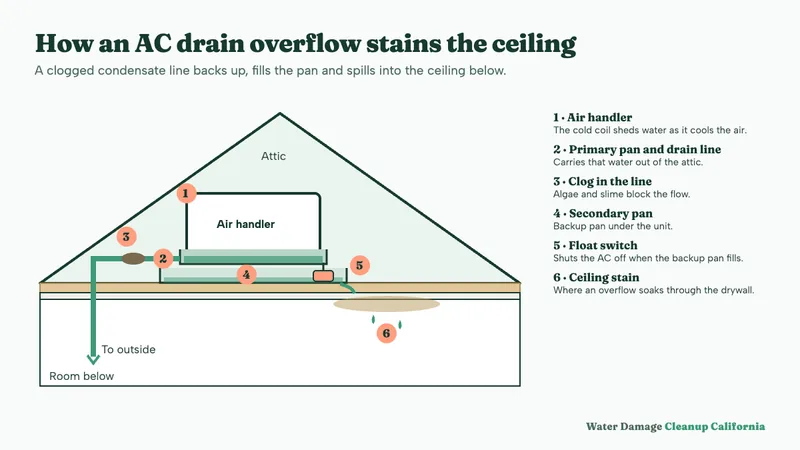
In the Coachella Valley, the air conditioner runs for much of the year, so a clogged condensate line is a frequent cause of ceiling stains. Triple-I lists accidental discharge from air conditioning, plumbing and appliances among the water losses standard policies name. See AC condensate leaks, water heater leaks and leak monitoring for second homes.
Will homeowners insurance cover water damage in Riverside County?
It depends on where the water came from. The California Department of Insurance says homeowners policies do not cover flood damage but do cover other kinds of water damage. The NAIC adds that plumbing leaks and roof leaks are typically covered, while ground water and rain runoff are not.
FEMA also says most homeowners insurance does not cover flood losses. A burst supply line and a creek overflow can therefore get different answers from the same insurer. Our California flood insurance guide explains separate flood cover.
California sets clocks for insurers in 10 CCR sections 2695.5 and 2695.7. The table summarizes them. Our insurance claims guide covers photos and paperwork.
| Step | Insurer deadline | Section |
|---|---|---|
| Acknowledge a claim | No more than 15 calendar days | 2695.5(e) |
| Accept or deny after proof of claim | No more than 40 calendar days | 2695.7(b) |
| Pay after acceptance | No more than 30 calendar days | 2695.7(h) |
If an insurer is slow, the department's consumer hotline is 1-800-927-4357.
What should I do in the first hour after water gets in?
Stop the source, make the area safe and start the paperwork. The EPA advises drying water-damaged areas and items in the first 24 to 48 hours to prevent mold, and holding indoor humidity between 30 and 50 percent, and below 60. Most of these steps need no equipment.
- Close the main shutoff, or the valve at the fixture. Cut power to a wet room only if the panel is dry and easy to reach.
- Film every wet room, then photograph damaged belongings before moving them.
- Report the loss to your insurer and ask how it wants documents sent.
- Call a restoration team and ask what moisture readings they record.
- Stay out of moving water in streets and washes. Ready.gov warns that six inches of moving water can knock a person down.
The what to do after water damage guide has the longer list, and emergency water damage help explains how a call works. If a stain has already darkened, read mold after water damage.
This site is the local water damage restoration line and information resource. You have no obligation to hire anyone you reach. The team confirms availability, price and scope, and choosing a restoration company lists questions to ask.
Sources: Riverside County, Inland Empire, Corona and 2018 Southern California mudflows (Wikipedia); IICRC S500; California Department of Insurance, February 4, 2025 release; California Department of Insurance, Residential Property Claims Guide; 10 CCR 2695.5 and 10 CCR 2695.7; American Red Cross, frozen pipes; NAIC, homeowners insurance; Triple-I, disasters covered by homeowners insurance; FEMA, flood insurance; EPA, mold and moisture; Ready.gov, floods.
Coverage
Cities and communities in Riverside County
Requests come from 43 cities and communities here, covering 100 ZIP codes. The cities with their own guide come first.
- Aguanga
- Anza
- Banning
- Beaumont
- Blythe
- Cabazon
- Calimesa
- Cathedral City
- Coachella
- Desert Center
- Desert Hot Springs
- Hemet
- Homeland
- Idyllwild
- Indian Wells
- Indio
- La Quinta
- Lake Elsinore
- March Air Reserve Base
- Mecca
- Menifee
- Mira Loma
- Moreno Valley
- Mountain Center
- Murrieta
- Norco
- North Palm Springs
- Nuevo
- Palm Desert
- Palm Springs
- Perris
- Quail Valley
- Rancho Mirage
- San Jacinto
- Sun City
- Thermal
- Thousand Palms
- Whitewater
- Wildomar
- Winchester
Water Damage Cleanup California is the local water damage restoration line and information resource for California. When you call or send a request, it reaches a local water damage restoration team that serves your area. That team confirms whether it can reach you and gives its own scope, price and timing. Confirm them directly before you agree to anything.