For Los Angeles County homeowners
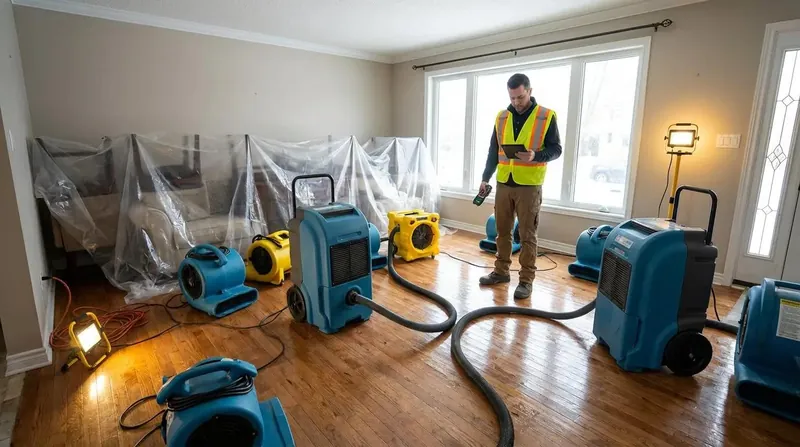
For water damage restoration in Los Angeles County: stop the leak, record the damage, then dry the structure in the first 24 to 48 hours. Standard homeowners policies usually exclude flood and sewer backup. Requests are taken county-wide.
On this page (8)
- Which Los Angeles County cities and ZIP codes do you take requests from?
- Why does water damage look so different across Los Angeles County?
- Does the Los Angeles River still flood?
- What do hillside homes face when a big storm arrives?
- Which parts of the county should check what first?
- Do older homes and earthquakes change what leaks in Los Angeles County?
- Will insurance pay for storm, flood or sewer water in Los Angeles County?
- How quickly should I start drying after a leak in Los Angeles County?
Which Los Angeles County cities and ZIP codes do you take requests from?
People across the county can request water damage restoration in Los Angeles County, whether they live in a big city or a small town. The ZIP finder's Los Angeles County anchor shows covered codes. Which streets a restoration team will drive to is settled with you by phone.
Wikipedia says the county holds 88 incorporated cities and 101 unincorporated areas. The name on your mailing address may therefore differ from the government that issues your permits.
City pages cover Los Angeles, Long Beach, Glendale, Pasadena, Santa Clarita and Torrance.
The 2020 census counted 3,898,747 people in the city of Los Angeles, and Long Beach is the second-largest city in the county. Suburbs in the San Fernando, San Gabriel and Pomona valleys are covered too. Neighboring regions have their own pages: Ventura County, Orange County, Riverside County and Kern County.
Why does water damage look so different across Los Angeles County?
The county packs very different ground into one boundary. Wikipedia describes 70 miles of Pacific coast plus mountain ranges, valleys, forests, islands, lakes, rivers and desert. A leak in a beach-area condo and a roof failure in a foothill house start from different weather and different construction, so the first checks differ too.
Climate splits the same way. The north of the county has a desert climate, and most of the rest is semi-arid or hot-summer Mediterranean, with rain mostly in winter and snow on some northern mountains. Within the city, Wikipedia gives a July average high of 70 degrees at the Santa Monica Pier and 95 degrees in Canoga Park, 15 miles away.
That spread matters for drying. A damp coastal house and a hot valley house hold moisture differently, so ask the restoration team what readings they take and how often they come back to log them. Our cost guide covers what shapes a bill.
Does the Los Angeles River still flood?
Mostly it stays in its channel, because it was rebuilt to do exactly that. Wikipedia says the river runs nearly 51 miles from Canoga Park to its mouth in Long Beach, now in a concrete channel on a fixed course. The channel followed devastating floods in the early 1900s.
Before that, the river wandered across a flood plain now covered by Los Angeles and Long Beach. The same article says floods destroyed houses and killed people and livestock. It lists the Crescenta Valley flood of 1933 and 1934 and the Los Angeles flood of 1938, after which the Army Corps of Engineers began encasing the bed and banks.
Not every stretch is paved. Wikipedia names the Sepulveda Dam basin near Van Nuys, an 11-mile reach east of Griffith Park and the last few miles in Long Beach. It adds that Bell, Bell Gardens, Cudahy, Maywood and South Gate sit in the river flood plain and flooded significantly before the channel existed.
Water that arrives from outside is a different category from a broken pipe. IICRC S500 classes river and stream flood water as Category 3, grossly contaminated. Read about flood damage restoration before you touch anything.
What do hillside homes face when a big storm arrives?
They face more rain, wet slopes and moving debris. Wikipedia says rainfall in Los Angeles is usually higher in the hills and coastal slopes than on the flat basin. Downtown averages 14.67 inches a year, mainly from November to March, and hill neighborhoods get more.
Wikipedia also notes that average years are rare. A short string of dry years with 5 to 10 inches is followed by one or two wet years above 20 inches, and a series of rainy days can bring floods to lowlands and mudslides to the hills. The danger is highest after wildfires have stripped the slopes.
The 2018 mudflow article shows how that plays out. A January 2018 storm led to mandatory evacuations in parts of Los Angeles, Santa Barbara and Ventura counties because fire-burned slopes had lost the vegetation that held soil in place. Our mudslide page and atmospheric river guide cover the next steps.
During the January 2023 storms, a sinkhole near Chatsworth swallowed two cars, a reminder that heavy rain can break things that looked solid.
Which parts of the county should check what first?
The sources point to four different kinds of ground in the county. The table matches each one with a note from Wikipedia and a first inspection to make after a leak or storm. Treat it as a prompt rather than a flood map, and verify your own address with the county.
| Part of the county | What Wikipedia says | First thing to check |
|---|---|---|
| Gateway Cities and Long Beach | Several cities sit in the old river flood plain; the river ends in Long Beach | Ask the city or county for your flood zone |
| San Fernando Valley | The river begins at Canoga Park and passes through the Sepulveda Dam basin | Where roof and yard water drains in a storm |
| Hillsides and foothills | Higher rainfall on hills; mudslides follow wildfires | Gutters, slope drainage and burn-area warnings |
| Westside and beach cities | Ballona Creek flows into Santa Monica Bay at Playa del Rey | Garages, low entries and street drains |
Wikipedia adds that the Los Angeles County Department of Public Works runs the countywide flood control system, so it is a sensible first call about drainage near you.
Do older homes and earthquakes change what leaks in Los Angeles County?
They can raise the odds of a hidden leak. Wikipedia says Los Angeles neighborhoods developed piecemeal, and some were separate cities before they merged, so house age varies block by block. If yours is older, ask a plumber to check the original supply lines and shutoff valves.
Shaking is the second factor. Wikipedia records the magnitude 6.7 Northridge earthquake in 1994, and says Long Beach sits on the Newport-Inglewood Fault. The magnitude 6.4 quake of 1933 killed 120 people there, and most damage was in unreinforced masonry buildings.
Apartments and condos are part of this picture. Wikipedia says a survey counted 3,226 soft-story buildings in Long Beach holding 26,000 living units, and the city encourages retrofits. If you rent or own a unit, read tenant and condo water damage to see who handles a leak from the unit above.
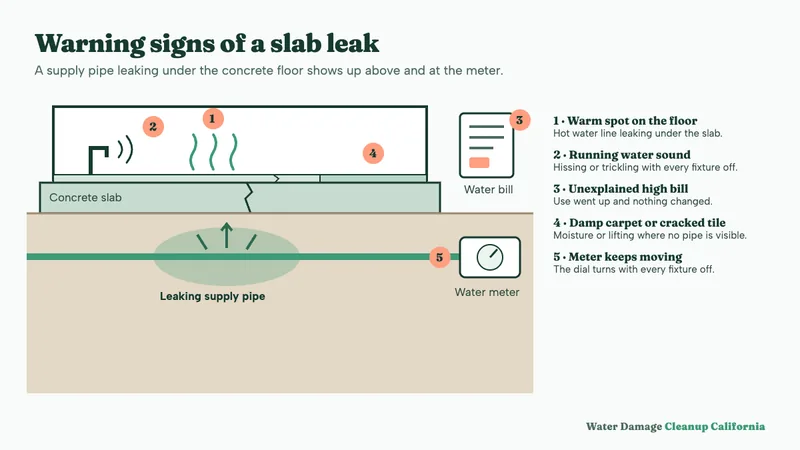
After a strong quake, look at the water heater and its flexible connectors first. Our guide to a leaking water heater explains the signs, and the slab leak page matters if your house sits on a concrete slab.
Will insurance pay for storm, flood or sewer water in Los Angeles County?
Often yes for a sudden plumbing failure and no for rising outside water. The Triple-I lists accidental discharge from plumbing, heating, air conditioning or an appliance among the perils a standard form names. Flood is excluded and sold apart, and FEMA says most homeowners insurance does not pay for flooding.
Sewer backup is its own category. The Triple-I says typical homeowners cover and flood insurance both skip it, so it has to be added as an endorsement or bought as a product.
A burst supply line and a flooded street can therefore land in different boxes on the same night. Tell your insurer exactly what happened, and read the claims guide and the sewage backup page before you sign any work order.
How quickly should I start drying after a leak in Los Angeles County?
As early as you can, because the clock is short. The EPA puts the target at 24 to 48 hours for getting wet areas and items dry, so mold does not take hold. It also wants indoor air kept below 60 percent relative humidity, ideally between 30 and 50.
- Close the main water valve, and switch off power to wet rooms only if that is safe.
- Take photos and video of everything before you move it.
- Notify your insurer, ask what paperwork it expects, and keep every receipt.
- Contact a restoration team and ask which readings they take and how they will log drying.
- Keep out of fast water in the street. Ready.gov notes that just six inches of moving water can knock a person off their feet.
Our emergency page has more, and mold after water damage explains what to do if growth has started. The Triple-I advises waiting for the adjuster before any major permanent repair.
Sources: Los Angeles County, Los Angeles, Los Angeles River, Long Beach, 2018 Southern California mudflows and 2023 California floods (Wikipedia); IICRC S500; Triple-I, disasters covered by homeowners insurance; Triple-I, settling claims after a disaster; FEMA, flood insurance; EPA, mold and moisture; Ready.gov, floods.
Coverage
Cities and communities in Los Angeles County
Requests come from 133 cities and communities here, covering 507 ZIP codes. The cities with their own guide come first.
- Los AngelesCity guide
- Long BeachCity guide
- GlendaleCity guide
- PasadenaCity guide
- Santa ClaritaCity guide
- TorranceCity guide
- LancasterCity guide
- Sherman OaksCity guide
- BurbankCity guide
- Santa MonicaCity guide
- PalmdaleCity guide
- Acton
- Agoura Hills
- Alhambra
- Altadena
- Arcadia
- Artesia
- Avalon
- Azusa
- Baldwin Park
- Bell
- Bell Gardens
- Bellflower
- Beverly Hills
- Calabasas
- Canoga Park
- Canyon Country
- Carson
- Castaic
- Cerritos
- Chatsworth
- City Of Industry
- Claremont
- Compton
- Covina
- Culver City
- Diamond Bar
- Dodgertown
- Downey
- Duarte
- El Monte
- El Segundo
- Encino
- Gardena
- Glendora
- Granada Hills
- Hacienda Heights
- Harbor City
- Hawaiian Gardens
- Hawthorne
- Hermosa Beach
- Huntington Park
- Inglewood
- La Canada Flintridge
- La Crescenta
- La Mirada
- La Puente
- La Verne
- Lake Hughes
- Lakewood
- Lawndale
- Littlerock
- Llano
- Lomita
- Lynwood
- Malibu
- Manhattan Beach
- Marina Del Rey
- Maywood
- Mission Hills
- Monrovia
- Montebello
- Monterey Park
- Montrose
- Mount Baldy
- Mount Wilson
- Newhall
- North Hills
- North Hollywood
- Northridge
- Norwalk
- Pacific Palisades
- Pacoima
- Palos Verdes Peninsula
- Panorama City
- Paramount
- Pearblossom
- Pico Rivera
- Playa Del Rey
- Playa Vista
- Pomona
- Porter Ranch
- Rancho Palos Verdes
- Redondo Beach
- Reseda
- Rosemead
- Rowland Heights
- San Dimas
- San Fernando
- San Gabriel
- San Marino
- San Pedro
- Santa Fe Springs
- Sierra Madre
- Signal Hill
- South El Monte
- South Gate
- South Pasadena
- Stevenson Ranch
- Studio City
- Sun Valley
- Sunland
- Sylmar
- Tarzana
- Temple City
- Toluca Lake
- Topanga
- Tujunga
- Universal City
- Valencia
- Valley Village
- Valyermo
- Van Nuys
- Venice
- Verdugo City
- Walnut
- West Covina
- West Hills
- West Hollywood
- Whittier
- Wilmington
- Winnetka
- Woodland Hills
Water Damage Cleanup California is the local water damage restoration line and information resource for California. When you call or send a request, it reaches a local water damage restoration team that serves your area. That team confirms whether it can reach you and gives its own scope, price and timing. Confirm them directly before you agree to anything.