For Rancho Cucamonga homeowners
For water damage restoration in Rancho Cucamonga, CA, shut off the water, photograph everything and start drying early. Requests come from ZIP codes 91701, 91730, 91737, 91739 and 91729. A restoration team confirms scope and price, with no obligation to hire.
On this page (8)
- Which Rancho Cucamonga ZIP codes do you take requests from?
- What is the land and housing like in Rancho Cucamonga?
- What water damage should Rancho Cucamonga homeowners expect?
- Can Rancho Cucamonga businesses request help too?
- Which services can a Rancho Cucamonga request involve?
- Which nearby communities does a Rancho Cucamonga request reach?
- What should you do first when water enters a Rancho Cucamonga home?
- How do California insurance rules apply to a Rancho Cucamonga claim?
Which Rancho Cucamonga ZIP codes do you take requests from?
Water damage restoration in Rancho Cucamonga, CA is requested from the home ZIP codes 91701, 91730, 91737 and 91739. The PO box code 91729 is also on the list, but a box has no street address, so give a home code for a house. The restoration team's callback confirms your street.
The city belongs to San Bernardino County. Wikipedia reports 174,453 people and 60,129 housing units in the 2020 census. The San Bernardino County ZIP finder lists codes in the towns next door.
What is the land and housing like in Rancho Cucamonga?
The city sits on an alluvial plain just south of the San Gabriel Mountains foothills, according to Wikipedia. That puts neighborhoods at the foot of a slope, where rain runs downhill. The article also mentions a wildland-urban interface where bears sometimes wander through.
Wikipedia says the city was formed in 1977, when the communities of Alta Loma, Cucamonga and Etiwanda voted to incorporate. Each of the three has its own history, so homes built in one may differ in age from the next. Ask a seller, inspector or neighbor when your house was built and what has been replaced.
The article also names Terra Vista, a master-planned community of nearly two square miles in the middle of town. In planned communities, association rules can decide who fixes what. Read HOA water damage responsibility before you start repairs, and tell the association early.
What water damage should Rancho Cucamonga homeowners expect?
The likeliest causes are ordinary: a failed water heater, a leaking supply line, a roof that lets rain in or an air conditioner drain that backs up. The city is dry for much of the year, so a roof or pipe problem can sit unnoticed until it rains or a bill jumps.
Wikipedia puts yearly precipitation at 17.68 inches, so storms are not constant but they do arrive. After one, read roof leak damage and the after-storm water checklist. For a stain on a ceiling, see ceiling water damage.
Wikipedia classes the climate as hot-summer Mediterranean. Air conditioners work hard in long summers, and their drain lines can clog. The AC condensate leak page explains that kind of leak. If you live below a burned slope, post-wildfire flood damage covers mud and debris.
| Part of the city | What Wikipedia says | First thing to check |
|---|---|---|
| North, near the foothills | Alluvial plain below the San Gabriel Mountains | Gutters, grading and runoff paths |
| Terra Vista and planned areas | Master-planned community of nearly two square miles | Association rules before repairs |
| Alta Loma, Cucamonga, Etiwanda | Three communities merged in 1977 | Age of plumbing and roofing |
| South, near Milliken Avenue | About seven square miles of distribution centers | Roof drains and lease terms |
Can Rancho Cucamonga businesses request help too?
Yes, although restoration teams differ on commercial work, so ask whether yours takes your size of job. Wikipedia says about seven square miles around Milliken Avenue are occupied by distribution centers and manufacturers, and shops and offices ring that area. Different buildings raise different questions.
A leak in a warehouse can wet stock, and a leak in a shop can close the doors. Read your lease to see who handles repairs and tells the insurer. The commercial water damage page lists first steps, and contents pack-out covers moving stock out of a wet room.
Which services can a Rancho Cucamonga request involve?
A request can cover any stage, from stopping the source to drying and repair. Restoration teams differ in what they take on, and they confirm scope and price with you directly. A typical job starts with water removal, then drying, then repairs once the structure is dry.
- Emergency water damage restoration when water is still spreading
- Water removal and extraction for standing water
- Water damage mitigation to limit further harm
- Structural drying for wet walls and subfloors
Contacting this site does not oblige you to hire anyone, and the restoration team you speak with sets its own price.
Which nearby communities does a Rancho Cucamonga request reach?
Requests also come from the neighbors: Upland on the west, Ontario to the south, Fontana to the east and Montclair, along with the mountain communities of Mount Baldy and Lytle Creek. A restoration team sets its own range, so a mountain address needs a direct question.
Wikipedia describes Rancho Cucamonga as bordered by Upland on its west, Ontario on its south, the San Gabriel Mountains on its north and Interstate 15 and Fontana on its east. For other towns, start at the San Bernardino County page.
What should you do first when water enters a Rancho Cucamonga home?
Stop the water, keep people safe and begin drying quickly. The EPA says to dry water-damaged areas and items within 24 to 48 hours to prevent mold. Sewage or flood water is a job for a professional, so keep children and pets away from it.
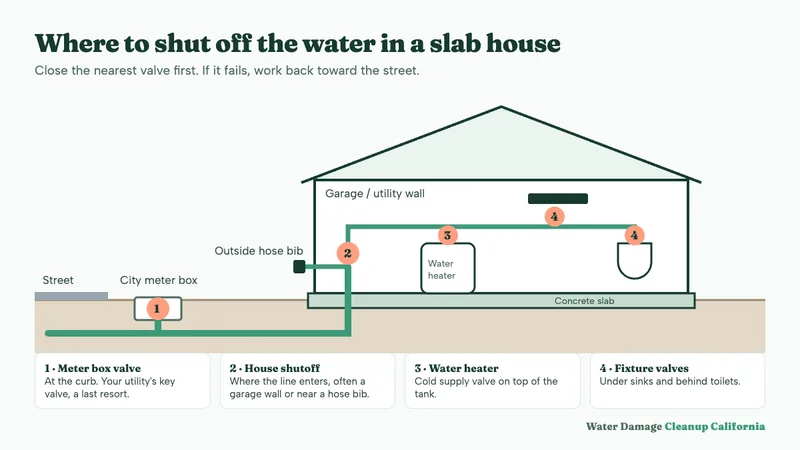
- Close the main water valve or the meter box.
- Turn off electricity to wet areas if the panel is dry and reachable.
- Lift rugs, electronics and papers onto dry surfaces.
- Take photos and video of damage before cleanup.
- Report the loss to your insurer and note the time.
- Ask a restoration team how it records moisture readings.
Our what to do after water damage guide expands each step.
How do California insurance rules apply to a Rancho Cucamonga claim?
Two California Department of Insurance rules set the clock. An insurer must acknowledge a claim within 15 calendar days under 10 CCR 2695.5. Once it has proof of claim, it must accept or deny within 40 calendar days under 10 CCR 2695.7. Write down each date.
The CDI says homeowners policies do not cover flood damage but do cover other kinds of water damage. Rain through a storm-damaged roof and a creek that spills over are therefore handled differently. The insurance claim guide and California flood insurance page explain the difference.
Asking for a call does not oblige you to hire anyone. Each restoration team states its own availability, scope and price, and you can compare before you decide.
Sources: Rancho Cucamonga, California (Wikipedia); 10 CCR 2695.5 and 10 CCR 2695.7; CDI, Residential Property Claims Guide; EPA, mold and moisture.
Water Damage Cleanup California is the local water damage restoration line and information resource for California. When you call or send a request, it reaches a local water damage restoration team that serves your area. That team confirms whether it can reach you and gives its own scope, price and timing. Confirm them directly before you agree to anything.