The short version
Apartment water damage restoration involves the building owner for structure and shared pipes, and you for belongings and your own insurance. Report leaks in writing, take photos and videos of all damage and begin drying inside the first 24 to 48 hours. This is general information, not legal advice. Restoration teams differ, so confirm directly.
On this page (9)
- Who handles water damage in an apartment building?
- What does California require a landlord to keep in repair?
- What does a renters policy cover after a leak?
- Who do I call first for each kind of apartment leak?
- How does restoration work in a multi-unit building?
- What if the water came from a sewer line or a dirty source?
- When does dampness or mold become a housing problem?
- What if I own a condo instead of renting?
- What should I do first when my apartment floods?
Who handles water damage in an apartment building?
It is split. The building owner or association normally deals with the structure and shared pipes, while each resident deals with personal belongings and their own insurance. Which side a given leak falls on depends on the source, your lease or governing documents and who caused it.
Apartment water damage restoration is harder than a single-family job because walls, ceilings and pipes are shared. Water that starts in one unit can wet the unit below, the one beside it and the hallway. This site is not a law office, so treat everything here as general information and not legal advice.
The renters, landlords and condos guide gives the wider picture. This page focuses on what happens in a multi-unit building and who to call first.
What does California require a landlord to keep in repair?
California sets habitability standards for rentals, and plumbing and weatherproofing are on the list. If a leak leaves a unit with active water intrusion or lasting dampness, the owner is expected to address it. Report problems in writing so there is a dated record.
Civil Code section 1941.1 describes a dwelling as untenantable if it substantially lacks standard characteristics. The list includes effective waterproofing and weather protection of the roof and exterior walls and plumbing that was lawful when installed and is maintained in good working order. It also reaches units described in Health and Safety Code section 17920.3.
Section 17920.3 names dampness of habitable rooms among the conditions that make housing substandard. Whether your situation meets the legal test is a question for a tenant aid organization, a legal aid office or an attorney. You can read the wording of Civil Code 1941.1 yourself.
What does a renters policy cover after a leak?
A renters policy generally protects your belongings and may help with extra living costs, but the wording decides. Flood is excluded under standard renters and homeowners policies, while accidental discharge from plumbing or an appliance is a named peril on standard forms. The building itself is the owner's insurance, not yours.
According to Triple-I, standard homeowners and renters policies leave out flood, which needs its own policy. The same article names accidental water discharge from plumbing, heating or cooling systems, sprinklers or an appliance as a covered peril on standard forms. Neglected maintenance is not covered.
The California Department of Insurance advises reporting any water damage claim immediately to your agent or company. Photograph the damage first, as covered in the insurance claims guide.
Who do I call first for each kind of apartment leak?
Call the property manager or maintenance line for building problems, your insurer for your belongings and a plumber or restoration provider for the source and the drying. In an emergency with active flooding, start with whoever can shut the water off fastest.
| Situation | Start with | Paperwork to check |
|---|---|---|
| Ceiling stain after a storm | Property manager, in writing | Lease repair clause |
| Leak from the unit above | Property manager, then your insurer | Renters policy, dated photos |
| Pipe burst inside your own wall | Building shutoff, then manager | Lease, renters policy |
| Sewage from a floor drain | Manager, then a qualified provider | Lease, policy endorsements |
| Appliance you own overflows | Shut the valve, then insurer | Renters policy, lease |
The table is a starting map, not a legal ruling. If you cause a leak, such as a washer hose you installed, expect questions about responsibility. A copy of your lease and policy in a phone folder saves time when a leak happens at night.
How does restoration work in a multi-unit building?
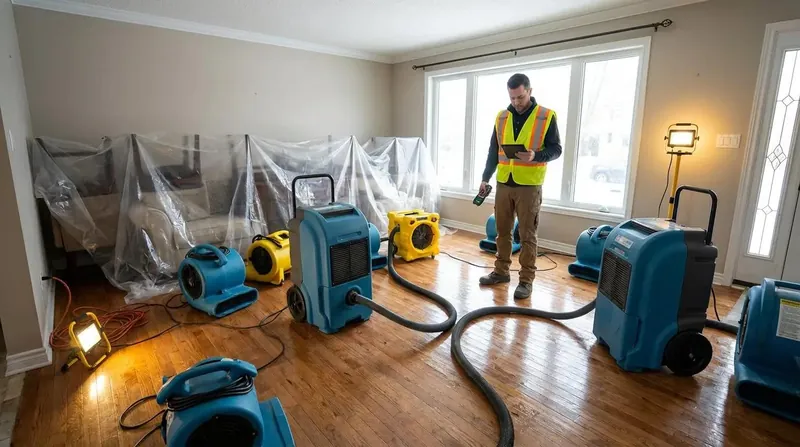
A provider usually starts by finding the source, then measures moisture in every affected unit, not only the one that called. Wet ceilings, wall cavities and floors are dried with air movers and dehumidifiers, and materials that cannot be dried are removed. Restoration teams differ in how they work, so ask for a written scope.
In a shared building, that scope can involve more than one household and the building owner, because drying may require access to adjoining units and removing shared finishes. The first 24 to 48 hours matter most. The EPA says wet or damp materials dried within that window will not grow mold in most cases.
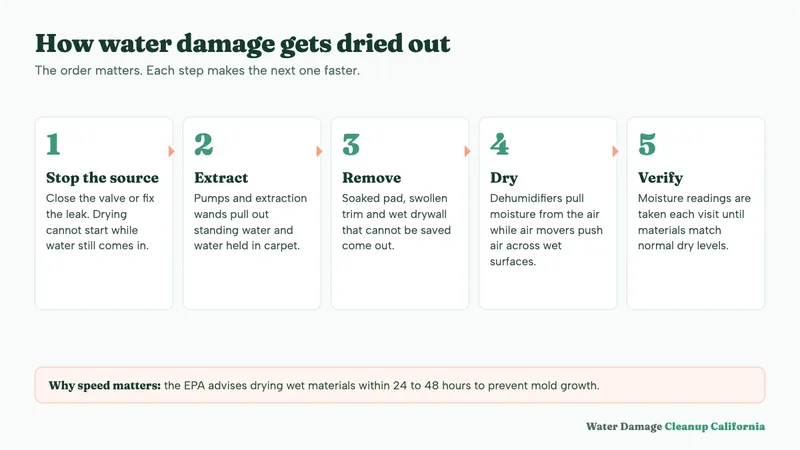
The structural drying page explains how equipment is placed and how readings are checked, and the categories and classes page explains how providers classify the water.
What if the water came from a sewer line or a dirty source?
Treat it as hazardous and keep people and pets out. The EPA's advice for sewage or other contaminated floodwater is to hire a professional who has handled contaminated buildings before. Tell the manager right away, since shared lines are usually the building's concern.
The IICRC S500 standard describes Category 1 as clean water such as a supply line, Category 2 as gray water such as washer or dishwasher discharge and Category 3 as grossly contaminated water such as sewage or rising flood water. Porous materials touched by Category 2 or 3 water are usually removed instead of cleaned.
Triple-I reports that a typical homeowners policy and flood insurance both leave out sewer backup, which is sold separately or as an endorsement. Look for that endorsement on your renters policy. See the sewage backup page for the first steps.
When does dampness or mold become a housing problem?
When it persists and affects health. California's housing code names visible mold and dampness as conditions of substandard housing, and the owner must fix them if cited by a code enforcer. Small amounts of mold on surfaces that normally collect moisture are treated differently.
The California Department of Public Health renter booklet lists the signs: visible mold, a mold odor, visible water damage such as stains, peeling paint, warped floors and rotting wood, and damp or moist materials. It says that if you control the dampness, you control the mold. Landlords must give prospective tenants this booklet before the lease, a duty that began January 1, 2022 under the Toxic Mold Protection Act.
Write down what you see and when, and report it in writing. Our mold guide explains cleanup. The EPA considers a moldy patch under about 10 square feet (roughly 3 feet by 3 feet) manageable for most people, while sewage or larger areas call for a professional.
What if I own a condo instead of renting?
Your association's declaration usually decides who repairs what, and California's Civil Code supplies defaults when it is silent. Typically the association handles common areas and you handle the inside of your unit. Report any leak to the manager or board in writing.
Civil Code section 4775 says that, unless the declaration says otherwise, the association repairs and maintains the common area and each owner maintains their separate interest. It also covers repairs that restore interrupted gas, heat, water or electrical service starting in the common area, and the board must begin that process within 14 days of the interruption. The HOA responsibility page walks through the section in more detail.
What should I do first when my apartment floods?
Stop the water, make the space safe, record the damage and notify the building and your insurer. Then arrange drying. Do not wait for a final decision on who is responsible, because wet materials start to deteriorate before disputes are settled.
- Shut off the water at the fixture stop, or ask maintenance to close the building valve.
- Turn off power to wet areas at the breaker if you can do it safely.
- Take photos and video of each wet area before anything is moved.
- Message the property manager in writing and keep the thread.
- Call your insurer and ask what to keep.
- Move belongings out of the wet area and run fans if it is safe.
- Ask a restoration provider to measure moisture in the walls and floor.
The CSLB consumer guide says a down payment on a home improvement job cannot be more than $1,000 or 10 percent of the contract price, whichever is less, and advises paying only as work is completed. That applies if you hire a contractor yourself, so ask who is hiring before anyone signs. More how-tos sit in the water damage guides.
Sources: EPA, A Brief Guide to Mold, Moisture and Your Home; EPA, Mold Cleanup in Your Home; Triple-I, Which disasters are covered by homeowners insurance; California Department of Insurance, Residential Property Claims Guide; Civil Code 1941.1; Health and Safety Code 17920.3; Civil Code 4775; CDPH, Information on Dampness and Mold for Renters in California; CSLB, Terms of Agreement: A Consumer Guide to Home Improvement Contracts; IICRC S500.
Water Damage Cleanup California is the local water damage restoration line and information resource for California. When you call or send a request, it reaches a local water damage restoration team that serves your area. That team confirms whether it can reach you and gives its own scope, price and timing. Confirm them directly before you agree to anything.