For San Diego County homeowners
For water damage restoration in San Diego County, act in the first 24 to 48 hours: stop the water, film every room and begin drying. Flood and sewer backup typically sit outside a standard homeowners policy. We take requests across the county.
On this page (8)
- Which San Diego County areas and ZIP codes do you take requests from?
- How do San Diego County's canyons and mesas change where water goes?
- Has the San Diego River flooded Mission Valley?
- Do the coast, inland valleys and mountains need different checks?
- How wet does San Diego County actually get?
- What happens after a wildfire in San Diego County?
- Will insurance cover flood or sewer water in San Diego County?
- What comes first when water gets into a San Diego County home?
Which San Diego County areas and ZIP codes do you take requests from?
Anyone in the county can ask for water damage restoration in San Diego County, from the South Bay to the North County coast and out to the East County suburbs. City pages cover San Diego, Chula Vista, Carlsbad and Oceanside. Look up a code in the San Diego County ZIP finder. Whether a given restoration team will drive to your block is decided on the call.
Wikipedia says the county is the second most populous in California, with 3,298,634 residents in the 2020 census. It names four informal regions: North County, East County, the South Bay and the rural Mountain Empire out toward Imperial County. Distances are long, so ask any restoration team about travel to your corner of it.
Up the coast, Orange County has its own guide, and so does Riverside County over the mountains to the northeast.
How do San Diego County's canyons and mesas change where water goes?
They steer it. Wikipedia says the city sits on about 200 deep canyons and hills that separate its mesas. People built homes and businesses on the mesas and mostly left the canyons wild, so storm runoff from a mesa street can end up draining toward the nearest canyon edge.
That has a practical side for owners. A house near a canyon rim should have gutters and downspouts that carry water well away from the foundation, and a yard that slopes away from the walls. A house at the bottom of a street can collect runoff in a garage or entry.
The same article says the San Diego River runs through the middle of the city from east to west and divides it into northern and southern halves. Reservoirs and Mission Trails Regional Park also separate developed areas. If you are unsure where your lot drains, a walk outside during the next rain will tell you more than a map.
Has the San Diego River flooded Mission Valley?
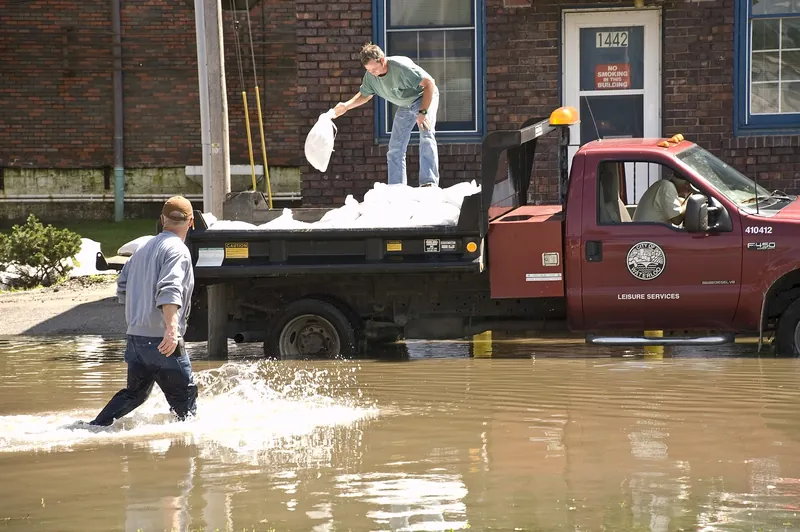
Yes, more than once. Wikipedia says the worst flood in the area came in 1862, when Mission Valley was inundated and houses in lower Old Town flooded as winds from a sea storm backed water up from the bay. That flood held its peak for more than 24 hours.
Earlier history was unstable too. A flood in the fall of 1821 moved the channel in one night, and Wikipedia says an earlier dam was overtopped in 1916, adding to floodwater in Mission Valley. El Capitan Dam went up in 1935, and levees and jetties along the river mouth were finished by 1955.
The valley's growth brought a new problem. According to the same article, businesses along the banks began to flood in heavy rain, and owners funded a plan to straighten the river. It also notes that the river discharges only during flooding, so a dry channel is not proof of safety.
If water comes in from outside, it falls under flood rules, not plumbing rules. Read flood damage restoration for how that work differs.

Do the coast, inland valleys and mountains need different checks?
They do, because the county has sharp microclimates. Wikipedia says a thick marine layer can keep the air cool and damp within a few miles of the coast, then give way to sunshine 5 to 10 miles inland. The table shows how far apart nearby places can be.
| Place | What Wikipedia gives | What it suggests |
|---|---|---|
| Downtown San Diego | January low 48 F, August high 77 F | Damp air can slow drying near the water |
| El Cajon | January low 42 F, August high 89 F | Bigger swings between day and night |
| Julian | January low 29 F | Freezing is possible, so protect exposed pipes |
| Borrego Springs | About 5 inches of rain a year, August high 106 F | Rare storms hit unprepared roofs |
The Red Cross lists unheated attics, crawl spaces, garages and kitchen cabinets as the supply pipes most at risk from freezing, which matters at Julian's elevation. Our burst pipe page explains what to do.
How wet does San Diego County actually get?
Dry most of the year, and sometimes very wet in a short stretch. Wikipedia says rainfall can be heavy when it does occur, and that the mountains get far more than the coast: Palomar Mountain and the Laguna Mountains receive 20 to 40 inches a year.
That pattern fits long dry spells that hide roof problems until a storm finds them. Cracked flashing, clogged gutters and aging tile or shingles show up as ceiling stains after the first hard rain. The roof leak page and the after-storm checklist list what to look at.
Atmospheric rivers drive some of California's heaviest storms. Wikipedia's atmospheric river article says they bring about 50 percent of the state's annual precipitation, though that figure is statewide, not for San Diego. Our atmospheric river guide explains the term.
What happens after a wildfire in San Diego County?
Burned hillsides can turn the next heavy rain into a mudflow, and this county has a long record of fires. Wikipedia's mudflow article says fire-scarred slopes lose the vegetation that holds soil, which destabilizes the ground and greatly helps mudflows form.
San Diego County has a long fire record. The county article lists the Cedar Fire in 2003, the Witch Creek Fire in 2007, the May 2014 fires and the Lilac Fire in December 2017, and says fire season usually runs from late July to late October. It also says the county holds more than 1,000,000 acres of chaparral.
If you live below a burned slope, watch for evacuation alerts during storms and ask the county about debris-flow risk. Read our mudslide page for the damage side. Smoke and ash are separate problems, and this site covers water.
Will insurance cover flood or sewer water in San Diego County?
A standard policy draws a hard line at flood. For San Diego homes, that means a rising river or street runoff is usually uninsured unless you bought flood cover, while a sudden pipe or appliance failure may be covered. The Triple-I describes flood as a separate NFIP or private purchase.
The NAIC says rain runoff and ground water fall outside homeowners cover, while a plumbing or roof leak is typically inside it. The Triple-I adds that maintenance failures and mold are not covered either, and that sewer backup is sold as its own endorsement.
A mesa-top roof leak and a Mission Valley street flood therefore reach your insurer as different claims. Our claims guide and sewage backup page go through the paperwork.
What comes first when water gets into a San Diego County home?
Stop the source, make the space safe and start drying quickly. The CDC wants a flooded home fully cleaned out and dry in 24 to 48 hours, and soaked carpet and upholstery you cannot dry fast removed. That leaves mold very little time to start.
- Find the main shutoff and close it. If standing water touches outlets, stay out and call an electrician.
- Record the damage on video, room by room, before moving furniture.
- Report the loss to your insurer and find out which steps it wants first.
- Call a restoration team and ask which readings they log and how they confirm the structure is dry.
- Do not paint or caulk over anything that looks moldy. The EPA says to clean it properly first.
The emergency page goes deeper, and water removal explains how extraction works.
Sources: San Diego County, San Diego, San Diego River, 2018 Southern California mudflows and Atmospheric river (Wikipedia); Triple-I, disasters covered by homeowners insurance; NAIC, homeowners insurance; Red Cross, frozen pipes; CDC, mold and your health; EPA, mold cleanup.
Coverage
Cities and communities in San Diego County
Requests come from 51 cities and communities here, covering 182 ZIP codes. The cities with their own guide come first.
- Alpine
- Bonita
- Bonsall
- Borrego Springs
- Boulevard
- Camp Pendleton
- Campo
- Cardiff By The Sea
- Coronado
- Del Mar
- Descanso
- Dulzura
- Encinitas
- Escondido
- Fallbrook
- Guatay
- Imperial Beach
- Jacumba
- Jamul
- Julian
- La Jolla
- La Mesa
- Lakeside
- Lemon Grove
- Mount Laguna
- National City
- Pala
- Palomar Mountain
- Pauma Valley
- Pine Valley
- Potrero
- Poway
- Ramona
- Ranchita
- Rancho Santa Fe
- San Luis Rey
- San Marcos
- San Ysidro
- Santa Ysabel
- Santee
- Solana Beach
- Spring Valley
- Tecate
- Valley Center
- Vista
- Warner Springs
Water Damage Cleanup California is the local water damage restoration line and information resource for California. When you call or send a request, it reaches a local water damage restoration team that serves your area. That team confirms whether it can reach you and gives its own scope, price and timing. Confirm them directly before you agree to anything.