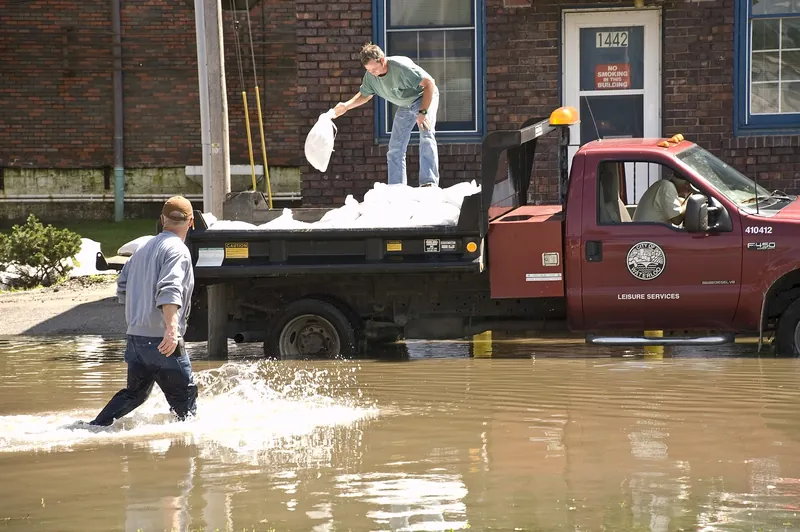
The short version
Flood damage in California gets treated as contaminated water. The work clears mud and soaked porous materials, disinfects whatever remains, and dries the structure ahead of any rebuild. Because homeowners policies exclude flood, claims normally go through a separate flood policy, mainly the NFIP.
On this page (11)
- How does California define flood damage for a homeowner?
- What makes flood water a Category 3 hazard?
- When can you walk back into a house that flooded?
- What causes floods across California?
- How does flood damage restoration work, step by step?
- Which belongings should go in the trash after a flood?
- What keeps mold from taking hold after a flood?
- Will insurance pay to clean up after a flood in California?
- Does insurance cover mudslides and debris flows?
- What are the steps and deadlines for a flood claim in California?
- Which questions belong in a call with a flood provider?
How does California define flood damage for a homeowner?
Flood damage comes from water that enters from outside the building: creeks and rivers spilling over, runoff pouring off hillsides, storm drains that fall behind, or mud and debris sliding down a slope. A leak from your own plumbing or roof is a separate problem with its own rules.
Every restoration team sets its own scope and terms, so confirm them directly before you agree.
The distinction counts twice. It shapes how the cleanup proceeds, since outside water is filthy. It also determines which insurance policy, if any, responds, so note where the water came from before work begins.
What makes flood water a Category 3 hazard?
Water from outdoors is rated Category 3, or grossly contaminated, since it picks up soil, bacteria, chemicals and sometimes sewage along the way. The IICRC S500 standard assigns that class to river and stream overflow and other surface water from outside, the same group as sewage.
The rating sets the plan. Porous materials touched by Category 3 water, including carpet, pad, insulation and the bottom of the drywall, are normally pulled out rather than dried. Hard surfaces are cleaned and disinfected first.
Ask every provider which category they chose and their reasoning. Water from a supply line or appliance begins cleaner, as the guide to water damage categories and classes explains. For a backed-up sewer line, see sewage backup cleanup.
When can you walk back into a house that flooded?
Wait until the water stops rising, power to the wet area is shut off and you have scanned for hazards. Never wade through water you cannot see through, and never flip a breaker while standing in water. Run through this checklist before going in:
- Breakers for the flooded rooms are off, and an electrician has examined anything that sat in the water.
- You smell no gas. If you do, get out and phone the gas utility from outside.
- Floors feel firm, ceilings are not sagging and walls are not leaning.
- Rubber boots, gloves and goggles are on, as the CDC advises for flood cleanup.
Outdoors, moving water is the greater threat. Ready.gov warns that just six inches of fast water can topple an adult, and a foot of it can carry off a vehicle. In a slab house, water can quickly reach outlets, the garage and equipment near the floor, so assume those are live until someone has checked.
What causes floods across California?
Flooding follows when a storm drops more water than soil and channels can absorb. NOAA Research says about 30 to 50 percent of annual precipitation in the west coast states arrives in just a few atmospheric river events, so a single stalled storm can finish a season's worth of rain within days.
Two recent winters illustrate this. NOAA's satellite service reports that a run of nine atmospheric rivers struck California especially hard from late December 2022 into January 2023. Over 32 trillion gallons of water fell on the state, and flooding hit the Central Valley, the Salinas Valley and the Santa Cruz Mountains.
Across that period NOAA counted over 1,400 rescues, and the California Geological Survey mapped more than 700 reported landslides. The National Weather Service's river forecast center puts the cost of flooding disasters from December 26, 2022 through March 19, 2023 at an estimated $3.5 billion, with more than 20 deaths.
Come February 2024, NOAA's climate office reports, Los Angeles took in over 12 inches of rain, roughly triple its February average. The National Weather Service logged a Topanga storm total just beyond 14 inches. The weather pattern behind such events is explained in atmospheric river water damage in California and the after-storm checklist.
How does flood damage restoration work, step by step?
Flood work follows a fixed order: document, clear standing water and mud, tear out soaked materials, clean and disinfect, dry with equipment, then confirm readings before anything is closed. Providers sequence the work in their own ways, so request the plan in writing before it starts.
- Document first. Photograph the water line on each wall and every damaged item before anything is shifted.
- Remove water and mud. Pumps and shovels clear garages, floors and low rooms.
- Take out what cannot be saved. A flood cut removes drywall above the water line, letting the cavity dry and the wet insulation come out.
- Clean and disinfect. Studs, subfloor and every surface that stays get scrubbed and treated.
- Dry with equipment. Fans and dehumidifiers run until a meter reads dry on the materials. See structural drying.
- Verify before rebuilding. Hidden mold often starts when a wall is closed over wet framing.
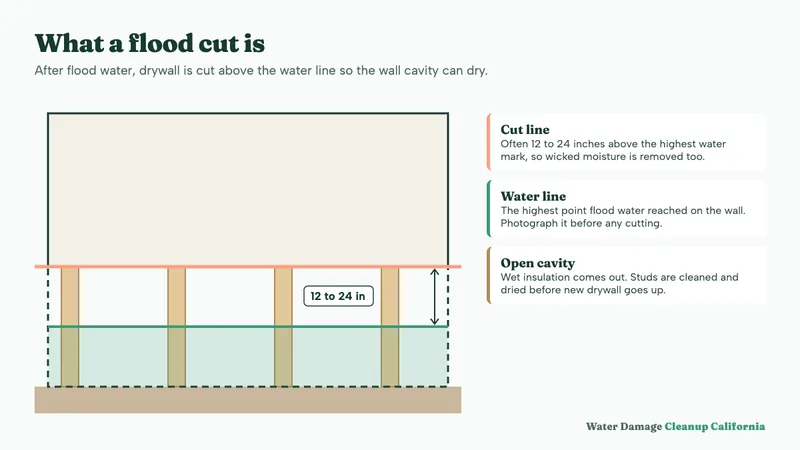
How the floor is built changes the job. On a slab, the concrete gets cleaned and dried while flooring laid on top typically comes up. With a crawl space, ask the provider how the area beneath the floor will be inspected and dried, because water can pool there unnoticed.
Which belongings should go in the trash after a flood?
Discard absorbent items that flood water soaked through and that no cleaning can fully dry out. Think carpet with its pad, mattresses, sofas and chairs, plush toys, wet insulation, the lowest drywall, plus food or medicine that the water reached. Take a photo of each item first, since the adjuster will ask.
| Area | Frequently cleaned | Frequently replaced |
|---|---|---|
| Floors | Tile, sealed concrete | Carpet, pad, laminate |
| Walls | Stucco, masonry and framing | Insulation, drywall under the cut line |
| Furniture | Glass, metal, certain solid wood | Upholstered pieces, particleboard |
| Household goods | Metal tools, dishes, hard plastic | Food, mattresses, soft toys |
On hard surfaces, the CDC lists household cleaner, soap and water, or no more than one cup of household bleach per gallon of water. It cautions against ever mixing bleach with ammonia or other cleaners.
Appliances and electrical items that sat in flood water need a qualified technician before use. Maintain a running list noting item, room, rough age and place of purchase, because that list becomes your contents claim. The contents pack-out page covers what a provider can sort and photograph.
What keeps mold from taking hold after a flood?
Get the soaked materials out and dry the structure fast. To prevent mold growth, the EPA says water-damaged areas should be dry within 24 to 48 hours, and the CDC cites the same window for flood cleanup. The EPA further advises holding indoor humidity under 60 percent, ideally 30 to 50 percent.
- Leave walls open until a meter shows the framing and subfloor have dried.
- The EPA says not to paint or caulk over moldy surfaces.
- When contaminated water left mold behind, the EPA recommends a professional with water-damaged building experience.
- The CDC notes that asthma or a mold allergy can bring on severe reactions.
The California Department of Public Health says the state does not license mold remediators. That raises the value of written scopes and moisture readings. For more, read mold after water damage.
Will insurance pay to clean up after a flood in California?
Typically not through a homeowners policy. The California Department of Insurance says homeowners policies do not cover flood damage, though they do cover other kinds of water damage. Flood coverage is its own policy, chiefly from the National Flood Insurance Program or a handful of private insurers.
| Water source | Standard homeowners | Where cover comes from |
|---|---|---|
| Creek, river or street water rising into the home | Excluded | A separate flood policy |
| Runoff and ground water | Not typically covered | A separate flood policy |
| Sewer or drain backup | Not typically covered | An endorsement or a separate product |
| Plumbing or roof leak | Typically covered | Your homeowners policy |
Per the NAIC, ground water and rain runoff damage is not typically covered, and Triple-I adds that sewer backups call for their own coverage. Your policy wording controls, so check with your agent.
Few homes carry flood coverage. A report from a California Department of Insurance working group says that in September 2019 fewer than 5 percent of California homes held NFIP flood insurance. It adds that about 500,000 properties lie within Special Flood Hazard Areas on FEMA maps.
Coverage does not start instantly. The department says a flood policy takes effect 30 days after purchase, unless a federally regulated lender requires it for a home in a designated high-risk area. A policy bought while a storm approaches usually will not help.
Does insurance cover mudslides and debris flows?
Often not, unless fire played a part. A February 2025 California Department of Insurance release says homeowners and commercial policies typically exclude flood, mudslide and debris flow, unless a recent wildfire or another covered peril triggered them. The Commissioner's bulletin reminded insurers of their duty to cover mudslide damage caused by recent wildfires.
Montecito is the worst case on record. A USGS paper reports that on January 9, 2018, a burst of rain landed on the Thomas Fire burn area above the town, and the resulting debris flow caused 23 fatalities, at least 167 injuries and 408 damaged homes.
Below a recent burn scar, what triggered the slide can decide a claim, so save photos and dates for both the fire and the storm. Learn more on the mudslide and debris flow page.
What are the steps and deadlines for a flood claim in California?
Tell whichever company sold your flood policy, once conditions are safe, and document it all before cleaning. For NFIP claims, the California Department of Insurance lists 1-800-638-6620. The department says it does not regulate the NFIP, so its claim timelines may not apply to those policies.
- Report the loss and record the claim number.
- Photograph and video every wall and item, water line included, before touching anything.
- Protect the property. Triple-I advises reasonable steps to limit further damage, with major permanent repairs held until an adjuster has inspected.
- Keep receipts and damaged items on hand for the adjuster's visit.
- Collect itemized bids listing materials and prices line by line.
Claims with private insurers fall under California's claim regulations, which set timelines. Under 10 CCR 2695.5(e), an insurer must acknowledge a claim within fifteen calendar days. Under 2695.7(b), it must accept or deny within forty calendar days of receiving proof of claim.
Any denial must come in writing and state that you may ask the California Department of Insurance to review it. If you get stuck, call the department's consumer hotline at 1-800-927-4357. The water damage insurance claim guide walks through the full sequence.
Which questions belong in a call with a flood provider?
Find out which water category the provider assigned, what gets removed and why, how dryness will be measured, and what the written scope covers. Answers vary by provider, and this site cannot answer for any of them. Verify every point directly ahead of the start date.
- Will the walls and floors be photographed before anything comes out?
- Which readings show the structure is dry?
- Does the quote itemize, and what might alter it?
- Who talks to the insurer, and what if the insurer pays less?
The Contractors State License Board says a down payment cannot exceed $1,000 or 10 percent of the contract price, whichever is less, with a narrow bond exception. It also advises paying only as work gets completed.
The guide to choosing a restoration company goes deeper. If a business rather than a home took on water, read commercial water damage, and locate your area on the service areas page.
Sources: Ready.gov, Floods; IICRC, S500 standard; EPA, A Brief Guide to Mold, Moisture and Your Home; EPA, Mold Cleanup in Your Home; CDC, About Mold and Your Health; NOAA Research, Atmospheric Rivers; NOAA NESDIS, Atmospheric Rivers Hit West Coast; NWS CNRFC, December 2022 and January 2023 storms; NWS WPC, February 4, 2024 event review; NOAA NCEI, U.S. Climate in February 2024; USGS, Montecito Debris-Flow Event; CDI, Residential Property Claims Guide; CDI, February 4, 2025 release; CDI, Flood Insurance Resources; CDI, Climate Insurance Working Group report; 10 CCR 2695.5; 10 CCR 2695.7; CDPH, Frequently Asked Questions about Mold; CSLB, Home Improvement Contracts guide; Triple-I, Which disasters are covered; Triple-I, Settling claims; NAIC, Homeowners Insurance.
Water Damage Cleanup California is the local water damage restoration line and information resource for California. When you call or send a request, it reaches a local water damage restoration team that serves your area. That team confirms whether it can reach you and gives its own scope, price and timing. Confirm them directly before you agree to anything.