The short version
An atmospheric river California storm can bring days of heavy rain that leaks roofs, floods doorways and overloads drains. Clear gutters first, photograph the house, and check whether you carry flood cover, since a flood policy waits 30 days. Afterward, dry within 24 to 48 hours. Restoration teams differ, so confirm terms directly.
On this page (11)
- What is an atmospheric river, and why does California get them?
- How much of California's rain comes from atmospheric rivers?
- How are atmospheric rivers rated?
- What damage did the 2022 to 2023 atmospheric rivers cause?
- What did the February 2024 atmospheric river do?
- How does an atmospheric river get water into a house?
- What should I do before an atmospheric river arrives?
- Does insurance cover atmospheric river water damage?
- Is flood insurance worth checking before the next storm?
- What happens on burned hillsides during an atmospheric river?
- What should I do after the rain stops?
What is an atmospheric river, and why does California get them?
An atmospheric river is a long, narrow band of moist air that carries water vapor from the tropics toward higher latitudes, according to NOAA. When one stalls over California, it can drop days of heavy rain, which is why atmospheric river California forecasts matter to anyone with a roof, a crawl space or a creek nearby.
Wikipedia describes these bands as typically several thousand kilometers long and only a few hundred wide. The best known type is the Pineapple Express, named for moisture streaming in from the Hawaiian tropics.
Most are weak and welcome. The trouble comes when a strong one parks over wet ground or recently burned slopes. If water is already inside, the emergency water damage restoration page explains how a request works.
How much of California's rain comes from atmospheric rivers?
NOAA reports that on average, about 30 to 50 percent of annual precipitation in the west coast states falls in just a few atmospheric river events. That is a regional figure, not a California-only one. It still tells you that a few storms can decide the whole water year.
It also explains why a roof that stayed dry for years can start leaking after a single storm. Flashing, sealant and old shingles may never have been tested by sustained rain. The roof leak storm damage page covers what to do when water comes through the ceiling.
How are atmospheric rivers rated?
Researchers at the Center for Western Weather and Water Extremes at Scripps Institution of Oceanography created a five-level scale in February 2019. It runs from weak to exceptional, or from beneficial to hazardous. Rank depends on how much water vapor is moving and how long the storm lasts.
Wikipedia describes the duration rule this way: an event lasting under 24 hours is moved down one rank, and one lasting longer than 48 hours is moved up one. Length matters because the ground and the drains do not get a chance to recover.
A low category can still leak a weak roof, and a high one can overwhelm a street drain.
What damage did the 2022 to 2023 atmospheric rivers cause?
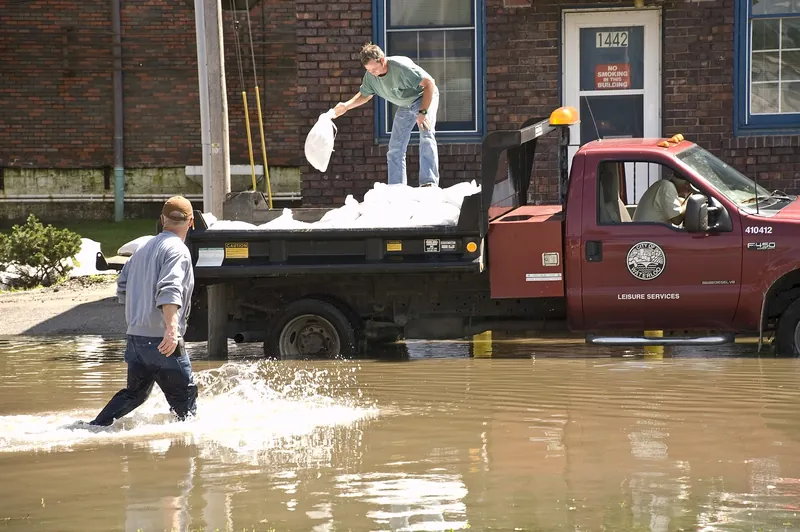
NOAA's satellite service reports that a series of nine atmospheric rivers struck the West from late December 2022 into January 2023, and that California was hit particularly hard. The same report says more than 32 trillion gallons of water rained down across the state, and flooding reached the Central Valley, the Salinas Valley and the Santa Cruz Mountains.
The California Nevada River Forecast Center says flooding disasters in California cost $3.5 billion from December 26, 2022 through March 19, 2023, and that the impacts led to more than 20 deaths. NESDIS reports more than 1,400 rescues and more than 700 landslides mapped by the California Geological Survey.

What did the February 2024 atmospheric river do?
The National Weather Service Weather Prediction Center reviewed the storm that arrived on February 4, 2024. Topanga had rainfall totals just breaking 14 inches, the Bel Air Hotel recorded 11.64 inches, and downtown Los Angeles passed 9 inches, about 65 percent of its seasonal rainfall in 48 to 60 hours.
The NWS Bay Area office documented a bomb cyclone with a peak wind gust of 102 mph and its first ever Hurricane Force Warning for the coastal waters. It reports that more than one million customers lost power at some point during the storm.
NOAA's national climate summary adds that Los Angeles received more than 12 inches of rain during February, about three times the February average. Wind, rain and outages arrived together, so a leaking roof and a dead sump pump could happen on the same night.
How does an atmospheric river get water into a house?
Water usually enters in five ways: through the roof, through walls and windows during wind-driven rain, from the ground at doors and low spots, up through drains when the sewer overloads, and through a failed pump or drainage system after a power outage. Each has a different first step and, often, a different insurance answer.
- Roof and attic: water follows rafters and drips from a ceiling far from the actual hole. See ceiling water damage.
- Walls and windows: wind pushes rain past worn seals and flashing. Stains may appear days later.
- Ground level: if your home is on a slab, water coming in at a door floods the whole floor at once. If it has a crawl space, water can pool underneath where nobody sees it.
- Drains: a surcharged sewer main can push sewage out of the lowest drain. See sewage backup cleanup.
- Hillside runoff: mud and debris carry weight and grit that ordinary water does not.
Ready.gov warns that six inches of moving water can knock a person down and one foot can sweep a vehicle away. Do not wade through floodwater to check on a house.
What should I do before an atmospheric river arrives?
Use the days of warning to clear what you control: gutters, downspouts, roof debris, and the paths water will take around the house. Then locate your main water shutoff and photograph the home as it is. Dated photos of a dry house make a later claim easier to explain.
- Clear gutters and downspouts and point them away from the foundation.
- Check the roof from the ground for lifted shingles or loose flashing, and call a roofer rather than climbing in wet conditions.
- Move valuables and electronics off floors and out of garages and low closets.
- Photograph each room and save the photos somewhere other than the house.
- Find your policy and your agent's number, and note whether you carry a separate flood policy.
- Charge phones and gather flashlights in case the power fails.
The water damage prevention guide has a longer maintenance list. After the storm, work through the after-storm water checklist.
Does insurance cover atmospheric river water damage?
It depends on where the water came from. The California Department of Insurance says homeowners policies do not cover flood damage but do cover other kinds of water damage, such as rain through a hole in the roof caused by wind or another covered exposure. Your actual policy wording controls.
| Where the water came from | Typical standard homeowners answer | Source |
|---|---|---|
| Roof leak | Typically covered | NAIC |
| Rain runoff or ground water | Not covered | NAIC |
| Flood | Excluded; separate flood policy needed | Triple-I, CDI |
| Sewer backup | Not covered unless you bought an endorsement | Triple-I |
| Mudslide or debris flow | Typically excluded, with a wildfire exception | CDI |
The NAIC says water damage from a home's plumbing or a roof leak is typically covered, while damage from ground water, rain runoff or snowmelt is not. Triple-I says sewer backups are not covered by a typical homeowners policy or by flood insurance, and are bought as a separate product or endorsement.
The insurance claim guide walks through filing. The EPA, CDC and CDI all stress prompt drying, and delay is where a covered loss can turn into mold that a policy may exclude.
Is flood insurance worth checking before the next storm?
Flood cover is a separate policy, and it is not instant. The California Department of Insurance says a flood policy takes effect 30 days after purchase, except for borrowers whose federally regulated lender requires it in a designated high-risk area. You cannot buy it after the forecast turns.
The CDI Climate Insurance Working Group reported that, in September 2019, only 227,000 homes were insured for flood by the National Flood Insurance Program, with about 12 million housing units in the state. That is less than 5 percent of all California homes.
The department says it does not regulate the NFIP. Ask your agent whether your address is in a mapped flood zone before the rainy season starts.
What happens on burned hillsides during an atmospheric river?
Fire changes how water moves across the ground, so a modest storm can trigger flash floods and debris flows on steep burned slopes. USGS says fire can dramatically alter how water moves across the landscape, and that hazard assessments for burned areas estimate the likelihood and volume of debris flows.
The USGS study of the January 9, 2018 Montecito event describes a burst of rain over the Thomas Fire burn area that mobilized about 680,000 cubic meters of sediment down urbanized fans. It lists 23 fatalities, at least 167 injuries and 408 damaged homes.
The California Department of Insurance says policies typically exclude flood, mudslide and debris flow unless a recent wildfire or another covered peril caused them. See the mudslide water damage page for the cleanup side.
What should I do after the rain stops?
Stay out of water you cannot see the bottom of, shut off power to wet areas if you can do so safely, and start drying. The EPA advises drying water-damaged areas and items within 24 to 48 hours to prevent mold, and the CDC gives the same window for flood cleanup.
Flood water from outside is Category 3 under the IICRC S500 standard, meaning grossly contaminated. The EPA advises calling a professional experienced with contaminated water when sewage or similar water caused the damage. Soaked carpet, cushions and drywall are often removed, not dried.
Photograph before you throw anything away, and keep receipts. Triple-I advises protecting the property from further damage while holding off on major permanent repairs until the adjuster has visited. The flood damage restoration page and the water damage guides cover the next steps.
Sources: NOAA Research, Atmospheric Rivers; Wikipedia, Atmospheric river; NOAA NESDIS, Atmospheric Rivers Hit West Coast; NWS CNRFC storm summary; NWS WPC event review, February 4, 2024; NWS Bay Area, February 3-5, 2024; NOAA NCEI, February 2024; Ready.gov, Floods; CDI, Residential Property Claims Guide; NAIC, Homeowners Insurance; Triple-I, Which disasters are covered; Triple-I, Settling claims after a disaster; CDI, Flood Insurance Resources; CDI, Climate Insurance Working Group report; USGS, Postfire debris-flow hazards; USGS, Montecito Debris-Flow Event; CDI press release, February 4, 2025; EPA, Mold and moisture; EPA, Mold cleanup; CDC, Mold and your health; IICRC S500.
Water Damage Cleanup California is the local water damage restoration line and information resource for California. When you call or send a request, it reaches a local water damage restoration team that serves your area. That team confirms whether it can reach you and gives its own scope, price and timing. Confirm them directly before you agree to anything.