For Glendale residents
For water damage restoration in Glendale, CA, shut off the water, photograph everything and begin drying within 24 to 48 hours. We take requests from nine home ZIP codes and five PO box codes. Restoration teams confirm scope and price.
On this page (8)
- Which Glendale ZIP codes do you take requests from?
- What kind of homes and terrain does Glendale have?
- Which leaks are most likely in a Glendale home or apartment?
- Do earthquakes and winter storms change the risk in Glendale?
- Which services can a Glendale request lead to?
- Which nearby communities can request help too?
- What should I do in the first hour after water enters my Glendale home?
- How do California claim rules apply to a Glendale water claim?
Which Glendale ZIP codes do you take requests from?
Requests for water damage restoration in Glendale, CA are accepted from the home ZIP codes 91201, 91202, 91203, 91204, 91205, 91206, 91207, 91208 and 91210. The same goes for the post office box codes 91209, 91221, 91222, 91225 and 91226. The Los Angeles County page covers the wider area.
A request from any of those codes goes to the intake line, and the restoration team who accepts it phones to confirm your street. Reach differs by restoration team, so the call settles what the ZIP list cannot. You can test any code in the ZIP finder before you dial.
What kind of homes and terrain does Glendale have?
Glendale is a mix of hillside streets and dense flatland apartments. Wikipedia places the city mostly in the Verdugo Mountains region, with a small part in the San Fernando Valley, about 10 miles north of downtown Los Angeles. The city incorporated in 1906, so some blocks are very old.
The flat south side changed later. Wikipedia says that in the 1980s many single-family houses in south Glendale were torn down for apartments and condominiums, and that the population then grew at a rate 60 percent higher than the county's. By 2014 thousands of new apartments were rising downtown.
That gives you three building types on one map: older houses in the hills, mid-rise apartments in the south and newer apartments near the core. Each fails in its own way, and each has its own owner to call first.
The 2020 census counted 196,543 residents, per Wikipedia, so a single leak in a stacked building can reach many households at once. That is worth remembering if you share a wall, floor or riser with neighbors.
North of the city lie the foothill communities of La Cañada Flintridge, La Crescenta and Tujunga, according to Wikipedia. If your lot sits below a slope, watch where runoff goes in a hard rain.
Which leaks are most likely in a Glendale home or apartment?
The likely list follows the building. Wikipedia describes older hillside houses and a large stock of apartments and condominiums, so supply lines, water heaters and shared stacks matter most. The table pairs each setting with a common failure and the page that explains it.
| Where you live | Common failure | Read next |
|---|---|---|
| Older house in the hills | Aging supply pipe or a leak under the floor | Burst pipes |
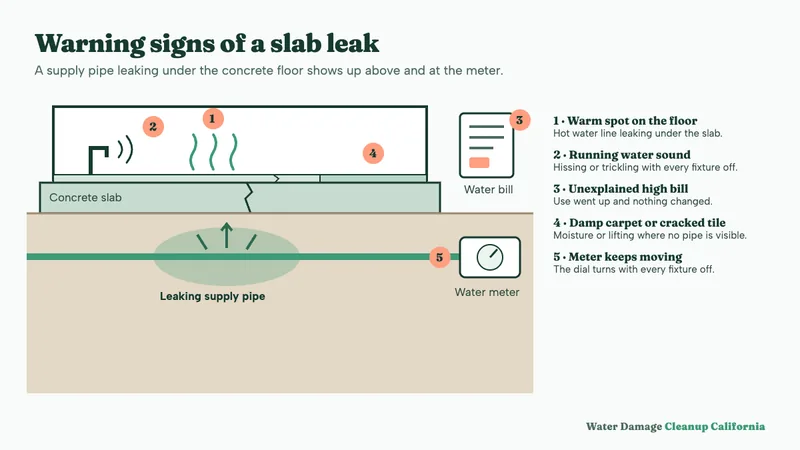
| House on a slab | Pipe leaking beneath the concrete | Slab leaks |
| Apartment or condo | Water arriving from the unit above | Upstairs neighbor |
| Garage or closet heater | Tank or connector failure | Water heaters |
If you rent, the lease decides who must act first, and our guide to renters, landlords and condos lays out the usual split. Condo owners should also read how an association divides responsibility.
Do earthquakes and winter storms change the risk in Glendale?
Both do, in different ways. Wikipedia says the Sierra Madre and Hollywood faults lie in the northern and southwestern parts of Glendale, with the Verdugo and Raymond faults crossing the middle and southeast. Shaking can crack a pipe, loosen a connector or tip a water heater.
Past quakes left marks. According to Wikipedia, 31 Glendale structures had to be demolished after the 1971 San Fernando earthquake, and the 1994 Northridge quake centered about 18 miles away damaged a public parking structure and the Galleria garages.
Rain is the other driver. Wikipedia gives Glendale an average of just over 21 inches a year, mostly from November to April, with wet years above 30 inches and dry years under 10. A roof that went through a dry season can show its weak spots in the first heavy storm, and our roof leak page explains what to check.
The same article says the Works Progress Administration channelized the Verdugo Wash between 1935 and 1937. The sources record no flood on it, so this page claims none. For a mapped answer on your address, ask the city and check FEMA's flood maps.
Which services can a Glendale request lead to?
A request can lead to any of the standard steps: stopping the spread, pulling out water, drying and rebuilding. Each restoration team offers a different mix, so confirm scope and price with them directly. The pages below explain what each step normally involves before anyone arrives.
- Emergency water damage help for active leaks and fresh flooding
- Water removal and extraction for standing water
- Structural drying for walls, slabs and subfloors
- Water damage repair for drywall, flooring and cabinets
- Commercial water damage for shops and offices
There is no obligation to hire the team you reach. It confirms availability, scope and price with you, and you can decline or ask for another quote. Choosing a water damage restoration company lists questions to ask.
Useful questions for the first call: how will they measure moisture, how often will they return to log readings, and will they handle your belongings or only the structure? Ask who deals with the insurer, and get the answer for every step before work begins.
In a Glendale apartment or condo, add one more question: does the restoration team already have access arrangements with your building manager? Shared walls and risers often slow a job.
Which nearby communities can request help too?
Neighbors on every side can ask. Wikipedia names the edges. To the south are the Los Angeles neighborhoods of Atwater Village and Glassell Park, and the rest lie west and east: Burbank and Griffith Park to the west, Pasadena and Eagle Rock to the east.
In the foothills, requests also come from Verdugo City, Montrose, La Crescenta and La Cañada Flintridge. Those towns sit along the same slope as northern Glendale, so a storm that tests one usually tests them all.
East of Glendale, Pasadena has its own page with Arroyo Seco notes. Permit and drainage rules may differ across a city line, so ask the local building department before repairs that need a permit.
What should I do in the first hour after water enters my Glendale home?
Stop the source, keep people safe and start documenting. The EPA says wet areas and belongings should be dried within 24 to 48 hours to prevent mold. Anything touched by sewage or outside flood water needs a professional, per the EPA.
- Close the main valve, or the shutoff for the leaking fixture.
- Step out of rooms where water meets electrical outlets or cords.
- Photograph the damage, the source and the water line before moving things.
- Put dry towels under legs of furniture and lift small items clear.
- Tell the building manager or HOA if the water came from another unit.
- Write down the claim number and adjuster's name from your first insurer call.
Our what to do after water damage guide goes further, and the mitigation page explains why early drying shapes the final bill.
How do California claim rules apply to a Glendale water claim?
California sets clocks that insurers must follow. Under 10 CCR 2695.5(e), the insurer has 15 calendar days to acknowledge a claim, send forms and begin investigating. Under 2695.7(b), it has 40 calendar days after proof of claim to accept or deny in whole or in part.
A denial of a first-party claim must be in writing and list every reason, per 2695.7(b). It must also say you can ask the California Department of Insurance to review the matter.
The CDI says homeowners policies do not cover flood but do cover other kinds of water damage, such as rain through a wind-damaged roof. A pipe that failed and a creek that overflowed are separate events on paper.
Describe the source precisely, and read our insurance claim guide before you sign anything. If you are unsure about flood cover, the California flood insurance guide explains the 30-day wait on a new policy.
Sources: Glendale, California (Wikipedia); 10 CCR 2695.5 and 10 CCR 2695.7 (Cornell LII); California Department of Insurance, Residential Property Claims Guide; CDI, Flood Insurance Resources; EPA, mold and moisture.
Water Damage Cleanup California is the local water damage restoration line and information resource for California. When you call or send a request, it reaches a local water damage restoration team that serves your area. That team confirms whether it can reach you and gives its own scope, price and timing. Confirm them directly before you agree to anything.