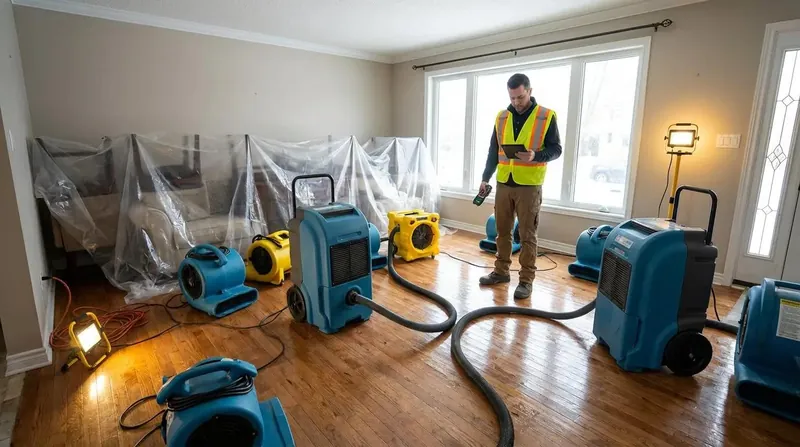
The short version
Fixr (2025) reports a national average near $3,000 for water damage restoration, within a $1,200 to $5,000 range. Cleaner water and a smaller wet area keep it lower. No California-only price turned up in our research, so request itemized written bids.
On this page (12)
- How much does water damage restoration cost in California?
- What does pulling water out of a building cost per square foot?
- Water category versus damage class: how do they differ?
- Which factors raise the price of water damage repair in California?
- What does restoring each building material cost?
- What should I expect to pay for flood cleanup?
- Which price lines apply to my kind of damage?
- Why do mitigation and rebuild show up as separate bills?
- What should I look for when reviewing a water damage estimate?
- Will a provider quote me a price by phone or estimate for free?
- How much of a water damage restoration bill does insurance cover in California?
- What can I do to limit the final bill?
How much does water damage restoration cost in California?
Our sources do not publish a California-only price, so national surveys are the best yardstick. Fixr gives $1,200 to $5,000 with a $3,000 average. Bob Vila draws on Angi and HomeAdvisor data and lands at $1,305 to $5,707, averaging $3,455.
None of that is a California quote, and this site sets no prices. Each restoration team prices its own work, so a bid in Los Angeles, Fresno or Redding may sit above or below these numbers.
The spread is wide because one phrase covers a damp bathroom floor and a soaked ground floor alike. Three variables do most of the damage to your budget: the cleanliness of the water, the area it reached, and the materials that soaked it up.
What does pulling water out of a building cost per square foot?
Fixr's national data lists extraction at $3.75 to $7.50 per square foot, and the rate climbs with each step in contamination. Equipment, disposal and added tear-out explain the climb. Your California bid could differ, so use the table below only as a reference point.
The IICRC S500 standard groups water into three categories. A category rates how contaminated the water is. Volume has nothing to do with it.
| IICRC S500 water category | Where it usually comes from | Fixr national extraction rate, per sq ft |
|---|---|---|
| Category 1 (clean) | A supply line or a burst pipe | $3.75 to $4.25 |
| Category 2 (gray) | A washer, a dishwasher, or a toilet that overflowed with no waste in it | $4.10 to $6.50 |
| Category 3 (black) | Sewage, a flooding river or stream, surface water from outdoors | $7 to $7.50 |
Source: Fixr national data, revised January 2025. Bids in California will vary.
If sewage is part of the picture, the EPA advises hiring a professional with experience in buildings that contaminated water has reached. The sewage backup cleanup and water removal pages describe how such jobs are typically organized.
Water category versus damage class: how do they differ?
Category describes the quality of the water. Class describes how far it traveled and how much material it soaked. A split supply line might wet one closet or three rooms with equally clean water, so the two labels vary independently, and either one can shift what you are quoted.
Fixr prices damage classes with flat ranges instead of a per-foot rate. Higher classes mean wider spread and more saturated material.
| Class of damage | Fixr flat range (national) |
|---|---|
| Class 1 | $150 to $400 |
| Class 2 | $500 to $1,000 |
| Class 3 | $1,000 to $3,000 |
Source: Fixr national data, revised January 2025. These are flat amounts rather than per-foot rates.
A jump from Class 1 to Class 3 mostly adds soaked material, drying gear and days on site. Closing the valve early is the easiest way to keep a job in a lower class.
Which factors raise the price of water damage repair in California?
Seven factors account for most invoices, and the first hours after a leak begins settle nearly all of them. Providers weigh them in different ways, so ask which ones explain your figure. A larger footprint and more saturated material almost always produce a bigger total.
- Water category. Clean, gray and black water are priced at different rates, as the first table shows.
- Spread. Water that travels into the next room or down a wall cavity widens the area needing drying.
- Area. Fixr prices extraction and restoration alike per square foot.
- Removed materials. Carpet pad, drywall and trim that cannot be saved come out and get replaced, a charge apart from drying.
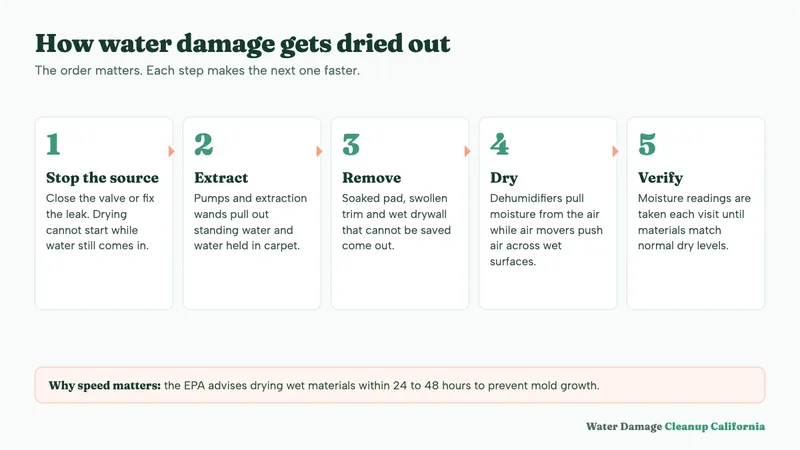
- Equipment and duration. Air movers and dehumidifiers stay on until moisture readings confirm dry materials.
- Contents. Furniture, stored boxes and electronics sitting in the wet area may have to be moved or treated.
- Access. Attics, wall cavities and crawl spaces take more effort than an open room. On a slab foundation, a break beneath the floor is another kind of job, described in slab leak water damage.
What does restoring each building material cost?
In Fixr's national figures, drywall is the least expensive material to restore per square foot, while plaster and hardwood sit at the high end. Carpeting and mold work land between them. A California bid may run higher or lower, so read the table as a loose guide.
| Building material | Fixr national restoration rate, per sq ft |
|---|---|
| Drywall | $1.50 to $3 |
| Carpeting | $4.75 to $10.50 |
| Plaster | $6.25 to $18.75 |
| Hardwood | $10 to $15 |
| Mold | $4.75 to $5.50 |
Source: Fixr national data, revised January 2025.
Bob Vila quotes a few jobs differently: $350 to $1,250 for ceiling repair, $200 to $500 to restore floors, and $1.50 to $3 per square foot for drywall repair. Both surveys agree on drywall. They are separate studies, so the remaining lines will not match.
What should I expect to pay for flood cleanup?
Neither of our sources offers a single flood cleanup total, since floods vary too widely. What the national data does show is that water arriving from outside counts as Category 3, and Fixr lists $7 to $7.50 per square foot for extraction by itself. Tear-out and rebuilding come on top.
IICRC S500 puts river or stream flooding and outside surface water in Category 3. Storm runoff that enters through a door or garage belongs to that group. Drywall and insulation that wicked up the dirty water are frequently removed instead of dried.
The flood damage restoration page covers the process, and mudslide water damage applies if debris arrived with the water. Standard homeowners coverage usually leaves flood out, as the insurance section further down explains.
Which price lines apply to my kind of damage?
Every type of loss corresponds to a different line in the national data. The list below matches common California causes to figures already quoted above. None of it prices your home or stands in for a provider's quote. It simply shows which published line best fits your situation.
- Burst pipe. Usually Category 1. Extraction then uses the clean-water rate, and drying plus any opened walls add to it. A plumber charges for the pipe itself. See burst pipe water damage.
- Ceiling damage. Bob Vila lists $350 to $1,250 for ceiling repair, and whatever leaked above the ceiling is another bill. See ceiling water damage.
- Sewage backup. Category 3 applies, so Fixr's $7 to $7.50 per square foot forms the floor of the estimate.
- Mold. Per Fixr, $4.75 to $5.50 per square foot. Bob Vila quotes removal as $1,100 to $3,400, averaging $2,200. See mold after water damage.
Mold is the one expense here you may be able to avoid. The EPA says that drying wet areas and items in the first 24 to 48 hours prevents growth.
Why do mitigation and rebuild show up as separate bills?
These are separate jobs, frequently handled by different companies on different timelines, so one invoice may cover only half the work. Mitigation halts the spread of damage through extraction, removal of unsalvageable material and drying. Rebuild brings the house back with fresh drywall, paint, flooring and trim.
Mitigation starts first and wraps up once moisture readings show dry materials. Rebuild comes afterward, and plenty of homeowners bring in another contractor for it. Find out if a quote includes one phase or two. The water mitigation page explains the first phase.
A cheap mitigation quote lacking a rebuild line is neither a bargain nor a trap by default. It may just be pricing a single phase.
What should I look for when reviewing a water damage estimate?
Work down the page and verify four items: equipment days, square footage, materials removed and supporting documentation. A clear estimate explains what each dollar buys. When a line confuses you, ask the provider to walk you through it before you sign.
- Equipment and days. Every air mover and dehumidifier should list the number of days it ran.
- Square footage. Extraction and tear-out lines ought to name the area and the rate applied.
- Materials removed. Pad, drywall, baseboard and insulation each deserve their own line rather than a lump sum.
- Photos and readings. Request the pictures and moisture readings behind the number of drying days.
- Rebuild items. Check which lines are mitigation and which are replacement work.
Each provider formats estimates differently, so confirm details directly. The glossary defines unfamiliar terms, and choosing a restoration company suggests questions worth asking.
Will a provider quote me a price by phone or estimate for free?
Whether a visit is free varies by provider, so ask before anyone drives over. Firm phone prices are uncommon, since someone normally has to see the damage and take readings. Be cautious about any fixed total given before someone sees the damage.
The Insurance Information Institute (Triple-I) recommends written bids with materials and prices itemized, which lets you weigh one company against another.
Line up the same rooms, materials and drying days in every bid. A much lower bid may omit something, so ask what. A much higher one may add something, so ask what. Water should not sit while you wait on bids: stop the source and begin extraction, then shop the rebuild quotes.
How much of a water damage restoration bill does insurance cover in California?
The answer turns on what caused the loss and what your policy says. The California Department of Insurance (CDI) states that homeowners policies exclude flood damage yet cover other kinds of water damage. Compare your deductible with the repair estimate before filing.
- Often covered: a sudden discharge or overflow from plumbing, air conditioning or a household appliance, and freezing in those systems, per Triple-I. A roof leak is typically covered as well, the NAIC notes.
- Left out of standard policies: flood, which most homeowners insurance excludes, according to FEMA.
- Typically an add-on or excluded: sewer backup, mold and damage from poor maintenance.
Our sources hold no California payout average. For national scale, the Triple-I fact sheet shows $15,400 as the average water damage and freezing claim from 2019 to 2023. That measures claim size, not a payout anyone is promised. Our insurance claim guide goes further.
What can I do to limit the final bill?
Shut the valve quickly, then dry wet materials within the EPA's 24 to 48 hour mold-prevention window. Day one is where most savings happen, so the sequence of your first moves counts for more than any haggling that follows.
- Stop the source. Turn off the main shutoff or the closest valve, because running water pushes a job into a higher class.
- Clear the wet zone when it is safe, so furniture and boxes quit absorbing water.
- Call early. Extraction and drying can start with a restoration provider while you deal with the plumber and the insurer.
- Record everything. Save photos, video and receipts, and keep damaged items until the adjuster has visited, per Triple-I.
- Lower the humidity. The EPA recommends keeping indoor levels under 60 percent, ideally 30 to 50 percent.
The contact page is the way to reach a restoration team. Restoration teams differ, so confirm details directly.
Sources: CDI, Residential Property Claims Guide; Fixr: Water Damage Restoration Cost, updated January 31, 2025; Bob Vila: water damage restoration cost, updated May 30, 2023; IICRC S500; EPA, Mold cleanup in your home; EPA, A Brief Guide to Mold, Moisture and Your Home; Triple-I, Homeowners and renters insurance facts; FEMA, Don't have flood insurance; NAIC, Homeowners Insurance; Triple-I, Settling insurance claims after a disaster; Triple-I, Which disasters are covered by homeowners insurance?
Water Damage Cleanup California is the local water damage restoration line and information resource for California. When you call or send a request, it reaches a local water damage restoration team that serves your area. That team confirms whether it can reach you and gives its own scope, price and timing. Confirm them directly before you agree to anything.