The short version
Handling commercial water damage restoration in California starts with the source: stop it, confirm power and safety, move people and stock, photograph the loss, then alert your insurer and the owner or landlord. Large commercial jobs are not accepted by every provider, so confirm directly. Your commercial policy decides coverage.
On this page (11)
- What are the first moves for a business hit by a water leak?
- Why does a business loss play out differently than a house loss?
- What water sources go with each kind of property?
- What should you do after a sprinkler system goes off?
- Will a commercial policy pay for water damage in California?
- Does the tenant or the owner bear the loss?
- Is every restoration provider equipped for a big commercial job?
- What does drying a large commercial building involve?
- How should you handle water from a storm, a flood or a sewer line?
- What can a business set up ahead of the next storm?
- Where else can a property manager look for guidance?
What are the first moves for a business hit by a water leak?
Shut off the water, make the premises safe, move people and inventory away from the water, document the damage, and then tell your insurer and the building owner or landlord. Follow that sequence. The opening hour is about stopping water from reaching more of the building before help shows up.
- Close the shutoff. Turn off the valve closest to the leak, or the main. A sprinkler discharge is a special case, since the company that maintains that system may have to shut it down.
- Check power and safety. Never touch electrical equipment while standing in water. If the panel sits in a wet area, phone an electrician rather than reaching for it yourself.
- Clear people, then stock. Get staff and customers off wet floors. After that, raise inventory, records and electronics off the ground where it is safe to do so.
- Record the loss. Take photos and video of the source, the wet floors and the affected stock before anything is moved or discarded.
- Notify the insurer and the owner. Triple-I advises contacting your agent or company right away and postponing major permanent repairs until the adjuster has assessed the loss.
- Then phone a restoration provider and ask if it accepts commercial jobs of your size.
A split supply line follows nearly the same path as in the burst pipe guide. For the opening hour in more depth, read the emergency water damage page.
Why does a business loss play out differently than a house loss?
Water behaves identically in a shop and in a house. The surroundings are what change: more people with a stake, a business that may need to keep operating, bigger floor areas and building systems that houses lack. Those factors shape how the work is planned and who signs off.
- Several parties. A tenant, an owner and a property manager may each be answerable for part of the building, and each may carry a different insurer.
- Lost business. A day of being closed can cost more than the repair, so schedules bend around opening hours.
- After-hours access. Night or weekend work requires keys, alarm codes and security to be arranged ahead.
- Shared structure. Water moves through common walls and ceilings into neighboring suites and the floors below.
- Fire protection systems. A single sprinkler discharge can release a large amount of water in moments.
- Larger drying setups. A big floor plate calls for more equipment and often more electrical capacity.
For that reason, a business job usually begins with a longer discussion of access, occupants and scope than a house job does.
What water sources go with each kind of property?
Each kind of property has its own typical culprits, and the source often settles who gets the first call. The table below is a general guide, not a forecast for your building. A plumber, a building engineer or your insurer can say what fits your property.
| Property type | Common water sources | Watch for |
|---|---|---|
| Office | Rooftop equipment, restroom fixtures, supply lines, roof leaks | Server closets, paper files, tenants on lower floors |
| Retail store | Roof leaks, runoff at the entrance, supply lines, air conditioner drain lines | Bottom shelves, flooring, display fixtures |
| Restaurant | Dish machines, ice makers, backed-up floor drains, supply lines | Food safety, cooking equipment, contamination from drains |
| School or church | Failed roofs and gutters, restrooms, storm runoff | Big open rooms, plus set times for classes or services |
| Rental building | Plumbing inside units, water heaters, appliance leaks, the roof | Multiple tenants, party walls, notices to residents |
| Warehouse | Roof leaks, runoff at loading doors, floor drains, sprinkler release | Stock on pallets, concrete slab floors, high ceilings |
A rental building fits several of those rows. The tenant and condo guide deals with the unit side, and leaks from overhead are in the roof leak and storm damage guide. Churches also get a dedicated water damage page.
What should you do after a sprinkler system goes off?
A discharge can dump a large volume of water into a building within moments, and it can occur by accident. Triple-I counts accidental discharge or overflow from sprinkler systems among the perils named on standard policy forms. For a business, though, your own policy wording governs coverage.
Shutting the system down and putting it back in service falls to the fire protection contractor that maintains it, not a restoration provider. Pumping and drying can begin once the water is off.
Explain to your insurer what set it off, whether an accident, a fire or a damaged pipe. The trigger shapes the claim. Fire damage is a separate matter from the water damage this page addresses.
Will a commercial policy pay for water damage in California?
Maybe, though a commercial policy differs from a homeowners policy and its wording rules. Coverage, exclusions and the duties it places on you after a loss all vary. Read the policy or talk to your agent before assuming anything about your own building.
According to the California Department of Insurance, homeowners and commercial policies typically exclude flood, mudslide and debris flow, unless a recent wildfire or another covered peril caused them. Triple-I adds that standard homeowners and renters policies leave out flood, that sewer backup coverage is bought separately, and that poor maintenance damage is not covered.
Find out as well if the policy replaces income lost during a closure, and how it treats stock and contents. Flood and sewer backup deserve their own questions.
California's fair claims rules require an insurer to acknowledge a claim within 15 calendar days at most and to accept or deny it within 40 calendar days at most after proof of claim. The Department's consumer hotline is 1-800-927-4357. The insurance claim guide was written with homes in mind, but the habits transfer: photograph first, keep receipts, and hold damaged items until the adjuster visits.
Does the tenant or the owner bear the loss?
That turns on the lease and where the water came from, so locate the lease and alert the owner early. Neither side is at fault by default. A tenant does not automatically own a leak inside a wall, and an owner is not automatically liable for a tenant's inventory.
Give the landlord or property manager written notice as soon as you know, and keep a copy. Next, settle three points: who books the drying of the structure, who takes care of contents, and which insurer backs each side.
A manager responsible for several units should keep a single record that covers every affected space. Lease questions are for a lawyer, and this site cannot answer them. In multi-owner buildings, the HOA responsibility guide shows how shared plumbing divides the blame.

Is every restoration provider equipped for a big commercial job?
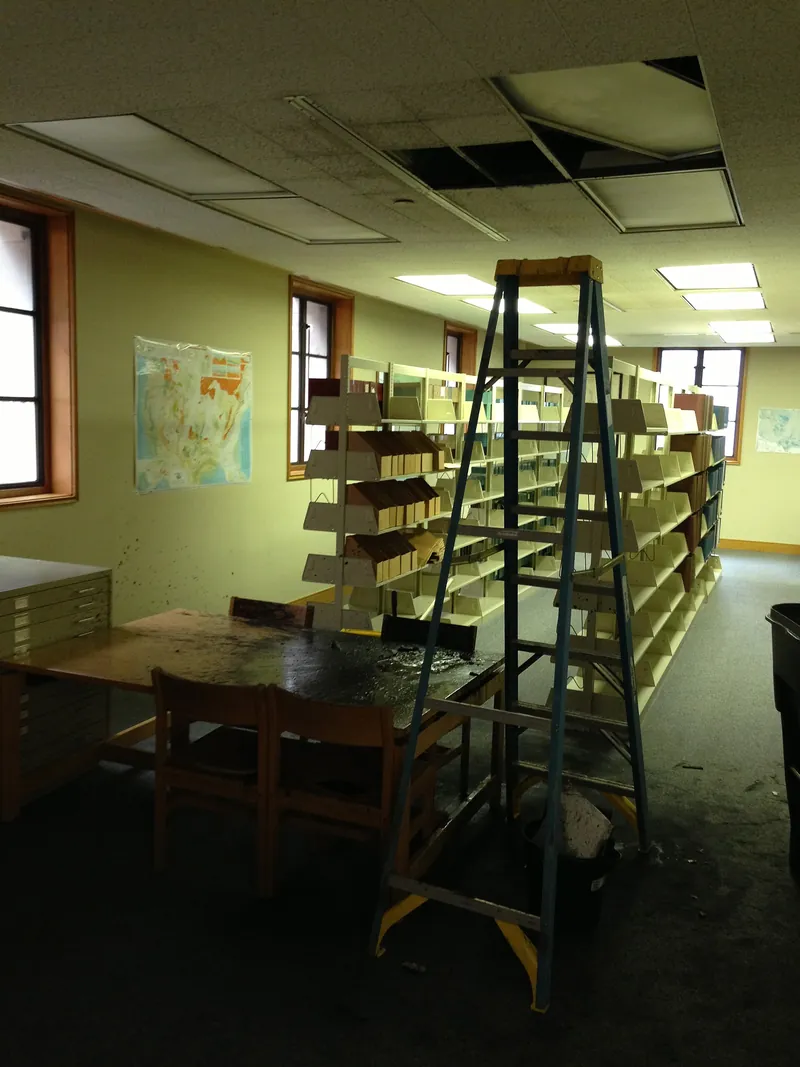
No, so ask before counting on one. Some providers accept commercial work and others do not, and size limits and service lists vary from company to company. This site cannot know in advance which team will take a given building.
When you call, describe the size of the affected area, the property type and the water source. Ask if work can happen after hours and how it would be scheduled around people still using the space. If the provider cannot take the job, ask who it would recommend.
The Contractors State License Board says it licenses and regulates about 285,000 contractors in California. Ask any provider for its license number and verify it with CSLB, reachable at 800-321-2752.
The guide to choosing a restoration company offers more questions and warning signs. Nothing here promises that a provider is available or handles commercial work.
What does drying a large commercial building involve?
The reasoning is the same as for a house, only larger: cut off the source, pump out the standing water, pull whatever cannot be saved, set up dehumidifiers and air movers, and check progress against moisture readings. The EPA advises drying wet areas within 24 to 48 hours to prevent mold growth, so the timing pressure does not change.
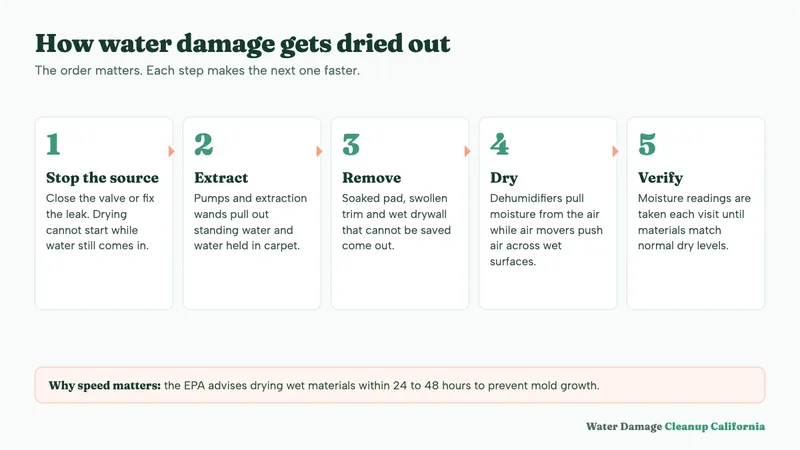
A large floor area needs extra equipment, and the building may lack the spare circuits to power it. Concrete slabs and masonry walls can retain moisture longer than they appear to, so ask to see readings at every visit.
For how moisture is tracked, see the structural drying guide, and for the early work, the water mitigation guide.
How should you handle water from a storm, a flood or a sewer line?
Assume it is contaminated until a professional says otherwise. Under the IICRC S500 standard, sewage, flood water rising from rivers and streams, and surface water from outdoors all fall in Category 3. The EPA advises hiring a professional who has dealt with buildings damaged by contaminated water.
In a restaurant, or any building with floor drains, a backup can push dirty water into occupied areas, so keep people and food zones clear. The sewage backup cleanup guide and the flood damage restoration guide show how those jobs differ.
Storms in California can be severe. NOAA reports that a series of nine atmospheric rivers hit the West Coast from late December 2022 into January 2023, and California Geological Survey mapped more than 700 reported landslides due to rainfall.
Sitting outside a mapped flood zone offers no exemption, because storm runoff and overwhelmed street drains reach those properties too. See the atmospheric river guide.
What can a business set up ahead of the next storm?
Put the shutoff locations, the phone list and the things worth protecting on one sheet, and give copies to the right people. A page like that saves the first and most expensive minutes of a water loss, when people are still hunting for valves and phone numbers.
- Shutoffs. Find the main water valve, every suite's valve and the water heater supply, then label and photograph each one.
- Sprinkler contact. Record who maintains the system and how to reach them.
- Phone list. Keep policy numbers beside the names of your plumber, electrician, owner, property manager, insurer and agent.
- Off-hours access. Write down who has the keys and the alarm codes.
- Move-first list. Decide which records, equipment and stock leave first, and shelve them above floor level when possible.
- Water heater bracing. The California Department of Insurance lists bracing a water heater to a wall among the retrofits that can lower earthquake insurance premiums.
The prevention guide covers common leak points, and the after-storm checklist is useful once the rain has stopped.
Where else can a property manager look for guidance?
Begin with the pages that match the water source, because the source decides the first call. A manager with several buildings can treat the water damage guides as a library of checklists, and the glossary as a reference for terms on a work order.
To see which regions this site covers, use the service areas page. What providers accept varies, so check with them yourself.
Sources: EPA, Brief Guide to Mold, Moisture and Your Home; EPA, Mold Cleanup in Your Home; Ready.gov, Floods; Ready.gov, Ready Business; IICRC S500; Triple-I, Settling insurance claims after a disaster; Triple-I, Which disasters are covered by homeowners insurance; CDI, press release of February 4, 2025; 10 CCR 2695.5; 10 CCR 2695.7; CDI, Residential Property Claims Guide; CDI, Earthquake Insurance; CSLB, press release 24-21; NOAA NESDIS, Atmospheric Rivers Hit West Coast.
Water Damage Cleanup California is the local water damage restoration line and information resource for California. When you call or send a request, it reaches a local water damage restoration team that serves your area. That team confirms whether it can reach you and gives its own scope, price and timing. Confirm them directly before you agree to anything.