For San Bernardino County homeowners
For water damage restoration in San Bernardino County, CA, stop the water, photograph each room and start drying in the first 24 to 48 hours. Runoff entering a home is flood water, which standard homeowners policies exclude. Requests come from the valley, the mountains and the high desert.
On this page (9)
- Which San Bernardino County cities and ZIP codes do you take requests from?
- How big is San Bernardino County, and where do most people live?
- What do foothill creeks and flood channels mean for valley homes?
- How do Santa Ana winds and wildfire season affect water damage?
- What changes for Big Bear, Lake Arrowhead and the high desert?
- Who handles a leak if I rent or live in a condo?
- Does the San Andreas Fault matter for water damage here?
- What are the insurer's deadlines on a San Bernardino County claim?
- What should I do first when water gets in?
Which San Bernardino County cities and ZIP codes do you take requests from?
Requests for water damage restoration in San Bernardino County come from the valley cities, the mountain communities and the high desert. A restoration team confirms whether they can reach your address, because this is one of the biggest counties in the country and restoration teams differ on how far they drive.
Two cities have their own pages: Ontario and Rancho Cucamonga. For any other address, try the San Bernardino County ZIP finder.
Wikipedia says the 2020 census counted 2,181,654 people here, the fifth-most populous county in California. Next door is Riverside County, and Los Angeles County, Orange County and Kern County have hubs of their own.
How big is San Bernardino County, and where do most people live?
It is enormous, but crowded in one corner. Wikipedia calls it the largest county in the contiguous United States by area, reaching from the San Bernardino Valley to the Nevada border and the Colorado River. It also says 89 percent of residents live in three census divisions that cover only 9 percent of the land.
That corner holds the valley cities. Wikipedia names Ontario, Chino, Chino Hills, Upland, Fontana, Rialto, Colton, Montclair, Rancho Cucamonga, San Bernardino, Loma Linda, Highland, Redlands and Yucaipa, among others. The table sorts the county into three settings.
| Setting | Communities Wikipedia names | What to ask the restoration team about |
|---|---|---|
| Valley | Fontana, Rialto, Redlands, Upland, Chino Hills | Foothill runoff, flood channels, older plumbing, rentals |
| Mountains | Crestline, Lake Arrowhead, Running Springs, Big Bear Lake, Forest Falls | Snow, frozen pipes, cabins that sit empty |
| High desert | Victorville, Hesperia, Apple Valley, Adelanto | Air conditioner drains, water heaters, long drives |
Mention your setting along with your street when you call.
What do foothill creeks and flood channels mean for valley homes?
They decide where storm water runs. Wikipedia says City Creek, Lytle Creek, San Timoteo Creek, Twin Creek and Warm Creek feed the Santa Ana River through flood control channels, and the river forms part of the city of San Bernardino's southern border. Homes near a channel or under the mountains deserve a check after heavy rain.
Ontario's history shows why. Wikipedia says the Chaffey brothers built a drainage system to bring water down from the foothills of Mount San Antonio, and it was meant to prevent the floods that periodically afflict the area. Rancho Cucamonga sits just south of the San Gabriel Mountain foothills.
Runoff in a house is flood water. The IICRC S500 standard sets outside surface water at Category 3, grossly contaminated, which needs trained handling. Our pages on storm and flood damage and flood damage restoration explain the steps.

How do Santa Ana winds and wildfire season affect water damage?
They set up two separate problems. Wikipedia says Santa Ana winds feel especially strong around San Bernardino because dry air is funneled through Cajon Pass, and in extreme cases reach 60 miles per hour, downing power lines and causing property damage. A roof opened by wind can leak in the next rain.
The same article says those winds, plus cold wet winters and hot dry summers, raise wildfire danger in foothill, canyon and mountain communities. After a fire, a burned slope sheds mud when rain arrives. Read post-wildfire flood and mudflow damage and roof leak water damage.
Insurance treats mud differently from a roof leak. The California Department of Insurance said in a February 2025 release that homeowners and commercial policies typically exclude flood, mudslide and debris flow, unless a recent wildfire or another covered peril caused it.
What changes for Big Bear, Lake Arrowhead and the high desert?
Snow and distance. Wikipedia names Snow Summit, Bear Mountain and Snow Valley as the county's winter resorts, and says Arrowhead Springs, around 3,000 feet up, sometimes gets heavy snow. A mountain home used only on weekends can leak for days unseen.
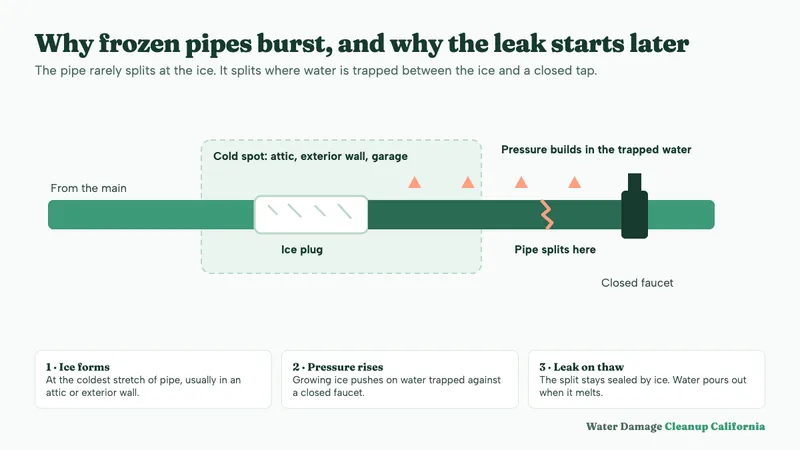
The American Red Cross says supply pipes in attics, crawl spaces, garages and kitchen cabinets are most at risk of freezing. It advises keeping the heat at 55 degrees Fahrenheit or higher while away, and letting cold water drip from faucets on exposed pipes.
Out in the Victor Valley, a failed water heater or a clogged air conditioner drain is likelier than ice. Our guides to second-home leak monitoring, burst pipes and AC condensate leaks cover those cases.
Who handles a leak if I rent or live in a condo?
It depends on who owns the part that failed. Wikipedia reports that 39.2 percent of occupied housing units in the county were renter-occupied in the 2020 census, so many leaks start in a building someone else owns. Report the leak to the landlord or association in writing and keep a copy.
The answer for your unit turns on the lease, the governing documents and which pipe or roof section failed. Our renters, landlords and condos guide, upstairs neighbor guide and HOA responsibility page explain the common splits.
Renters can still document their own belongings. Photograph each item and note when you first saw the leak.
Does the San Andreas Fault matter for water damage here?
It can, through broken pipes and tipped water heaters. Wikipedia says the San Andreas Fault runs along the base of the San Bernardino Mountains and through the northern part of the city of San Bernardino. Shaking can snap a supply line.
The California Department of Insurance says standard homeowners policies do not cover earthquake damage, except fire. A California Earthquake Authority sample policy does cover water released from water heaters or supply pipes inside the home as a direct result of an earthquake. The policy you hold controls, so check it.
California law also requires residential water heaters to be braced, anchored or strapped against earthquake motion, according to Health and Safety Code 19211. Our water heater leak page shows what a failing tank looks like.
What are the insurer's deadlines on a San Bernardino County claim?
California sets clocks in 10 CCR sections 2695.5 and 2695.7. An insurer must acknowledge a claim in no more than 15 calendar days, and after proof of claim must accept or deny in no more than 40 calendar days. The California Department of Insurance also says homeowners policies do not cover flood but do cover other water damage.
FEMA says most homeowners insurance does not cover flood losses either, and Triple-I notes sewer backups need their own cover. Read the insurance claims guide and the California flood insurance guide before you decide what to file.
What should I do first when water gets in?
Stop the source, protect people, then begin drying. The EPA advises drying water-damaged areas and items in the first 24 to 48 hours to prevent mold, and keeping indoor humidity between 30 and 50 percent, and below 60. These steps can start before anyone arrives.
- Shut the main valve or the fixture valve. Turn off power to a wet room only when the panel is dry and reachable.
- Record video of every affected room, then close-up photos of damaged items.
- Tell your insurer about the loss and ask how it wants the claim documented.
- Ask a restoration team which readings they take and how they log drying progress.
- Avoid flowing water in streets and washes. Ready.gov warns that six inches of moving water can knock a person down.
The what to do after water damage guide goes deeper, and emergency water damage help explains the request process. See mold after water damage if a stain keeps spreading.
This site is the local water damage restoration line and information resource. You have no obligation to hire the team you reach, and the team confirms availability, price and scope itself.
Sources: San Bernardino County, San Bernardino, Ontario and Rancho Cucamonga (Wikipedia); IICRC S500; California Department of Insurance, February 4, 2025 release; California Department of Insurance, earthquake insurance; California Department of Insurance, Residential Property Claims Guide; California Earthquake Authority sample policy; Health and Safety Code 19211; 10 CCR 2695.5 and 10 CCR 2695.7; American Red Cross, frozen pipes; Triple-I, disasters covered by homeowners insurance; FEMA, flood insurance; EPA, mold and moisture; Ready.gov, floods.
Coverage
Cities and communities in San Bernardino County
Requests come from 72 cities and communities here, covering 116 ZIP codes. The cities with their own guide come first.
- Adelanto
- Amboy
- Angelus Oaks
- Apple Valley
- Baker
- Barstow
- Big Bear City
- Big Bear Lake
- Bloomington
- Blue Jay
- Bryn Mawr
- Cedar Glen
- Cedarpines Park
- Chino
- Chino Hills
- Cima
- Colton
- Crestline
- Daggett
- Earp
- Essex
- Fawnskin
- Fontana
- Forest Falls
- Fort Irwin
- Grand Terrace
- Green Valley Lake
- Guasti
- Helendale
- Hesperia
- Highland
- Hinkley
- Joshua Tree
- Lake Arrowhead
- Landers
- Loma Linda
- Lucerne Valley
- Ludlow
- Lytle Creek
- Mentone
- Montclair
- Morongo Valley
- Mountain Pass
- Needles
- Newberry Springs
- Nipton
- Oro Grande
- Parker Dam
- Patton
- Phelan
- Pinon Hills
- Pioneertown
- Red Mountain
- Redlands
- Rialto
- Rimforest
- Running Springs
- Skyforest
- Sugarloaf
- Trona
- Twentynine Palms
- Twin Peaks
- Upland
- Victorville
- Vidal
- Wrightwood
- Yermo
- Yucaipa
- Yucca Valley
Water Damage Cleanup California is the local water damage restoration line and information resource for California. When you call or send a request, it reaches a local water damage restoration team that serves your area. That team confirms whether it can reach you and gives its own scope, price and timing. Confirm them directly before you agree to anything.