The short version
Categories grade the water itself: Category 1 is clean, Category 2 is gray, Category 3 is grossly contaminated. Classes grade the spread, meaning how much of the building got wet. Categories drive safety and price per square foot, classes drive the size of the job. Ask any provider for both labels in writing.
On this page (9)
- What are the water damage categories?
- Which category fits a California leak, storm or sewer backup?
- Why does Category 3 water need a different approach?
- What do water damage classes mean?
- How do categories and classes work together?
- How do categories and classes change the cost?
- How do water categories affect an insurance claim?
- Does the category affect mold risk and drying time?
- What should I ask a provider about my category and class?
What are the water damage categories?
A water damage category is a rating of what the water carries. It says nothing about volume. The IICRC S500 standard sets three levels: Category 1 for clean water, Category 2 for gray water, and Category 3 for grossly contaminated water. Providers use the level to decide on protective gear and cleaning.
Think of the category as the question "what is in this water?" A burst supply line and a sewage backup can flood the same hallway, yet they are handled very differently. The category is usually written on the estimate, so you can ask about it by name. If you searched for water damage categories because a quote mentions one, this page explains what the number means and what to ask next.
The water damage glossary defines other terms you may see on paperwork, and the full set of California water damage guides covers the rest of the process.
Which category fits a California leak, storm or sewer backup?
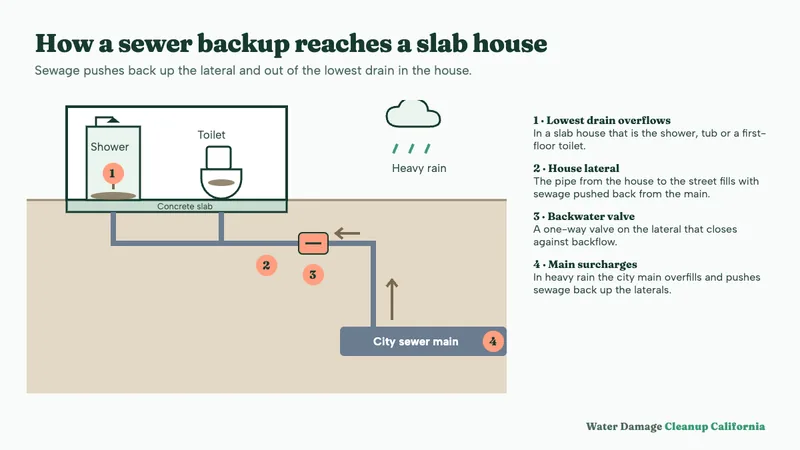
It depends on where the water came from. The IICRC S500 lists Category 1 for supply lines and burst pipes, Category 2 for washer, dishwasher and toilet overflow without waste, and Category 3 for sewage, rising flood water from rivers or streams, and outside surface water.
| Category | Water source (IICRC S500) | California example | What to ask |
|---|---|---|---|
| 1, clean | Supply line, burst pipe | A split pipe in a garage wall, or a failed supply hose | How fast can the wet area be dried? |
| 2, gray | Washer, dishwasher, toilet overflow without waste | A washing machine drain that overflowed onto a hallway floor | Which materials stay, and which come out? |
| 3, grossly contaminated | Sewage, river or stream flood water, outside surface water | Storm runoff entering a doorway, or a sewer line backing up a drain | How will the work area be contained and the waste handled? |
Storm runoff that enters a house is outside surface water, so it falls under Category 3 in that list. Rain that enters through a damaged roof is a different case. Ask the provider how it classifies the water and why, since the answer drives the price and the plan.
Why does Category 3 water need a different approach?
Category 3 water can carry sewage and other contamination, so the job shifts from drying toward cleaning and removal. For damage caused by sewage or similarly tainted water, the EPA recommends hiring a professional who has worked on buildings hit by that kind of water.
That is why homeowners are told not to treat sewage as a do-it-yourself job. Protective gear, containment and disposal all matter. The CDC advises wearing rubber boots, gloves and goggles for flood cleanup and never mixing bleach with ammonia or other cleaners.
Porous materials are the usual casualties. Soaked carpets and upholstery that cannot be dried quickly should be thrown out, according to the CDC. If a drain backed up, the page on sewage backup cleanup walks through the steps, and the mudslide water damage page covers debris and runoff after fire areas wash out.
What do water damage classes mean?
Classes describe how much of the building got wet, while categories describe how dirty the water is. Fixr sorts jobs into Class 1, Class 2 and Class 3, and its price ranges climb with each step. In general, a higher class means more wet material to dry and usually more equipment and time.
Class is a size-of-the-problem label. A small, contained leak that touched little material sits at the low end. Water that soaked through walls, flooring and more of the structure sits higher. Because the classes depend on measurements taken on site, a provider should explain how it reached its class instead of just stating it.
Fixr's cost guide, updated January 31, 2025, lists flat national ranges for each class.
| Damage class | Fixr national range | What it tells you |
|---|---|---|
| Class 1 | $150 to $400 | Smallest amount of wet material |
| Class 2 | $500 to $1,000 | More of the room or structure is wet |
| Class 3 | $1,000 to $3,000 | The largest of the three classes Fixr lists |
These are national figures, not California quotes, and providers set their own prices. Use them only to check whether a number is far outside the usual range.
How do categories and classes work together?
Every job has both labels, and they answer different questions. The category covers what the water carries, and the class covers how far it spread. A job can be Category 1 and a high class, such as a clean pipe break that soaked several rooms, or Category 3 and a low class, such as a small sewage spill.
Reading both together shows why two jobs of the same size can cost very different amounts. The clean-water job is mostly about speed and drying equipment. The sewage job adds protective gear, cleaning and removal of materials that cannot be saved.
When a provider writes up a job, expect something like "Category 2, Class 2" and then the reasons. If the paperwork gives one label and not the other, ask for both. The water mitigation page explains the early work, and structural drying covers the equipment side that the class helps determine.
How do categories and classes change the cost?
Higher categories raise the price per square foot of water extraction, and higher classes raise the overall job. In its January 31, 2025 update, Fixr prices extraction per square foot at $3.75 to $4.25 for clean water, $4.10 to $6.50 for gray water and $7 to $7.50 for black water. All of these are national figures.
For the whole job, Fixr gives a national range of $1,200 to $5,000 and an average of $3,000. It also breaks restoration costs per square foot by material, down by material, with $1.50 to $3 for drywall, $4.75 to $10.50 for carpeting and $10 to $15 for hardwood.
The Insurance Information Institute reports that water damage and freezing claims averaged $15,400 across 2019 through 2023. That average covers all causes and severities, so it is not a price for your job. For California-specific guidance, read the water damage restoration cost guide, and ask any provider to show how it priced your category and class.
How do water categories affect an insurance claim?
Category 3 sources are the ones most likely to run into policy exclusions. Triple-I says standard homeowners and renters policies leave out flood. It adds that neither a typical homeowners policy nor flood insurance pays for a sewer backup. Each is sold separately, so the category on your estimate can shape what a claim covers.
The California Department of Insurance says homeowners policies do not cover flood damage but do cover other kinds of water damage. The NAIC notes that damage from household plumbing or a leaking roof is usually covered, whereas ground water and rain runoff generally are not. So a Category 1 plumbing break lands in a different spot than Category 3 runoff.
Check your own policy for an endorsement before you assume anything. Report the damage to your agent or company right away, as the CDI advises. The insurance claim guide has the California steps.
Does the category affect mold risk and drying time?
Mold risk depends mostly on how fast things dry, not on the category label. To head off mold, the EPA advises drying wet areas and belongings in 24 to 48 hours. It also wants indoor humidity under 60 percent, with 30 to 50 percent as the ideal range.
After a flood, the CDC names the same 24 to 48 hour window. Delay is what turns a clean-water leak into a mold problem, which is why even a Category 1 job should not sit. The EPA adds that a moldy patch under about 10 square feet is usually a do-it-yourself job, but sewage or contaminated water is not.
Insurance can also be tied to mold. The CDI says mold damage caused by a covered peril may be covered, while Triple-I says policies will not cover damage caused by lack of maintenance. The mold guide goes further.
What should I ask a provider about my category and class?
Ask for both labels in writing, with the reason for each. A good answer names the source of the water, which materials were wet and how the provider measured them. Restoration teams differ in how they document and price jobs, so confirm the details directly before work starts.
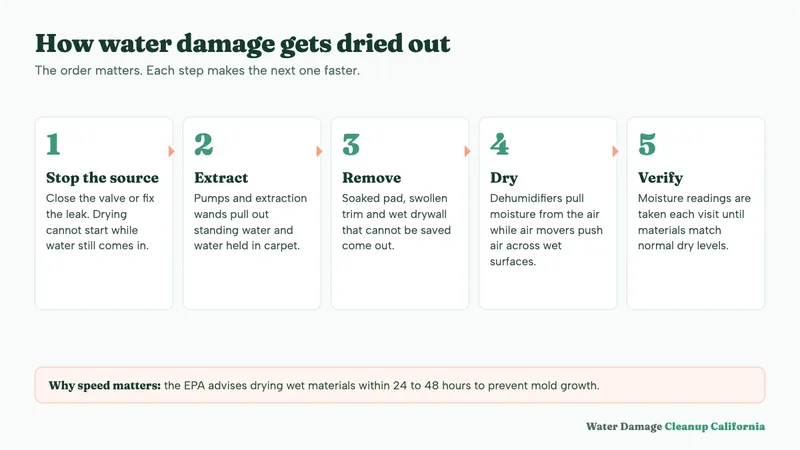
- Stop the source if it is safe: shut off water at the main or the fixture.
- Photograph the damage before anything is moved, as Triple-I advises.
- Ask which category the provider assigned and what the source was.
- Ask which class and how many rooms and materials it covers.
- Request itemized pricing with materials and prices listed line by line.
- Tell your insurer the category and keep every receipt.
Triple-I recommends written bids with line-by-line pricing. It also advises waiting on major permanent repairs until the adjuster has looked at the damage. When you are ready, the guide to choosing a restoration company lists more questions.
Sources: IICRC S500; Fixr, Water Damage Restoration Cost; EPA, Mold Cleanup in Your Home; EPA, A Brief Guide to Mold, Moisture and Your Home; CDC, About Mold and Your Health; Triple-I, Which disasters are covered by homeowners insurance; Triple-I, Settling insurance claims after a disaster; Triple-I, Facts and statistics; NAIC, Homeowners Insurance; California Department of Insurance, Residential Property Claims Guide.
Water Damage Cleanup California is the local water damage restoration line and information resource for California. When you call or send a request, it reaches a local water damage restoration team that serves your area. That team confirms whether it can reach you and gives its own scope, price and timing. Confirm them directly before you agree to anything.