The short version
A leak detector for a second home alerts you to water you would not see, but it only works if someone can act on the alert. Run a meter check, close the main valve if you can, keep the heat at 55 F in cold weather, and ask your insurer about its vacancy clause before a long absence.
On this page (10)
- Is a leak detector worth it for a second home or cabin?
- What kinds of leak monitoring work when nobody is home?
- Where do leaks start in a house that is rarely used?
- How do you check for a hidden leak before you leave?
- Should you shut off the water when you leave a second home?
- Does insurance change when a second home sits empty?
- What about freezing at a mountain cabin?
- What are the limits of remote leak detection?
- What should you do if a leak happens while you are away?
- Who should have your keys and contacts for a second home?
Is a leak detector worth it for a second home or cabin?
For a house that sits empty for weeks, a leak detector is one of the few ways to learn about a leak before the damage spreads. A detector that sends an alert to your phone replaces the neighbor who is not checking. Cleanup costs are in the restoration cost guide.
Triple-I says that in vacant homes, where checks are infrequent, leaks can run for extended periods before anyone sees them, which drives up repair and remediation costs.
Water damage is also common in general. The Insurance Information Institute reports that about one in 60 insured homes has a water damage or freezing claim each year, and that the average claim severity was $15,400 across 2019 to 2023. Those figures cover all homes, not only empty ones.
What kinds of leak monitoring work when nobody is home?
There are three broad types: point sensors that sit on the floor, flow monitors that watch the water line, and systems that can also close a valve. Each reports in a different way, and each has gaps. The EPA's WaterSense program describes leak detection and flow monitoring devices as tools that identify leaks or alert you to irregular water use.
| Type | What it notices | Main limit |
|---|---|---|
| Floor sensor | Water that reaches the spot where it sits | Misses a leak inside a wall or above a ceiling until water drips down |
| Flow monitor on the supply line | Water running when nobody should be using it | Cannot tell you which fixture or pipe is the source |
| Monitor with automatic shutoff | Unusual flow, then closes the main valve | Needs power and a connection, and a valve that works |
| Temperature or humidity sensor | A cold house, or damp air that suggests moisture | Points to a problem, not a location |
Triple-I lists remote monitoring, meaning leak detectors, thermostats and cameras, as one way to cut your exposure when a home is empty. This site does not recommend brands or products, so compare what each device reports and what it needs to keep working.
Where do leaks start in a house that is rarely used?
Leaks in a seldom-used house usually start at the same places as in any other home: supply lines, valves and the appliances that hold water. The difference is that nothing interrupts them. A slow drip under a sink or a loose hose behind a washer has days or weeks to run.
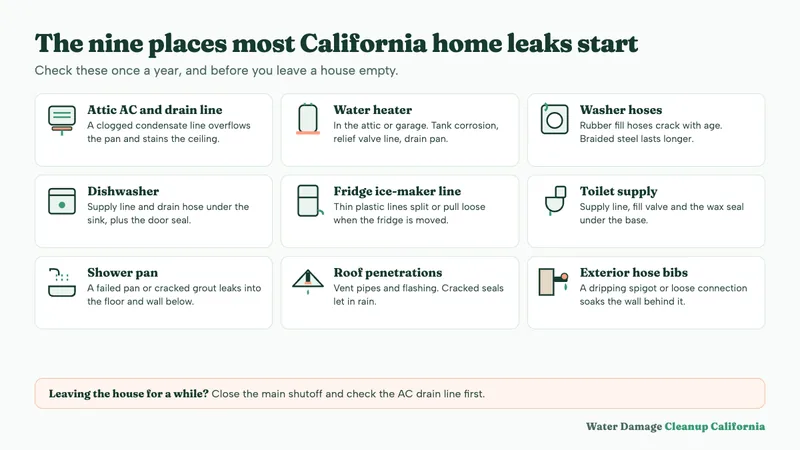
A walk-through before you leave is worth the ten minutes. Look at the spots below, and use the prevention guide for the full list.
- Water heater. Check the base, the pipe connections and the relief valve line. Our water heater leak page covers what a failing tank looks like.
- Washer hoses and dishwasher line. These are the appliance leaks that most often run unnoticed.
- Toilet supply lines and under-sink traps. Look for damp cabinet floors.
- Outdoor spigots and irrigation. The EPA notes that a leak in an irrigation system the thickness of a dime can waste about 6,300 gallons a month.
How do you check for a hidden leak before you leave?
Use the water meter. With every fixture and appliance off, the meter should not move. The EPA says that if the meter changes at all, you probably have a leak. This test takes a few minutes and finds leaks that are not visible under a sink or behind a wall.
- Turn off everything that uses water, including the ice maker, irrigation timers and any running toilet.
- Read the meter and note the dial or the leak indicator if it has one.
- Wait, then read it again. Any change points to a leak somewhere past the meter.
- Check toilets with dye. The EPA says a few drops of food coloring in the tank will show up in the bowl in 10 minutes if the flapper leaks.
- Look at the walls and floors under sinks and around the water heater for stains or soft spots. See signs of water damage for what to look for.
- Close the main shutoff before you go, if you have no reason to leave water on.
If the meter moves and you cannot find the source, a plumber can narrow it down. If your home sits on a slab, a leak under the floor is one possibility, and the slab leak page lists its warning signs.
Should you shut off the water when you leave a second home?
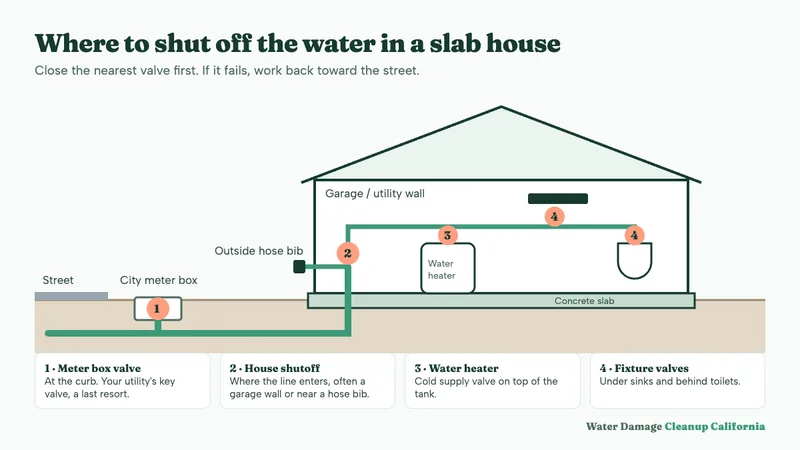
Shutting off the main supply is the simplest protection, because a closed valve cannot leak into the house. Triple-I lists shutting off the water supply, or fully winterizing the plumbing, among the steps for a vacant home. Whether you can do it depends on what else relies on that water.
Some homes cannot go fully dry. A fire sprinkler system, an irrigation system, a pool or a water softener may need supply, and an HVAC system with a condensate line is a separate case. Ask the people who installed or serve each system what is safe to turn off.
If you can close the main, find it before the trip, not during an emergency. The diagram below shows the usual shutoff points in a slab house, and your own layout may differ.
Does insurance change when a second home sits empty?
It can. Triple-I says most homeowners policies include a vacancy clause that limits or excludes coverage if the property is unoccupied for typically 30 to 60 consecutive days. Policies define vacant and unoccupied differently, so your own wording governs. Ask your agent before a long absence.
Triple-I adds that insurers offer vacant home policies or vacancy endorsements, and that failing to heat the home in winter could void coverage even under a vacant-home policy. A second home you visit on weekends is not the same as one that stays closed for months, but the policy decides where that line falls.
Standard policies also have limits that apply to any home. Triple-I notes that damage from lack of maintenance is not covered, and the NAIC says ground water and rain runoff damage is typically excluded. If a loss happens, the insurance claim guide walks through the steps, and the California Department of Insurance accepts complaints about claim handling.
What about freezing at a mountain cabin?
If your cabin is somewhere that freezes, the pipes are the main risk. The American Red Cross says supply pipes are most at risk in unheated areas such as crawl spaces, attics, garages and kitchen cabinets. A cabin that is empty in winter has all of those and no one to notice.
The Red Cross advises that when you are away in cold weather, you leave the heat no lower than 55 F and hold the thermostat at one setting around the clock. It also advises letting cold water drip from faucets served by exposed pipes. Triple-I gives the same 55 F figure for vacant homes.
A temperature sensor helps here, because a failed furnace is silent until the house is cold. When thawing a frozen pipe, the Red Cross says to use a heating pad, hair dryer, space heater kept away from anything flammable, or hot wet towels. It says never to use a blowtorch or any open flame. For the damage a split pipe causes, see the burst pipe page.
What are the limits of remote leak detection?
A detector tells you something is wrong. It does not fix it. Someone still has to reach the house, close a valve, and call for help, and a remote alert at 2 a.m. is of little use if no one can act on it.
Think through the gaps before you rely on one device:
- Power and internet. If either goes out, many devices stop reporting. Ask what the device does when it cannot connect.
- Batteries. A dead sensor sends no alert. Put battery checks on your pre-trip list.
- Placement. A sensor under the kitchen sink does not cover the attic air handler.
- Who gets the alert. If you are on a flight, a neighbor or property manager needs the alert too, and a key.
No device removes the risk. A monitor reduces how long a leak runs, and the right mix depends on your house. Providers and plumbers differ on what they advise, so confirm any plan with the person who will install it.
What should you do if a leak happens while you are away?
Get the water stopped first, then get the house dried. If you can close the main valve remotely or someone can reach the house, do that. Then call your insurer, photograph the damage, and arrange drying, because the EPA advises drying water-damaged areas within 24 to 48 hours to prevent mold growth.
When water has been running for days, expect more than a wet spot. Materials may have been wet long enough for mold to start, which is covered in the mold guide. A plumber stops the source, and a restoration provider handles drying, though teams differ in what they handle, so ask each one directly.
Who should have your keys and contacts for a second home?
Anyone you expect to respond to an alert needs three things: a key or access code, the location of the main shutoff, and the order of calls to make. A neighbor or property manager with only a phone number cannot stop a leak from the sidewalk.
Line up your contacts before you need them. Give a neighbor or manager access, write down the shutoff location, and keep your insurance agent's number with the alert instructions. More background is in the water damage guides. If you need a restoration provider, the contact form can connect you with one.
Sources: Triple-I, When No One's Home: Understanding Role of Vacancy Insurance; EPA WaterSense, Fix a Leak Week; Triple-I, Facts and Statistics: Homeowners and renters insurance; Triple-I, Which disasters are covered by homeowners insurance; NAIC, Homeowners Insurance; American Red Cross, Frozen Pipes; EPA, A Brief Guide to Mold, Moisture and Your Home; California Department of Insurance, file a complaint.
Water Damage Cleanup California is the local water damage restoration line and information resource for California. When you call or send a request, it reaches a local water damage restoration team that serves your area. That team confirms whether it can reach you and gives its own scope, price and timing. Confirm them directly before you agree to anything.